Schiele and the Vienna Secession: Vienna's radical art movements explained
Vienna: Upper Belvedere & Permanent Collection Entry Ticket
Who was Egon Schiele and why is his work important in Vienna?
Egon Schiele (1890–1918) was the most radical of Klimt's protégés and arguably the more original talent — his angular, psychologically confrontational drawings and paintings broke completely from the decorative Symbolism of his mentor. He died of Spanish flu at 28, three days after his pregnant wife, leaving an extraordinary compressed body of work. The Leopold Museum holds the world's largest Schiele collection.
Why Vienna 1897–1918 matters in art history
The period between the founding of the Vienna Secession in 1897 and the deaths of Klimt and Schiele in 1918 was one of the most consequential two decades in European art history. In a city of two million people, a small number of artists produced work that challenged the relationship between art and life, between representation and psychological truth, between decorative beauty and uncomfortable honesty — and did so with technical mastery that remains extraordinary by any subsequent standard.
This guide explains who the key figures were, what they made, and where to see their work in Vienna. If Klimt is your primary interest rather than Schiele and the wider movement, the dedicated Klimt trail guide covers his work across the city in more detail.
| Where | Museumsquartier (Leopold Museum), Belvedere, Albertina, Secession building |
| Cost | Around €10–22 per museum; combine 2–3 for a full day |
| Time needed | Half a day minimum for Leopold + Secession building |
| Getting there | U2 Museumsquartier or U1/U2/U4 Karlsplatz |
| Best time | Weekday mornings for smaller crowds at the Leopold |
The Vienna Secession: context and founding
By 1897, Vienna’s main artists’ organization — the Künstlerhaus — was controlled by a conservative establishment that prioritised historical painting and commercial success over artistic innovation. The situation was not unique to Vienna; similar conflicts produced the Munich Secession (1892) and the Berlin Secession (1898).
In Vienna, the break was led by Gustav Klimt, then 35, who had established himself as the leading academic mural painter in Austria. Along with 18 other artists — including Josef Hoffmann, Koloman Moser, Carl Moll, and Joseph Maria Olbrich — Klimt resigned from the Künstlerhaus and co-founded the Vereinigung Bildender Künstler Österreichs (Association of Austrian Visual Artists), informally known as the Vienna Secession.
The Secession’s governing principles:
- No jury selection — artists chose their own work for exhibition
- Total environment — exhibitions designed as Gesamtkunstwerke (total artworks)
- International scope — exchange of exhibitions with art movements across Europe
- Dissolution of boundaries between fine art and applied design
The Secession building on Friedrichstraße, designed by Olbrich in 1897–98, embodied these principles architecturally: white cube exterior with the golden dome, inside exhibition spaces that could be completely reconfigured for each show.
The key artists
Gustav Klimt (1862–1918)
The founder and philosophical centre of the Secession. Klimt’s development moved from academic historical painting (the Kunsthistorisches Museum ceiling work, 1890–91) through Symbolism (Judith, Pallas Athena, 1898–1901) to the mature golden style that reached its apex with The Kiss (1907–08) and the Faculty Paintings commissioned for the University of Vienna (since destroyed, known from photographs).
His signature technique — combining oil paint with gold leaf, the flattening of pictorial space into decorative surface, the contrast between explicitly rendered faces and hands against abstracted, patterned clothing — represents the synthesis of Japanese influence, Symbolist content, and Viennese decorative tradition.
After 1910, his work moved away from gold toward earthier tones and more psychological figuration, as seen in Death and Life (at the Leopold Museum).
Egon Schiele (1890–1918)
Schiele met Klimt around 1907, when Klimt was 45 and Schiele was 17. Klimt introduced him to contemporary European art, secured him models, and later arranged for collectors. But Schiele’s development as an artist was rapidly independent of his mentor.
Where Klimt used the decorative surface to create aesthetic distance, Schiele collapsed it: his figures are angular, physically confrontational, rendered with a rawness that makes the viewer uncomfortably aware of the body’s vulnerability. His self-portraits — which form the spine of his mature work — investigate physical self-awareness with an intensity that has no real precedent in European painting before him.
Schiele was arrested in 1912 and spent 24 days in prison for exhibiting erotic drawings where minors could see them. The experience affected him profoundly and is documented in drawings made in his cell that are among the most psychologically acute self-representations in his entire career.
He died on 31 October 1918, three days after his pregnant wife Edith, of Spanish flu. He was 28. The work he produced in his eight productive years (1910–1918) includes approximately 330 oil paintings and thousands of drawings and watercolours.
Josef Hoffmann and the Wiener Werkstätte
Josef Hoffmann (1870–1956) was the most consequential designer of the Vienna Secession and one of the founders of the Wiener Werkstätte in 1903. His work extended Secessionist principles into furniture, metalwork, ceramics, and graphic design — the idea that everything surrounding daily life could be made with the same intentionality as fine art.
The Palais Stoclet in Brussels (1905–11, designed by Hoffmann for the Belgian industrialist Adolphe Stoclet) is the masterpiece of Jugendstil domestic design: Klimt contributed the dining room frieze, Hoffmann designed everything else, and the result is the closest thing to a realized Gesamtkunstwerk in the movement’s history.
Oskar Kokoschka (1886–1980)
Kokoschka was the third significant figure of early Austrian Expressionism. His early work (the poster for the 1908 Kunstschau exhibition, the illustrated poem “Die träumenden Knaben”) pushed Jugendstil toward a rawer psychological expressionism. His portrait series from 1909–1914 — including the famous portrait of Adolf Loos — is among the most penetrating psychological portraiture of the 20th century.
Kokoschka survived both world wars and lived until 1980. His work is in the Leopold Museum and the Albertina.
Why the movement fractured after 1905
The Secession’s unity did not survive its own success. By 1905, a split emerged between the “Klimt Group” — artists who prioritised the applied and decorative arts (Hoffmann, Moser) — and members who wanted the Secession to remain focused on painting exhibitions. Klimt and his allies, including Hoffmann and Moser, resigned from the Secession in 1905 over this disagreement, taking with them much of the movement’s most celebrated talent.
The Secession building continued operating and still does today, but the “Klimt Group” secession-from-the-Secession is a reminder that even Vienna’s most famous rebellion against artistic convention could not stay unified for a full decade. This context matters for visitors: works by Klimt, Hoffmann and Moser after 1905 were made outside the Secession’s own institutional structure, even though they remain definitively part of the broader movement historically.
Where to see the work in Vienna
Where-to-see comparison
| Venue | What’s there | Approx. price | Time needed |
|---|---|---|---|
| Leopold Museum | World’s largest Schiele collection (220 works) | €13–16 | 2–3 hours |
| Vienna Secession building | Klimt’s Beethoven Frieze | Around €10 | 45–60 min |
| Upper Belvedere | The Kiss, Judith, Death and the Maiden | €16–22 | 2 hours |
| Albertina | Largest Klimt drawings collection | €13–20 | 1.5–2 hours |
| Wien Museum | Klimt early work, Schiele, Kokoschka in social context | €10 | 1–1.5 hours |
Vienna Secession building: The Beethoven Frieze (1902) by Klimt is in the basement — 34 metres of allegorical painting that is the largest original Klimt work you can see at close range. The building also runs a programme of contemporary exhibitions in its upper galleries. Admission approximately €10.
Leopold Museum: World’s largest Schiele collection (220 works), significant Klimt (Death and Life, The Virgin), and substantial Wiener Werkstätte applied arts. See our Leopold Museum guide.
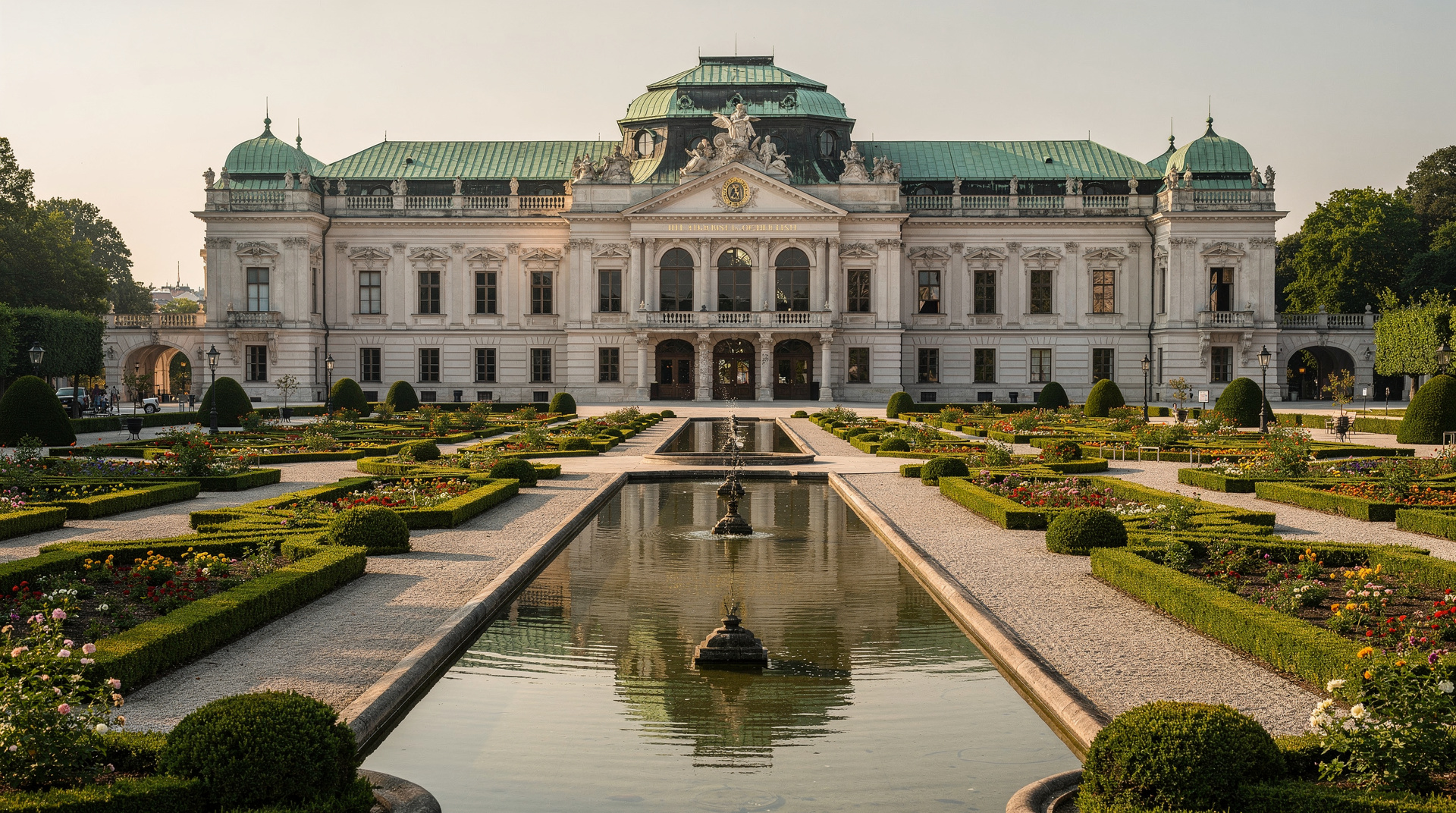
Vienna: Upper Belvedere and permanent collection entry ticketUpper Belvedere: Klimt’s The Kiss and Judith, Schiele’s Death and the Maiden, and a substantial collection of Waldmüller and 19th-century Austrian painting that contextualizes the Secession’s break with tradition.
Vienna: Belvedere and the best of Gustav Klimt private tourAlbertina: World’s largest collection of Klimt drawings and works on paper; significant Schiele drawings and prints. See our Albertina Museum guide.
Tickets for the Albertina exhibitionsWien Museum (Karlsplatz): Recently renovated, the Wien Museum holds Klimt’s early paintings and significant Schiele and Kokoschka works in the context of Viennese social history.
The Otto Wagner architecture connection
The Vienna Secession’s aesthetic transformed not just the art world but the built environment. Otto Wagner (1841–1918) — the dominant Austrian architect of the era — moved from Historicism to a Jugendstil-influenced modernism in the 1890s and beyond. His Vienna Stadtbahn pavilions at Karlsplatz (1894–99) — small Jugendstil structures with white marble facades and golden sunflower ornaments — are the most publicly visible examples of this architectural transformation. They are free to view from the outside and one pavilion is open as a café.
Planning a Secession-focused day or half-day
The Belvedere Palace guide and best museums in Vienna guide both help with sequencing if you want to combine this movement with the rest of Vienna’s museum landscape rather than a single-focus day. A practical order: start at the Leopold Museum in the morning (least crowded), walk to the nearby Secession building at midday for the Beethoven Frieze, then take the U-Bahn to the Belvedere or Albertina in the afternoon. This roughly follows the 3-day Vienna itinerary’s suggested museum day, adjusted to prioritise Schiele and Klimt specifically over a broader survey.
Making the most of the Museumsquartier
The Leopold Museum sits inside the Museumsquartier, so it pairs naturally with a visit to the neighbouring modern art galleries. If the contrast between Schiele’s raw figuration and later twentieth-century work appeals to you, the mumok guide explains what the modern collection offers. The courtyard between the buildings is also a good place to sit and absorb what you have just seen before deciding whether you have energy for a second museum.
Reading the art in its historical setting
The Secession did not happen in a vacuum. The artists were working in the shadow of the empire, and the Habsburg history guide gives the political backdrop that makes their rebellion easier to understand. A walk along the Ringstrasse shows the grand Historicist buildings the Secession was reacting against, and our Ringstrasse architecture walk turns that contrast into a route you can follow on foot. Seeing the conservative façades first, then the white-and-gold Secession building, makes the break feel physical rather than abstract.
If you want the older masters as a counterpoint, the Kunsthistorisches Museum guide covers the collection that represents the tradition Klimt and his colleagues walked away from. Visiting it before or after the Secession-focused stops gives a clearer sense of how far the movement travelled.
Practical tips for looking at Schiele
Schiele rewards slow looking. Many of his works are drawings and watercolours, and the fine line is easy to miss from across a room, so step close and then back again. Resist the urge to move through the galleries quickly: the self-portraits in particular reward a few minutes each rather than a glance. Visitors who find the subject matter intense sometimes alternate rooms of Schiele with the decorative arts, which gives the eye and the mind a rest without leaving the building.
For a personal account of following Klimt’s trail across the city, the Klimt trail diary is a useful companion, and the Vienna weekend itinerary shows how to fit a museum morning into a short stay. If you plan to visit several museums, compare the options in our Vienna Pass review before buying, since whether a pass pays off depends entirely on how many venues you actually enter. For longer trips, the 5-day itinerary leaves room to spread the art over separate mornings rather than cramming it.
Bad weather is a good reason to build a day around this subject. The Vienna in winter guide suggests how to use indoor attractions when the cold sets in, and the museums above fit that plan well.
Frequently asked questions about Schiele and the Vienna Secession
What is the Vienna Secession?
An artist’s association founded in 1897 by Klimt and 18 others, breaking from the Künstlerhaus to establish an independent exhibition space for modern art. Their building on Friedrichstraße, with the golden dome, still operates and houses Klimt’s Beethoven Frieze.
What is Jugendstil?
The German-language term for Art Nouveau — the decorative arts movement of the 1890s–1910s that sought to dissolve boundaries between fine art and applied design. In Vienna, it manifested through the Secession and the Wiener Werkstätte.
Where can I see Schiele’s work in Vienna?
The Leopold Museum (220 works — world’s largest collection), Upper Belvedere (Death and the Maiden), and Albertina (drawings).
Is the Vienna Secession building worth visiting?
Yes — especially to see Klimt’s Beethoven Frieze in the basement. Admission approximately €10.
Was Egon Schiele arrested?
Yes — in April 1912 on charges related to exhibiting erotic drawings where minors could see them. He served 24 days in prison.
What is the Wiener Werkstätte?
A production community of visual artists founded by Hoffmann and Moser in 1903, producing furniture, metalwork, ceramics, and textiles in a Jugendstil style. Operated until 1932.
Top experiences
Bookable activities with verified prices and instant confirmation on GetYourGuide.