Hallstatt
Plan a day trip from Vienna to Hallstatt: boat rides, the skywalk, the salt mine, realistic travel times and why an organised tour beats the train.
Vienna: Hallstatt Day Trip with Boat Ride / Skywalk
Quick facts
- Distance from Vienna
- 280 km (3h30 by tour bus)
- Best approach
- Organised day-trip tour (train is 3h30+ each way)
- Currency
- Euro (€)
- Main attraction
- Village, salt mine, skywalk, boat
Why Hallstatt is worth the journey
Hallstatt is the village that inspired a Disney film’s fictional kingdom, the most photographed alpine village in the world, and — on a Tuesday in May before 10:00 — one of the most genuinely beautiful places in Austria. On a Saturday in August at 13:00 it is also the most crowded spot in the country, with selfie sticks forming a dense thicket around the lake shore and tour buses queuing on the mountain road. Both of these statements are true simultaneously, and planning a visit well means taking both seriously.
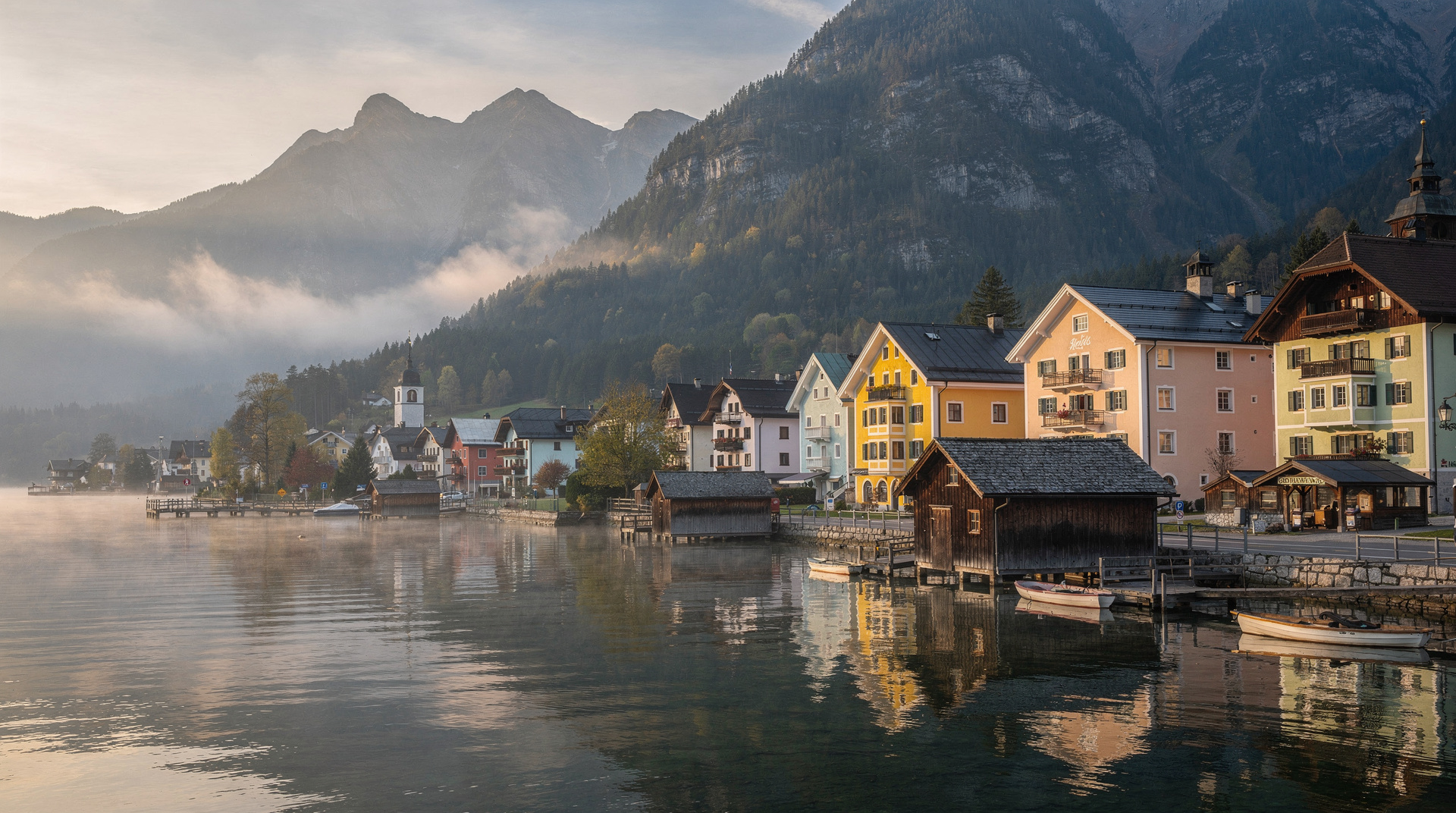
The village sits on a narrow strip of ground between a vertical cliff wall and the Hallstätter See, a deep glacial lake in the Salzkammergut region — an interior of Austria where the Alps pile up into their most dramatic forms. The lake is over 120 metres deep at its deepest point, a dark cold blue-green that turns silver in morning mist and reflects the cliff wall on still afternoons. The village was built on the only available ground: a shelf between the water and the rock so narrow that some of the older houses were built on stilts over the lake edge. The effect, from the boat or from the Skywalk above, is of a village that has been forced into its position by the landscape rather than chosen it.
Hallstatt gives its name to an entire archaeological period. “Hallstatt Culture” (roughly 800–450 BCE) refers to the Early Iron Age culture of Central Europe, named here because the area around the lake was a major salt-mining centre for over three thousand years — the word “Hall” in Austrian place names consistently indicates a salt history — and the archaeological finds from the cemetery and mine workings above the village provided the defining artefacts for the period. Salt made Hallstatt rich and important long before tourism existed.
| Distance from Vienna | 280 km (3h30 by tour bus; 3h30+ each way by train) |
| Cost | Day-trip tours from around €90–140/person; salt mine entry around €35 extra |
| Time needed | Full day (13 hours door-to-door on a tour); overnight recommended if possible |
| Best approach | Organised day-trip tour rather than the train |
| Best time | May–June or September, and before 09:00 in high summer |
How to get there from Vienna
This is where honest advice matters most. The train journey from Vienna Hauptbahnhof to Hallstatt takes roughly 3h30, including a change at Attnang-Puchheim (or Salzburg) and a final connection to Hallstatt station — which is on the opposite shore of the lake, requiring a short passenger ferry crossing to reach the village. The return journey repeats. Total: approximately 7 hours of travel for 2–3 hours in the village. It is technically feasible as a day trip but genuinely exhausting, and the logistics of coordinating train times with the ferry schedule require careful attention.
The practical alternative for most visitors is an organised tour.
The Hallstatt day trip with boat ride and skywalk departs from central Vienna, includes a boat ride on the lake and the funicular to the Skywalk viewpoint, and returns by early evening — around 13 hours door-to-door with about 4 hours in the village itself.
The Hallstatt day trip with hotel pickup is more comfortable if you prefer door-to-door service from your accommodation rather than meeting at a central departure point.
The Hallstatt mountains and alpine lakes day trip takes a more scenic route through the Gosau valley, including Wolf Lake and the broader Salzkammergut landscape — more alpine variety, slightly less time in Hallstatt village itself, but a better sense of the wider lake district.
Hallstatt sits at the far end of a chain that starts in the Wachau and passes Salzburg, and the villages between are the reason the drive never feels like pure transit: a Hallstatt, Salzburg, Melk, Alps and lakes day trip takes the whole chain in order.
What to do in Hallstatt
The Skywalk — a viewing platform on the cliff above the village, reached by the Hallstatt Skywalk funicular (or a 30-minute hike on marked trails). The view down to the village, the lake, and the surrounding mountains is the image on every postcard and it delivers fully in person — the perspective from above is the one that makes Hallstatt’s extraordinary position legible. The funicular journey itself takes about 10 minutes; the walk from the station to the platform an additional 10 minutes. Allow 45 minutes total for the round trip.
The salt mine (Salzwelten Hallstatt) — an 80-minute underground tour inside the mountain above the village, reached by the same funicular. Highlights include one of the world’s oldest wooden staircases (over 3,000 years old and still structurally sound), a 4D film on the history of salt mining in the region, the original wooden salt transport channels, and — the element most visitors remember — a pair of mine slides that descend through the mountain on polished wooden rails. The guides are professional and the tour well-organised; book timed entry in advance in summer, as capacity is limited and popular times sell out.
The bone chapel (Beinhaus) — in the graveyard behind the Catholic parish church. When Hallstatt’s tiny graveyard needed to make room for new burials, the older remains were exhumed and the skulls painted with the deceased’s name, dates, and decorative patterns — flowers for women, oak leaves for men — before being placed in the chapel. Approximately 1,200 painted skulls are displayed on the shelves. The practice continued into the early 20th century. It is, by any standard, an extraordinary thing to find in a small alpine village, and it speaks to the graveyard constraint that the lake-edge position imposed.
The village itself — the main lakeside promenade and the village square take 30–45 minutes to walk properly, more if you linger at the lake edge or stop at one of the small cafés. The church, the market square, and the boat dock all fit within 300 metres. The oldest houses on the lake edge date from the 16th and 17th centuries.
Boat on the lake — electric boats can be hired by the hour from the village dock, or some tours include a guided boat ride as part of the circuit. The view back toward the village from the water — the cliff wall, the houses, the church tower — is the view that travellers have been describing since the 18th century.
When to visit
May and June are the ideal months: alpine wildflowers above the treeline, the lake calm, visitor numbers manageable, and the salt mine and Skywalk running at full schedule. September is excellent — the crowds thin after the school holidays end, the light on the lake is different (lower, warmer, more golden), and the mountain trails are still open. October brings autumn colour on the surrounding slopes but the mine and some tours reduce their schedule; check ahead.
July and August are when the experience can turn from wonderful to overwhelming. Coach tours from across Asia and Europe converge on the village between 10:00 and 16:00; the main promenade becomes impassable at peak moments. The practical solution: arrive before 09:00 or stay overnight and be on the lake at dawn.
| Month | Crowds | What to expect |
|---|---|---|
| May–June | Low–moderate | Wildflowers, calm lake, full schedule of mine and Skywalk |
| July–August | Very high | Coach tours 10:00–16:00; arrive before 09:00 or stay overnight |
| September | Moderate, thinning | Golden light, quieter promenade, trails still open |
| October | Low | Autumn colour, but reduced schedules — check ahead |
Choosing between the tours
The three tours above differ less in what they show than in how they spend your hours. If the lake and the view from above are the point of the day, the boat-and-skywalk departure is the most direct. If getting out of the hotel without a morning transfer matters more, the pickup version removes that friction. If you would rather see the region as a landscape than as a single village, the mountains-and-lakes route trades some village time for variety. None of them is the wrong choice; the useful question is whether you want depth in Hallstatt or breadth across the Salzkammergut.
For a longer comparison of the day-trip format itself, including what to expect from the coach, the stops and the return, the Hallstatt day trip from Vienna guide goes through the whole day in order. Anyone still deciding whether Hallstatt is the right excursion at all should read the blog post on whether Hallstatt is overrun or magical, which takes the crowd question seriously rather than waving it away.
Planning the day well
A day trip to Hallstatt rewards a little preparation. Decide before you arrive which one or two things you most want: the Skywalk view, the salt mine, the bone chapel or simply time by the water. The village is small enough that you will see the centre whatever you do, so the choices that matter are the ones that need a queue or a timed ticket. Doing those first, while the day is still quiet, leaves the lakeside walk for the hours when you are happy to move slowly.
Bring layers even in summer. The village sits under a cliff and beside cold water, and the weather in the mountains changes faster than it does in Vienna. A light waterproof is more useful than a second camera lens, and comfortable shoes matter on the cobbled lanes and the marked trails above the village.
Respect the place as a living village. People live in the houses you are photographing, and the lanes are also their daily route. Keep to public paths, keep your voice down in the graveyard and around the church, and do not treat private gardens or doorways as photo sets. Visitors who do this find the locals far more welcoming than the crowd stories suggest.
Finally, give yourself a buffer at the end. Tours leave on a schedule, and the lakeside is exactly the sort of place where one more photograph turns into ten minutes. Settle on a meeting time with your group, and head back to the departure point a little early.
Pairing Hallstatt with other Austrian highlights
Hallstatt works best when it is not asked to carry a whole trip by itself. Many travellers put it between two very different experiences: the imperial city and its palaces on one side, and the river landscapes of the Danube on the other. If you have time for both, the Wachau day trip from Vienna guide and the Wachau valley destination page describe a gentler, vineyard-and-abbey day that makes a good contrast with Hallstatt’s alpine drama.
For a fuller picture of how many days to give the region around the capital, the how many days in Vienna guide helps you decide whether a full day away from the city is worth the cost to your sightseeing. The Vienna 5-day itinerary and the Vienna 7-day itinerary both leave room for a long excursion, and the Vienna destination page is the right starting point if you are still shaping the main city plan.
If you are picking one day trip only, compare it with Salzburg, which suits travellers who want a city with a music story rather than a lake. The Salzburg destination page and the Sound of Music day trip guide give a sense of what that alternative looks like.
Combining Hallstatt with the wider Salzkammergut
Hallstatt is the best-known stop in the Salzkammergut lake district, but the region has several other lakes with a similar character and far fewer crowds — the Salzkammergut lakes guide covers alternatives like Wolfgangsee and Altaussee for anyone who wants the same landscape without the queues. If you’re planning a multi-day version of this route rather than a single day trip, the Salzkammergut loop itinerary sequences several lakes and towns together.
Some visitors also combine a Salzkammergut trip with Salzburg itself — see the Salzburg day trip from Vienna guide or the Salzburg destination page — since the region sits roughly between the two cities. For a fuller comparison of how a Hallstatt day trip stacks up against other Vienna day-trip options, the best day trips from Vienna guide is a useful starting point.
The Hallstatt copy in China
Since 2012, a near-exact replica of Hallstatt village has stood in Luoyang, Henan Province, built by a Chinese developer who spent years photographing the original. The Austrian village has, with characteristic pragmatism, leaned into the attention — Hallstatt now actively markets to Chinese visitors and has established a “Hallstatt China” connection. The original is, in every sensory respect, better. The smell of the lake, the cold air off the cliff, the silence at 07:00 — none of these translate into a replica.
Overnight vs. day trip
If your itinerary has any flexibility, one night in Hallstatt transforms the experience. The village empties when the last day-trippers leave, and the evening and early morning — mist on the water, the cliff face catching the first light, the market square with nobody in it — is the Hallstatt that draws people back. Hotels book out months in advance for peak summer; plan well ahead if staying. See the Salzkammergut lakes guide and the Salzkammergut loop itinerary for the broader context.
Top experiences
Bookable activities with verified prices and instant confirmation on GetYourGuide.