Ringstrasse
Vienna's grand 19th-century boulevard: the Opera House, Parliament, Kunsthistorisches Museum and Rathaus in one 4km arc. Walk, tram or hop-on bus.
Vienna: Big Bus Hop-On, Hop-Off Sightseeing Tour
Quick facts
- Length
- 4 km arc around Innere Stadt
- Built
- 1858–1890 under Franz Joseph I
- Key buildings
- Staatsoper, Parliament, Rathaus, KHM, NHM, Burgtheater
- Best transport
- Tram 1/D, or hop-on hop-off bus
Vienna’s grandest boulevard
In 1857, Emperor Franz Joseph issued a rescript ordering the demolition of Vienna’s medieval city walls — the glacis and fortifications that had enclosed the Innere Stadt for centuries — to create space for a new boulevard. What followed was one of the most ambitious urban planning projects of the 19th century: a 4-kilometre arc of neo-Gothic, neo-Renaissance and neo-Baroque public buildings constructed in just three decades, each designed to project the power and cultural ambition of the Habsburg Empire at a moment when the dynasty was under pressure from nationalist movements across central Europe.
The result is extraordinary, slightly overwrought, and still the clearest single expression of what Vienna decided to make of itself in the age of the liberal bourgeoisie. It was also, in its time, the most technologically advanced urban development in Europe: underground drainage, gas lighting, and a boulevard wide enough for the new motor carriages that Vienna’s wealthy were beginning to acquire. Walking the Ringstrasse in 1900 was an encounter with modernity. Walking it now is an encounter with what the 19th century believed modernity should look like — and that is almost more interesting.
| Where | 4km arc around the Innere Stadt, Vienna |
| Cost | Free to walk; museum/theatre entries separate |
| Time needed | 90 minutes walking only; half a day with a museum stop |
| Getting there | Tram 1/D circles the whole route; walkable from Stephansplatz |
| Best time | Morning for photos, evening for floodlit buildings |
The architecture game
The Ringstrasse’s buildings were designed by different architects, each working in a different historical style chosen for symbolic reasons that the educated Viennese public of the time would have understood immediately:
Parliament (1883, Theophil Hansen) is Greek Revival because Greek democracy — the Athenian original — was the philosophical ideal of liberal constitutional governance. The building is a statement about what Austria was becoming politically. The Athena fountain in front, added later, is one of the Ring’s most-photographed spots.
The Rathaus (City Hall, 1883, Friedrich von Schmidt) is neo-Gothic because Gothic architecture was associated with the free civic culture of the medieval German cities — appropriate for a building that represents the citizens rather than the court.
The Burgtheater (1888, Gottfried Semper and Karl von Hasenauer) is neo-Baroque because theatre belonged to the aristocratic and court tradition. The semicircular wings added to allow the theatre’s expansion are some of the most graceful baroque-revival architecture on the Ring.
The Kunsthistorisches Museum and Naturhistorisches Museum (both 1891, Semper and Hasenauer) face each other across Maria-Theresien-Platz in perfect symmetry, which is architecturally satisfying and also slightly unnerving — two buildings of identical height, massing and design staring at each other across a formal garden. The KHM holds the art; the NHM holds the natural history. The symmetry is the point: art and science are equal, complementary, imperial.
The Staatsoper (1869, August Sicard von Sicardsburg and Eduard van der Nüll) opened the entire Ringstrasse project. Van der Nüll died by suicide after the emperor made a critical remark about the building; Sicardsburg died of grief two months later. The building they created is now the most important opera house in the German-speaking world. History has a particular irony.
Walking the Ring
The full circuit takes about 90 minutes at a brisk pace, or 2.5–3 hours with stops for photographs and reading building plaques. Start at the Staatsoper at the south end and walk anticlockwise (which keeps the buildings on your left, easier for photography):
Vienna State Opera (Staatsoper) — guided tours run on most days when there is no rehearsal. Standing room tickets (small price, standing only) for evening performances go on sale 80 minutes before curtain — three hours on your feet for a fraction of the seat price. The full standing-room experience, in a building of this quality, listening to a Vienna Philharmonic pit orchestra, is one of Vienna’s genuine unrepeatable experiences.
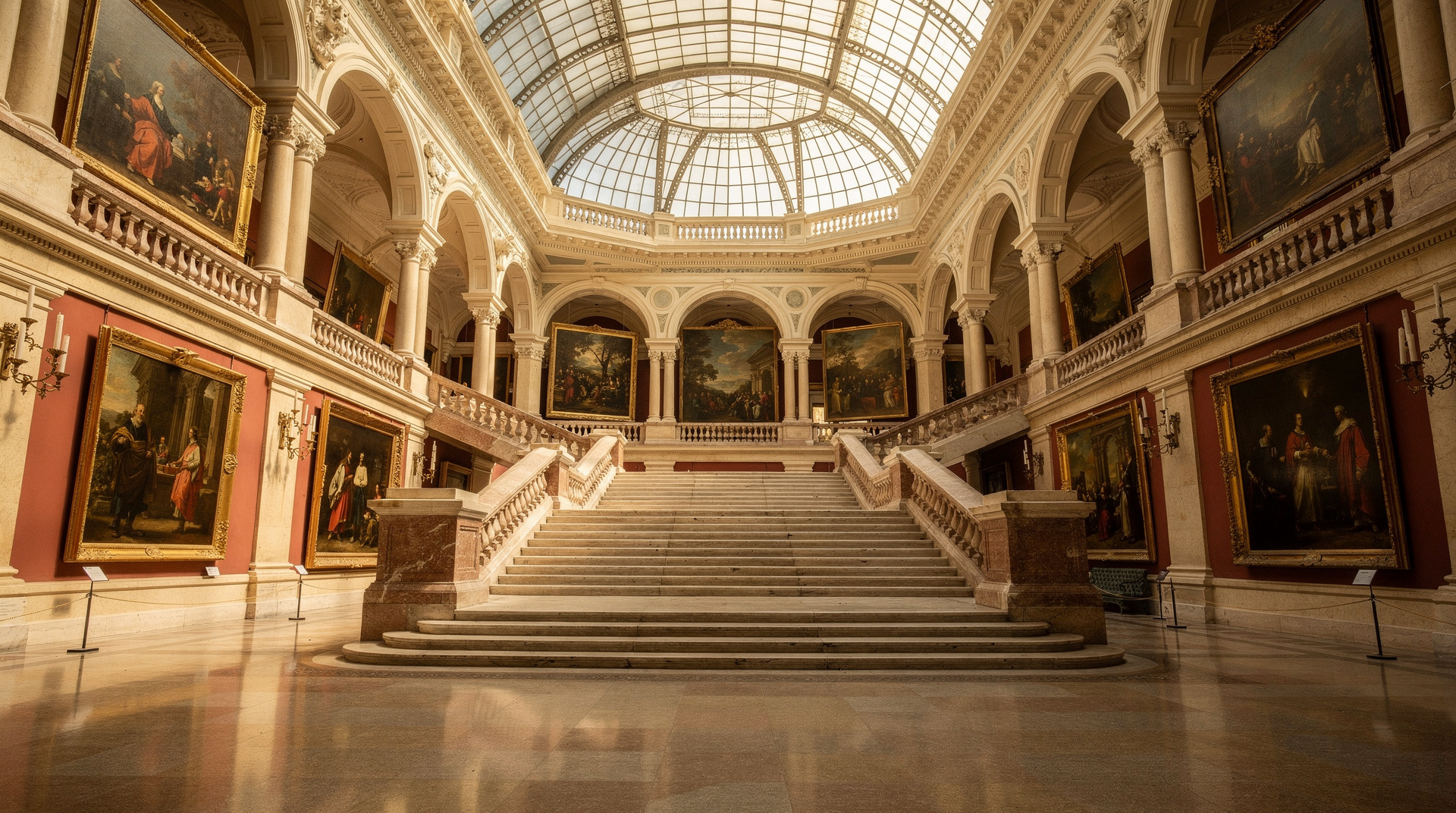
Kunsthistorisches Museum (KHM) — the imperial art collection spanning ancient Egypt through 17th-century Dutch masters. Bruegel’s Hunters in the Snow, Vermeer’s Art of Painting, and the entire Habsburg collection of Flemish and Italian Renaissance. One of Europe’s top five art museums, and the building is part of the experience — the grand staircase, the coffered ceilings, the marble everywhere.
Naturhistorisches Museum (NHM) — mirrors the KHM across the square. The Venus of Willendorf (25,000 years old, 11 cm tall — the world’s most famous Venus figurine) and the meteorite collection (the largest in the world) are world-class. The dinosaur gallery and marine hall are excellent for families.
Parliament — the neo-Greek building reopened after renovation with its interior fully accessible. Guided tours in German and English are available; book ahead as the interior is impressively grand.
Rathaus (City Hall) — the open courtyard hosts the outdoor cinema festival in July and August (free, extremely popular), the Christmas market in December (more atmospheric than the bigger Rathausplatz market), and the Vienna City Marathon start in spring.
Burgtheater — Austria’s national theatre, one of the two most prestigious German-language stages in the world. Guided tours in English run on weekday afternoons; the staircases and foyer frescoes (painted by Gustav Klimt and his brother Ernst early in their careers) are worth the tour time.
Hop-on hop-off or tram?
The Big Bus hop-on hop-off tour stops at all the major Ringstrasse buildings and includes recorded commentary in multiple languages. Useful for a city overview on day one, particularly if the weather makes walking uncomfortable.
The more Viennese approach — and a genuinely good experience — is tram line 1 (clockwise) or D (anticlockwise), which follow the Ring at street level for the price of a standard Vienna transit ticket. Slower than the hop-on bus, but you see the buildings at full scale from eye level and share the tram with locals rather than fellow tourists. Take the tram in the evening, when the buildings are lit and the traffic is lighter.
A guided city centre walking tour often covers the Ringstrasse highlights as part of a broader introduction to Vienna — the right option if you want historical and architectural context alongside the buildings themselves.
Reading the Ring as a story
It helps to treat the boulevard less as a list of buildings and more as a single argument told in stone. The Habsburg court wanted to show that it could modernise without surrendering its authority, and the liberal middle class wanted a city that reflected its own confidence. The Ring is where those two ambitions met, and you can sense the negotiation in the details: the court theatre in the baroque idiom of the aristocracy, the city hall in the Gothic idiom of free citizens, the parliament in the classical idiom of democratic ideals. For background on the dynasty that commissioned all of this, the Habsburg history guide is a good companion, and the Franz Joseph and Sisi guide puts a human face on the emperor who signed the order to pull down the walls.
A useful habit while walking is to stop at each building and ask two questions: what style is this, and who was it meant to impress? The answers are rarely subtle, and once you start asking them the boulevard stops being a blur of grand façades and becomes a sequence of deliberate statements. Children and teenagers often enjoy the game too, especially when it is framed as spotting which building is trying hardest to look important.
Photography along the boulevard
The Ring rewards photographers more than most Vienna streets because the buildings are set back behind gardens and squares, which gives you room to step away and frame them properly. Maria-Theresien-Platz, with the two museums mirroring each other, is the obvious composition. The Parliament and its fountain work well in soft morning light, while the Rathaus looks best when the gardens in front of it give you a clear foreground. For more ideas on where to point a lens across the city, the Vienna photography spots guide lists viewpoints beyond the Ring, and the Ringstrasse architecture walk guide flags the best angles for each façade.
If you plan to shoot at dusk, start earlier than you think you need to. The light changes quickly, the floodlights come on building by building, and the best moment is often the short stretch when the sky still has colour and the stonework is already lit.
Choosing your pace
The Ring suits very different kinds of visitor, and the right pace depends on what else you have planned.
- Short on time: walk the exterior arc, pause at the Staatsoper and Maria-Theresien-Platz, and skip every interior. This fits neatly into a first morning and leaves the afternoon free.
- Museum-minded: make the Kunsthistorisches Museum the centre of the day and treat the rest of the Ring as the walk between stops.
- Music-minded: build the day around a Staatsoper tour or a standing-room evening, and take the tram home afterwards.
- Travelling with children: the Naturhistorisches Museum and the open gardens carry the day; the Vienna with kids guide has more ideas for keeping a family moving.
If you are still deciding how many days the city deserves, the how many days in Vienna guide helps you place the Ring in the bigger picture, and the Vienna 3-day itinerary shows one way of slotting a Ring walk between the other headline sights. The Vienna weekend itinerary does the same for a shorter stay.
Evening on the Ringstrasse
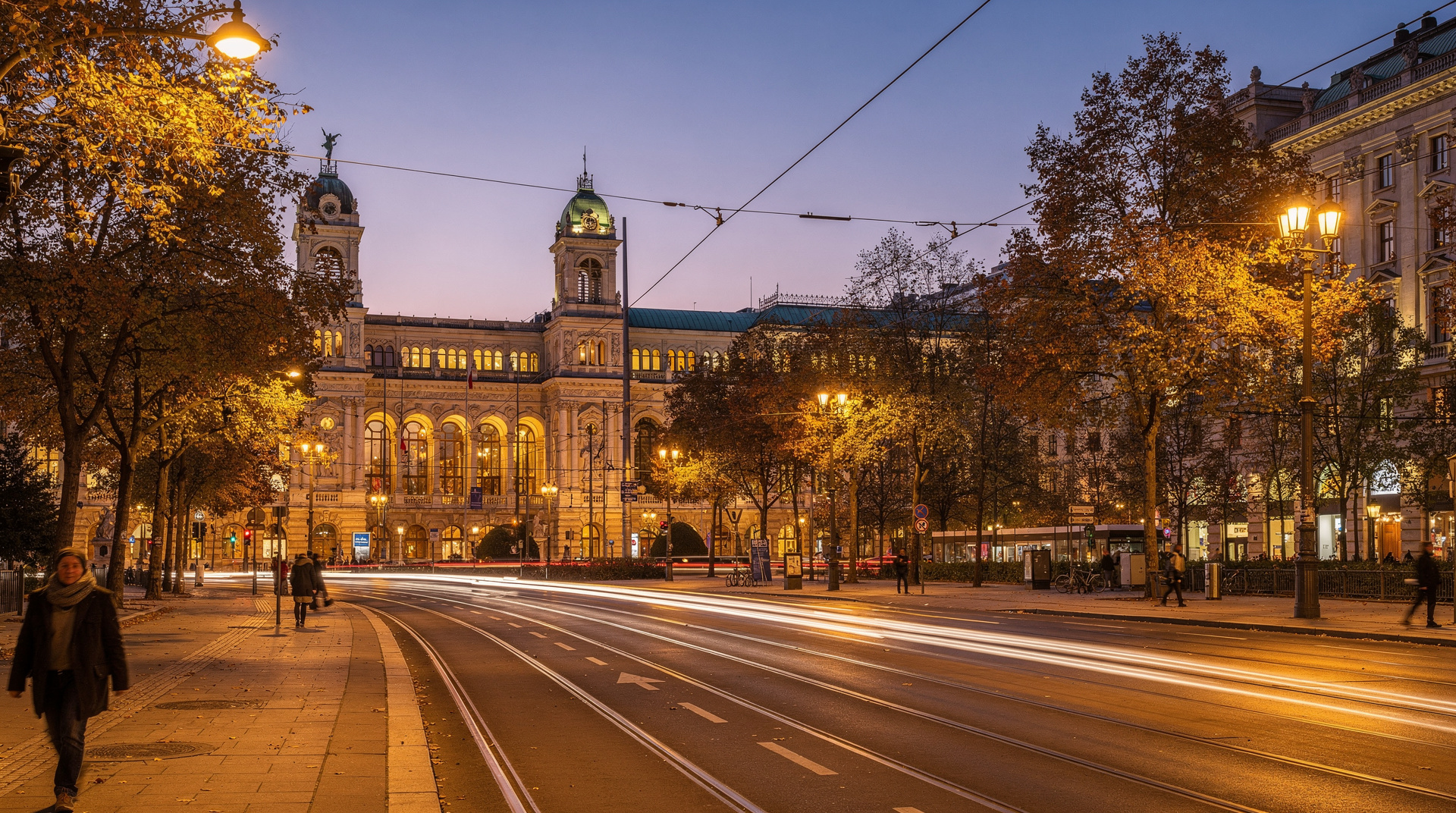
The Ringstrasse changes character after dark. The buildings are floodlit; the Staatsoper’s forecourt fills before curtain time; the Rathaus gardens host their seasonal events. A post-dinner walk from the Staatsoper to the Rathaus — roughly 1.2 km along the Ring — is one of Vienna’s best evening strolls. The combination of late 19th-century stone, theatrical lighting, and the sounds of the city winding down creates an atmosphere that is hard to manufacture and harder still to forget.
The detailed Ringstrasse architecture walk guide covers each building with historical notes, best viewing angles, and which interiors are open to the public at what times.
Which interiors are worth your time
Not every Ringstrasse building rewards going inside, and time on a first visit is scarce. This is a rough guide to where to spend it:
| Building | Worth entering? | Time | Best for |
|---|---|---|---|
| Staatsoper | Yes — standing room or tour | 45min–3hrs | Music lovers, architecture |
| Kunsthistorisches Museum | Yes, essential | 2–3hrs | Art, Habsburg collections |
| Naturhistorisches Museum | Yes, if time allows | 1–2hrs | Families, natural history |
| Parliament | Yes, with advance booking | 1hr | History, architecture |
| Rathaus | Only for events (cinema, markets) | 30min | Seasonal festivals |
| Burgtheater | Yes, guided tour only | 1hr | Theatre and Klimt frescoes |
The Kunsthistorisches Museum guide and the Naturhistorisches Museum guide go deeper on each collection, and the Vienna State Opera guide explains the standing-room system in full — it is one of Vienna’s best-value cultural experiences and worth planning around.
Combining the Ring with nearby sights
The Ringstrasse connects naturally to two other Vienna essentials on foot. The Museumsquartier sits just behind the Kunsthistorisches and Naturhistorisches museums, across Maria-Theresien-Platz — a natural continuation if the Ring’s imperial museums leave you wanting contemporary art as a contrast. And the medieval core of the Innere Stadt, enclosed by the Ring itself, is a five-minute walk from any point on the boulevard — Stephansdom, the Graben, and the Hofburg all sit just inside the arc. Most first-time visitors combine a Ring walk with an Innere Stadt wander into a single half-day.
Practical notes before you go
Comfortable shoes matter more than anything else you pack: the boulevard is flat and easy, but the stone pavements add up over a long day. Carry water in warm weather, since the Ring has little shade, and keep a light layer for the evening when you stop moving. Because the Ring is a working road, not a pedestrian zone, cross at the marked crossings and watch for trams and cyclists, which move quietly and quickly.
Public transport makes the route flexible. You do not have to commit to the full circuit; hop on the tram when your feet tire and hop off at the next building that interests you. The Vienna public transport guide explains tickets and how the network fits together, and the hop-on hop-off versus metro guide compares the bus option with simply using the city’s own trams and trains.
If you want to avoid the most common first-visit errors, the Vienna tourist traps guide is worth a read before you arrive, particularly for the costumed touts and overpriced cafés that gather around the busiest stretches of the Ring. When you want a proper break, a traditional coffeehouse is the better answer; the best coffee houses in Vienna guide suggests where to sit down, and the Imperial Palace side of the story continues naturally at the Hofburg, just inside the arc.
For the wider picture of how a Ring walk fits into a longer trip, the Vienna 5-day itinerary gives a relaxed pace that leaves room for the museums you only half-planned to visit.
Top experiences
Bookable activities with verified prices and instant confirmation on GetYourGuide.