Prater and Leopoldstadt
Vienna's Prater park and Leopoldstadt: the iconic Riesenrad ferris wheel, the Hauptallee chestnut walk, the amusement park and the best of the 2nd
Vienna: Skip-the-cashier-desk-line Giant Ferris Wheel Ride
Quick facts
- District
- 2nd (Leopoldstadt)
- Nearest U-Bahn
- Praterstern (U1/U2)
- Riesenrad height
- 65 metres
- Built
- 1897 (Riesenrad)
The Prater: Vienna’s public park
The Prater is the large green expanse east of the Innere Stadt, a former imperial hunting ground that Emperor Joseph II opened to the public in 1766 in one of the reformist gestures that defined his reign. Its 6 km² contains three very different zones: the Wurstelprater (the old amusement park), the Hauptallee (a 4.5 km chestnut-lined boulevard running east from Praterstern to the Lusthaus), and the Grüner Prater (the natural meadow, woodland and marshland area beyond the boulevard, less visited and genuinely wild in places).
Most visitors arrive for the Riesenrad — and it is worth it — but the Prater as a whole rewards more time than the ferris wheel and a quick walk back to the U-Bahn. Budget half a day to take in the amusement park atmosphere, the Hauptallee on foot or by bike, and the neighbourhood of Leopoldstadt beyond. The full Prater amusement park guide covers ride-by-ride detail if the Wurstelprater is your main reason for coming.
| Where | 2nd district (Leopoldstadt), Praterstern U1/U2 |
| Cost | Riesenrad around 14€; rides individually priced 2–8€ |
| Time needed | Half a day for park + Hauptallee; add an hour for Leopoldstadt |
| Getting there | U-Bahn to Praterstern, 2 minutes’ walk to the wheel |
| Best time | Weekday mornings or evenings; spring blossom late April |
The Riesenrad (Giant Ferris Wheel)
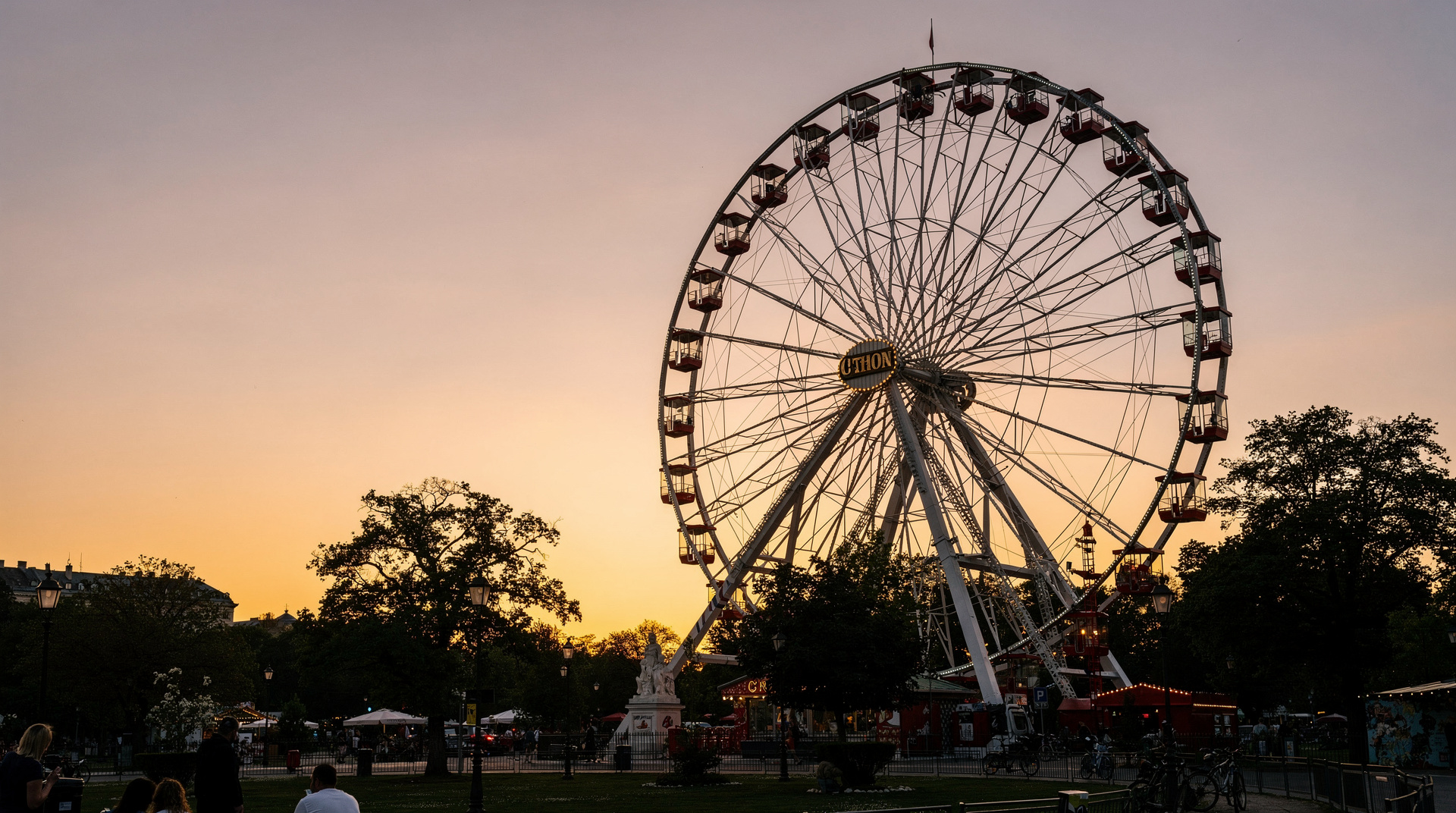
The Wiener Riesenrad, completed in 1897 to mark the Golden Jubilee of Emperor Franz Joseph, is one of Vienna’s most recognisable silhouettes and was at the time of construction the world’s largest ferris wheel. Its 14 enclosed red gondolas rotate 65 metres above the Prater in a full cycle that takes about 20 minutes. The view from the top looks across the Danube Canal, over the Vienna Woods to the southwest, and on clear days to the Kahlenberg hills above the vineyards.
The wheel has its most famous cinematic moment in Carol Reed’s The Third Man (1949) — the post-war Vienna film in which Orson Welles as Harry Lime delivers his “cuckoo clock” speech to a horrified Joseph Cotten from inside one of the gondolas. The scene used the real wheel, the real gondolas, and required no sets beyond the Prater itself. The film made the wheel an international image and has been doing so ever since.
Skip the cashier queue for the Riesenrad — the ride itself loads continuously and moves fairly briskly, but the ticket purchase queue can reach 45 minutes on summer mornings. Pre-booking removes this friction.
The Riesenrad Museum inside the wheel’s base tells the history of Vienna through eight gondolas that have been converted into historical dioramas — scenes from the city’s history from the Babenberg period to the post-war occupation, each with period objects and written context. Unexpectedly good for 30 minutes and included with the ride ticket. Most visitors walk past it, which is their loss.
The Wurstelprater amusement park
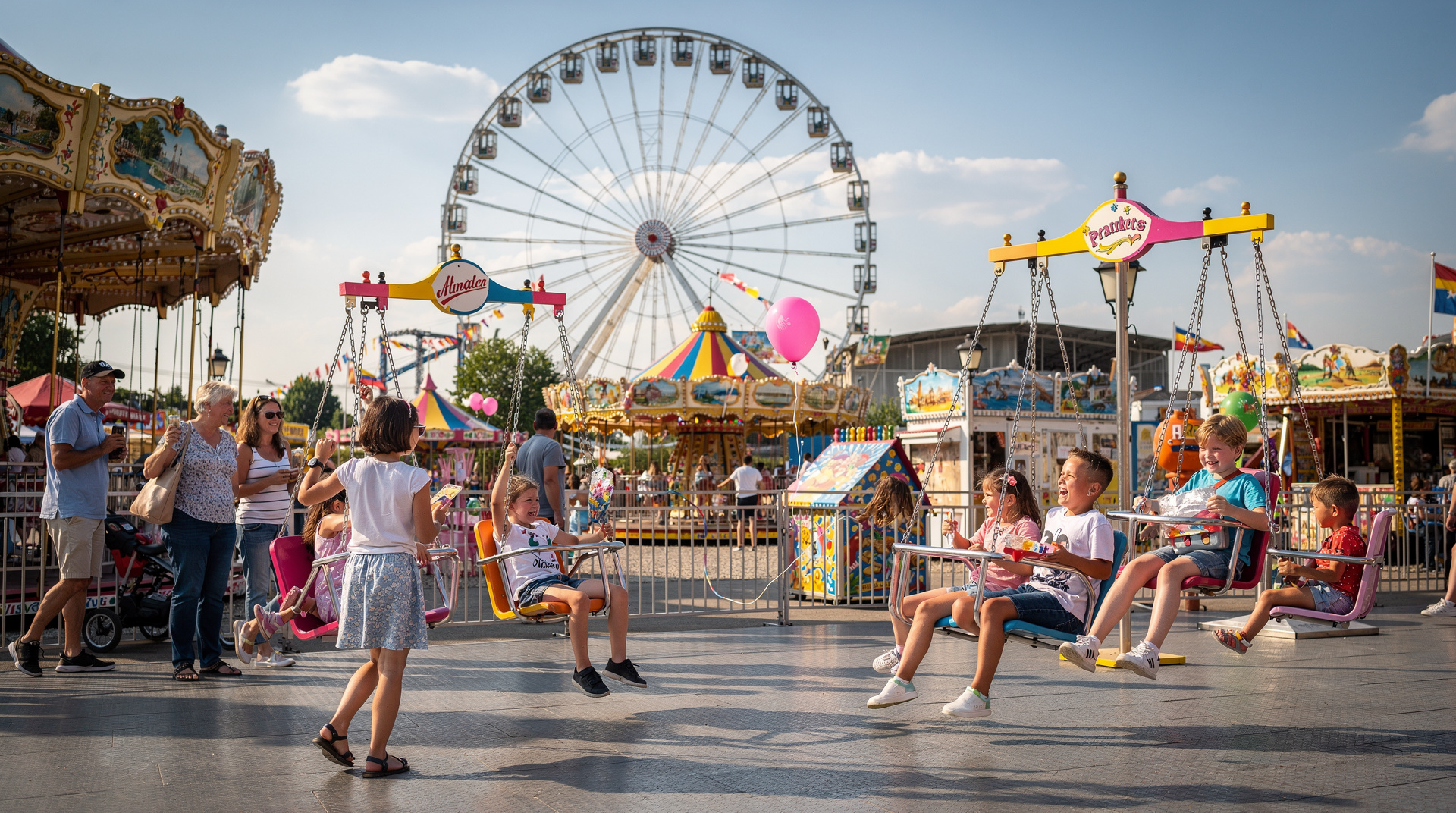
The Wurstelprater surrounding the Riesenrad is a traditional fairground that has been operating continuously since the early 19th century — rollercoasters, ghost trains, a labyrinthine ghost maze, bumper cars, shooting galleries, candy floss stalls, and the particular atmosphere of a fair that has not quite updated itself and is the better for it.
Modern theme parks optimise for throughput and family-friendly polish; the Wurstelprater has the slightly worn quality of somewhere that caters to Viennese families who have been coming for generations, with rides that are individually priced (around 2–8€) rather than a day-pass model, and a mix of serious thrill rides and children’s attractions that makes the whole thing feel more like a neighbourhood institution than a tourist attraction.
The Lilliputbahn — a narrow-gauge steam train that has been circling part of the Prater since 1928 — is worth the modest ticket price for a slow scenic loop through the chestnut trees and meadows. It runs a fixed circuit several times daily from April to October, and the engine is a genuine working steam locomotive. Children love it; adults tend to as well.
The Hauptallee
The Hauptallee is a straight 4.5 km avenue of horse-chestnut trees running east from the Praterstern to the Lusthaus pavilion at the edge of the Grüner Prater. In spring — when the chestnuts are in flower, usually late April to early May — it is one of Vienna’s most beautiful walks. The avenue is carpeted with candles of white blossom above and fallen petals below, and the scent carries throughout the park. It is also a cycling route, a running route, and on Sunday mornings, the place where half of Vienna seems to be doing one or the other.
The Lusthaus at the far end of the Hauptallee is a historic octagonal pavilion (built 1783, the only surviving imperial hunting pavilion in Vienna) that now operates as a restaurant, with outdoor seating in the meadow and a menu of traditional Austrian cooking that is better than a heritage-tourist-trap restaurant has any right to be.
The location — a lone building at the end of the long chestnut avenue, with meadows extending to the Danube on three sides — is peculiarly atmospheric, particularly in autumn when the chestnuts turn copper and the park empties of summer visitors. Photographers looking for classic Prater shots — the wheel against the sky, the chestnut avenue in blossom — will find the Vienna photography spots guide useful for timing and vantage points.
Hop-on hop-off and river cruise combo
The hop-on hop-off bus with Riesenrad and Danube cruise combo is a practical option for families covering multiple Vienna highlights in one ticket. The bus stops at Praterstern, the Riesenrad is included, and the cruise section covers the Danube Canal past the Leopoldstadt waterfront. Useful for a first day in Vienna when the priority is orientation alongside sightseeing.
Leopoldstadt neighbourhood
Beyond the Prater, Leopoldstadt (the 2nd district) has changed considerably since the mid-2000s. The Karmeliterviertel — the neighbourhood around the Karmelitermarkt in the northern part of the district — is now one of Vienna’s most pleasant urban villages: a Saturday farmers’ market that specialises in organic produce and artisan bread, independent cafés that draw a young Viennese crowd, and a Jewish heritage trail marking the district’s prewar history. The 2nd district was home to Vienna’s largest Jewish community before 1938, and plaques, restored synagogues, and the Vienna Jewish Museum’s Dorotheergasse branch document a community whose absence is still palpable in the district’s architecture.
Praterstrasse from the Praterstern into the inner city is lined with late 19th-century apartment buildings and a growing number of Vietnamese, Korean, and Japanese restaurants that make the street one of Vienna’s best for affordable dinners.
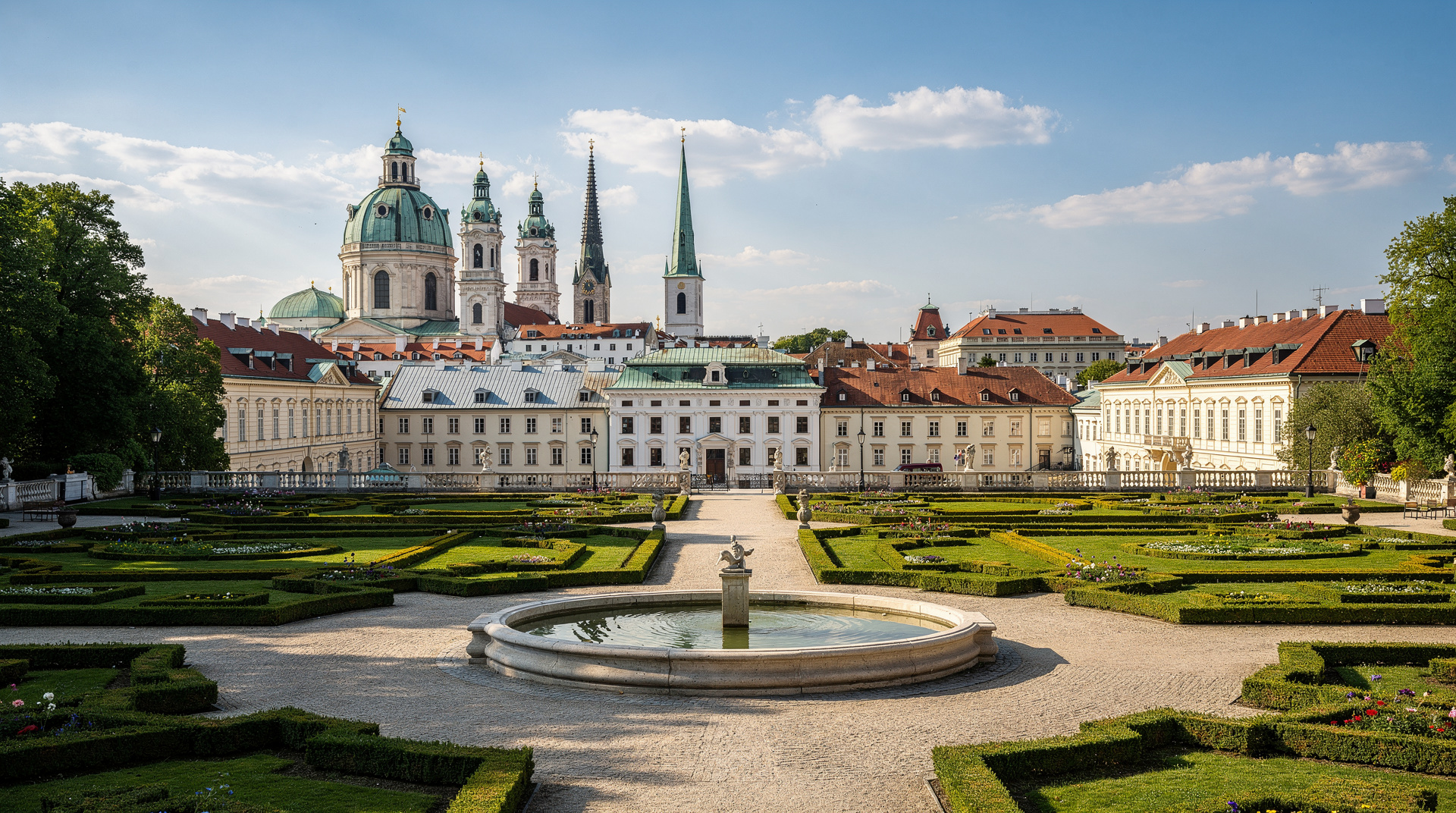
The Augarten — a formal baroque garden in the north of the 2nd district, enclosed by its original 18th-century walls — is less visited than the Prater but worthwhile for several reasons: the Augarten porcelain factory (the oldest operating porcelain manufacturer in German-speaking Europe, founded 1718) has a visitor centre and shop; the Flaktürme — two enormous WWII anti-aircraft concrete towers that rise above the trees and cannot be demolished safely — provide an unavoidable note of historical weight; and the park itself is a good green space mostly used by locals rather than tourists.
The contrast between the baroque formality of the allées and the brutal towers looming above them is a peculiarly Viennese experience. The Jewish Museum Vienna’s Leopoldstadt history is the fullest account of the district’s prewar community and its near-total destruction, and pairs well with a walk through the Karmeliterviertel.
Pairing the Prater with the rest of your Vienna days
The Prater works best as a slower counterweight to the heavier sightseeing days. After a morning in the palaces or museums, the open space of the park and the easy rhythm of the Hauptallee make a welcome change of pace. If you are still deciding how to divide your time, the how many days in Vienna guide helps place a half-day here alongside the big-ticket sights, and the Vienna weekend itinerary shows one way of slotting the wheel into a short stay.
An evening visit pairs naturally with a trip along the water. The evening Danube cruise guide explains how a river outing can follow a sunset ride on the wheel, so that the same evening gives you the city from above and from the water. Travellers who prefer a structured first day can read the hop-on hop-off versus metro comparison before deciding whether the bus combo described above suits them or whether the U-Bahn is simpler.
For families, the Prater is often the reward at the end of a day of more serious visiting. The Vienna with kids itinerary builds the Wurstelprater into a plan that keeps younger travellers engaged, while the Schönbrunn Zoo family visit is a good companion day on the other side of the city. Keeping the two on separate days avoids tired children and rushed rides.
Eating and resting around the park
The Prater and Leopoldstadt are better served for food than first-time visitors tend to expect. Inside the fairground, the stalls sell the usual sweet and savoury snacks, and they suit a quick bite between rides, but the district around Praterstern and the Karmelitermarkt offers more satisfying meals. A sit-down lunch at the Lusthaus after the long walk along the avenue is a pleasant reward, and a late-afternoon coffee in one of the Leopoldstadt cafés fits the unhurried mood of the neighbourhood. For more ideas on what to order and where, the Vienna food guide and the best restaurants in Vienna give wider context, while the Viennese coffee house guide explains the etiquette if you stop for a slow cup in a traditional café.
Bring comfortable shoes: the park is flat but large, and the pleasure of the Hauptallee comes from walking it without hurrying. On hot days, shade under the chestnuts is generous, and on cooler days a light jacket is enough for the evening wheel ride. Because the Wurstelprater is at its liveliest after dark, an early-evening start lets you see it in daylight, watch the lights come on, and finish with the view from the gondola.
Planning the Prater around the seasons
Seasonal timing changes the character of the visit more than almost any other Vienna sight. The Vienna in spring guide and Vienna in autumn guide both fit the Hauptallee at its best, while the Vienna in summer guide is worth reading if you plan to come in the busiest months and want to avoid the crowds. If you are travelling in the colder months, the Vienna winter guide helps you decide what to do when the fairground is quiet, and the best time to visit Vienna page puts all the seasons side by side.
When to visit and how much time to allow
Spring (late April–May) brings the Hauptallee chestnut blossom and mild weather for the Wurstelprater’s outdoor rides — the single best window for photography, especially early morning before the crowds arrive. Summer (June–August) is the busiest season: long opening hours, full operation of every ride, and warm evenings that make the Riesenrad’s sunset slot the most requested. Autumn (September–October) turns the Hauptallee copper and empties the park of day-trippers, making it the quietest time to walk the avenue or eat at the Lusthaus. Winter sees most Wurstelprater rides close (roughly November–March), though the Riesenrad keeps running year-round and the bare chestnut trees have their own stark appeal.
A half-day covers the Riesenrad, a walk through the Wurstelprater, and either the Hauptallee or Leopoldstadt — not comfortably both. A full day allows the Lilliputbahn, a proper Hauptallee walk to the Lusthaus, and time in the Karmeliterviertel or Augarten. Families with young children should budget extra time, as the Wurstelprater’s ride-by-ride pricing means little ones tend to want “just one more.”
Getting there and getting around
Praterstern (U1, U2, and multiple tram and bus lines, plus S-Bahn) sits two minutes’ walk from the Riesenrad and is the obvious arrival point from anywhere in the city — from the Innere Stadt it is a single U1 stop from Stephansplatz’s connecting station, or a short tram ride from Ringstrasse. Inside the park, the Wurstelprater and Hauptallee are flat and entirely walkable; the Lilliputbahn is the easiest way to cover the Hauptallee’s full length without walking it twice.
For a broader first-day overview that includes the Prater alongside the Danube waterfront, see the main Vienna destination guide. Travelling with children makes the Wurstelprater and Lilliputbahn an easy win — see the Vienna with kids guide for how to fit the Prater into a family itinerary.
Top experiences
Bookable activities with verified prices and instant confirmation on GetYourGuide.