Mozartkugel: original vs. fake — what Vienna is selling you
Vienna: Best of Vienna Food Tour
What is the original Mozartkugel and where can I buy it?
The original Mozartkugel was created in Salzburg in 1890 by Paul Fürst. The handmade Fürst version is only sold at the Fürst confectionery in Salzburg. The Mozartkugeln sold in Vienna are either Mirabell (blue/silver wrapper, factory-made) or unbranded versions — both are perfectly decent but not the original.
The Vienna Mozartkugel myth
Walk through Vienna’s souvenir shops along Kärntner Straße or the streets around Stephansdom and you’ll find Mozartkugeln everywhere — in the blue-and-silver Mirabell packaging, in elaborate gift boxes with Mozart’s portrait, in bulk bins where you can fill paper bags by hand. The shops lean heavily on the Mozart connection, and Vienna’s identity as the city of Mozart concerts and Mozart café menus makes the association seem natural.
Here’s what they won’t tell you: Mozart was born in Salzburg. The Mozartkugel was invented in Salzburg. The original, handmade version is still only available in Salzburg. What Vienna sells you is either a respectable factory-produced confection or, in tourist shops, an inferior version of that.
This guide explains what you’re actually buying, what the difference is between the real and the imitation, and how to spend your confectionery budget wisely.
| Real origin | Salzburg, 1890, Paul Fürst |
| Buy in Vienna | Mirabell from supermarket, €4–8/box |
| Avoid | Unbranded souvenir-shop versions |
| Buy the true original | Fürst Konditorei, Salzburg only |
| Better Vienna souvenir | Sachertorte or Manner wafers |
What you need to know
The history of Mozartkugel
Paul Fürst, a Salzburg confectioner, created the Mozartkugel in 1890. His original recipe: a core of pistachio marzipan, coated in nougat cream, then hand-dipped in dark couverture chocolate. The ball was shaped by hand, the chocolate applied by dipping (not moulding), and the result is slightly irregular — unlike factory versions where every ball is identical.
Fürst named the confection after Wolfgang Amadeus Mozart, capitalising on the centenary of Mozart’s death in 1891 and the growing tourist interest in Salzburg. The name stuck so thoroughly that it became the generic term for any similar chocolate ball.
Fürst’s recipe has never been trademarked — a deliberate choice that allowed him to continue using the name “Original Mozart-Kugel” while other manufacturers were free to make their own versions.
The three main versions
Paul Fürst Mozartkugel (the original):
- Made by hand in Salzburg, in the Fürst Konditorei workshops
- Each ball individually shaped and dipped
- Slight irregularities in shape and chocolate thickness — this is the tell
- Wrapped in gold foil with a blue “Paul Fürst” label (not to be confused with Mirabell’s blue wrapper)
- Sold exclusively at Fürst Konditorei locations in Salzburg: Alter Markt 13, Brodgasse 13, Mirabellplatz 5, and at the Salzburg airport
- Price: approximately €2.50–3 per ball
- Shelf life: relatively short (no preservatives) — about 3 weeks at room temperature
Mirabell Mozartkugeln (the mass-market Austrian version):
- Produced by Mirabell AG (now owned by the Storck group, Germany) in Salzburg
- Factory-produced, identical spheres, blue and silver foil packaging
- Widely available throughout Austria, Germany, and internationally
- Decent quality — a good confection, just not handmade
- Available at supermarkets throughout Vienna (BILLA, Spar, Interspar) for considerably less than tourist shops
- Price: €4–8 for a box of 12–24 at a supermarket; €2–3 per ball at tourist shops (significant markup)
Reber Mozart-Kugeln (the German competitor):
- Made by Reber confectionery in Bad Reichenhall, Bavaria, Germany
- Red and gold foil packaging
- Distributed internationally through upmarket confectionery and gift shops
- Similar recipe, similar quality to Mirabell
- Slightly more expensive and positioned as a premium product
The Vienna tourist shop versions
The unbranded Mozartkugeln sold loose or in generic gift boxes at Vienna souvenir shops are typically neither Mirabell nor Reber. They are made by smaller manufacturers or private labels with cheaper ingredients — thinner, sweeter chocolate, synthetic or low-quality marzipan, shorter shelf life. These are the version to avoid.
Visual identifier: no brand name on the wrapper, very bright/shiny foil, sold loose in a bin or in a gift box at an unusually low price per ball combined with high minimum purchase.
Vienna airport and train station shops
Vienna International Airport’s souvenir and duty-free shops stock Mirabell in factory packaging alongside unbranded gift boxes — the same rule applies at the airport as in the city: check for the Mirabell brand name and blue-and-silver foil, and be wary of “Mozart Original” gift tins with no manufacturer named on the packaging, since these are typically the same lower-grade confection sold near Stephansdom, repackaged for a departure-lounge price premium.
Wien Hauptbahnhof’s shops follow the same pattern. If you’re catching a flight and want a last-minute Mirabell purchase, the airport branded boxes are a reasonable option — just don’t expect the Fürst original to appear here either, since Fürst supplies only its own Salzburg locations plus the Salzburg airport.
A note on chocolate quality for the discerning buyer
For visitors who care specifically about chocolate quality rather than the Mozart branding, it’s worth knowing that both Mirabell and Reber use standard couverture chocolate rather than the higher cocoa-percentage chocolate used by boutique Austrian chocolatiers. If the goal is simply “good Austrian chocolate” rather than “a Mozartkugel specifically,” small chocolatiers in Vienna (several found via the Naschmarkt or in the Innere Stadt) produce single-origin and higher cocoa-content confections that outperform any Mozartkugel version on pure chocolate quality — they simply don’t carry the Mozart name, so they don’t show up in the same searches.
The honest buying guide
For a decent gift from Vienna
Buy Mirabell from a supermarket. BILLA Plus and Spar have them throughout Vienna, including in the Innere Stadt. A box of 14–24 costs €5–8. Far cheaper than tourist shops, same or better quality. The packaging is clearly branded and recognisable.
For the actual original
Go to Salzburg. The Paul Fürst Mozartkugel is genuinely excellent and noticeably different from factory versions — the slight irregularity, the crisper chocolate shell, the less sweet marzipan. It’s worth tasting at least once.
Vienna to Salzburg is a 2.5-hour Railjet train journey from Wien Hauptbahnhof. See the Salzburg day trip guide for logistics. The Fürst shop on Alter Markt (Old Market) is a 10-minute walk from Salzburg Hauptbahnhof.
If you’re not making the Salzburg trip, the Fürst online shop ships to most European countries.
How this compares with other Vienna food myths
Mozartkugel is not the only Vienna food product where the marketing outpaces the facts. Our broader Vienna food guide covers several similar cases — dishes and products that are heavily marketed to tourists but where the more interesting story (or the better product) requires a small adjustment to expectations. The Vienna pastry tour guide is useful background if you want to understand which Viennese sweets are genuinely local versus imported reputation, and the best restaurants in Vienna guide can point you toward places that get the classics right rather than trading on the city’s name alone.
As a souvenir strategy
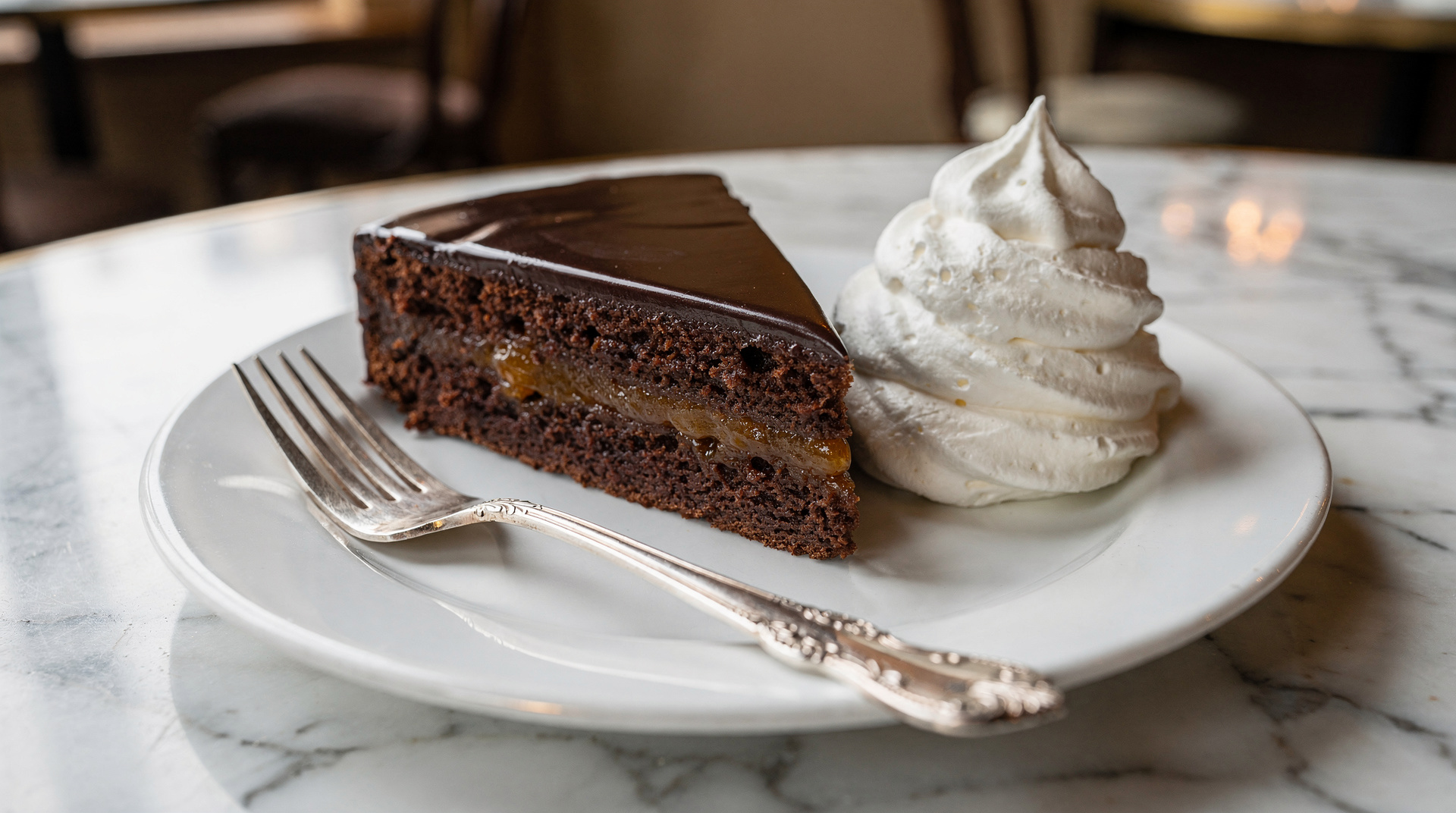
The Sachertorte from Hotel Sacher (in the sealed wooden box) is a more distinctively Viennese gift than Mozartkugeln, and genuinely produced in Vienna. See the Sachertorte guide for detail.
For an authentic chocolate experience from Vienna, consider the Manner wafer (the pink Neapolitan wafer, unmistakably Viennese) or pumpkin seed products from the Styria/Burgenland region — far more specific to Vienna/Austria than the Salzburg-born Mozartkugel.
How to read a wrapper before you pay
The simplest habit that protects you in any Vienna shop is to turn the box over. A genuine factory product names its manufacturer on the packaging, and that name is the first thing to check. If the only words you can find are “Mozart”, “Original” and “Vienna”, with no producer behind them, you are looking at a souvenir product rather than a confection with a reputation to defend. Compare the foil too: the branded versions have a recognisable, consistent look, while the anonymous ones tend to be loud and glossy.
Price per ball is the second clue. Tourist shops often display a low unit price and then hide the catch in a large minimum purchase or a decorated tin. Do the arithmetic at the till, and compare it with what the same brand costs on a supermarket shelf. Once you have done this once, the near-Stephansdom markup becomes obvious, and so does the logic of leaving the pedestrian streets for a few minutes. The same instinct serves you well across the city, and our Vienna tourist traps guide applies it to everything from concert tickets to cafés.
Fitting chocolate into a wider Vienna food plan
Mozartkugel hunting is a small errand, and it fits easily around bigger plans. If you are building a trip around eating, start with the Vienna food guide and the Vienna food tours compared page, then add sweets as a side quest rather than a destination. A morning at the Naschmarkt pairs naturally with browsing small Austrian producers, and a long coffee house afternoon, described in the Viennese coffee house guide, is the best place to try the city’s cakes in the setting they were made for.
Travellers who like to know which cafés deserve the queue can read Café Central vs. Landtmann vs. Sacher and the Sachertorte real vs. tourist comparison. Together with this page, they give you a clear picture of which Viennese sweets are worth real money and which are only worth a polite taste. For a first-person view of the cake pilgrimage, the Sachertorte pilgrimage diary is a good companion read.
Making the Salzburg detour worthwhile
If the Fürst original is what you want, treat the chocolate as one stop in a fuller day rather than the only reason to go. The Salzburg destination page describes the city beyond its confectioners, and the Salzburg from Vienna trip report shows how another traveller handled the day. Anyone weighing how many days Vienna deserves in total can check how many days in Vienna, and a Vienna 5-day itinerary leaves more room for an out-of-town excursion than a short weekend does.
Because the handmade version is short-lived and made without preservatives, plan to eat it soon after buying rather than carrying it through a long trip. Pack it last, keep it away from heat, and treat it as something to enjoy that same evening or within the next few days.
How food tours address the question
A good Vienna food tour guide will explain the Mozartkugel distinction — it’s exactly the kind of tourist-trap knowledge that a local guide provides and a generic guidebook omits.
The Vienna food tour covers authentic Viennese food culture including the honest story behind popular Austrian confections.
The Austrian food and coffee house tour similarly covers the reality of Vienna’s food marketing alongside genuinely Viennese experiences.
Honest tips
Do not buy Mozartkugeln from the souvenir shops near Stephansdom. These are the most expensive and least reliably made versions in Vienna. The supermarkets five minutes away sell Mirabell for a fraction of the price.
The Mozart “original” claim is meaningless in Vienna. Because the Mozartkugel name is not trademarked, anyone can call their product an “original Mozartkugel” without legal consequence. The only genuine original is Fürst in Salzburg.
Manner wafers are a genuinely Viennese alternative. The Josef Manner company (founded 1890, the same year as the Fürst Mozartkugel) makes the iconic pink-and-white Neapolitan wafers from their Vienna factory. They’re widely available, specifically Viennese, and most people prefer them to generic Mozartkugeln.
If you want to taste multiple Austrian chocolates, try the Naschmarkt. Some stalls carry a wider range of Austrian confectionery including regional specialties not available in tourist shops. See the Naschmarkt eating guide.
Buy supermarket Mirabell as a base comparison. If you’re going to Salzburg and want to understand what the Fürst original tastes like in comparison, eat a Mirabell first. The difference in chocolate quality and marzipan texture is noticeable.
Frequently asked questions about Mozartkugel
Why does Vienna market Mozartkugeln so heavily if they’re from Salzburg?
Vienna markets itself as the city of Mozart — concerts, cafés, costume-dressed touts. The connection to Mozart’s music is legitimate (he spent crucial years in Vienna). The connection to Mozartkugeln is purely commercial drift. It works because tourists don’t always distinguish Vienna from the broader “classical Austria” identity.
Is the Reber Mozartkugel better than Mirabell?
Side by side, they’re comparable. Reber uses slightly darker chocolate and claims a more refined marzipan recipe. Mirabell is sweeter and milder. Both are factory-produced. Blind-taste tests have not produced a clear winner. Personal preference applies.
Can I bring Mozartkugeln back to the US, UK, or Australia?
Mirabell Mozartkugeln in factory packaging can generally be brought as personal import in your luggage. Check current customs rules for your specific country. Quantities for personal use (a box or two) are typically fine. Commercial quantities or fresh/handmade versions (like Fürst) may have different rules.
Are there other Austrian regional sweets worth trying?
Linzer Torte (from Linz — allegedly the world’s oldest cake recipe, based on almond pastry and redcurrant jam), Punschkrapfen (rum-glazed pink cube cake, a very Viennese confection), and Kletzen bread (dried fruit loaf, traditional to winter) are all worth exploring. Ask at any good pastry shop or at the Naschmarkt.
Top experiences
Bookable activities with verified prices and instant confirmation on GetYourGuide.