Dürnstein
Visit Dürnstein in the Wachau: the blue baroque abbey, the castle where Richard the Lionheart was imprisoned, and the best apricot wine in Austria.
Wachau Valley: 3 Castles & Wine Private Guided Day Tour
Quick facts
- Distance from Vienna
- 90 km (includes train + taxi/bus from Krems)
- Population
- Under 1,000 — tiny village
- Key sights
- Blue abbey, Kuenringer Castle ruins, Danube views
- Best from
- Danube boat from Melk
Dürnstein: the Wachau’s most beautiful village
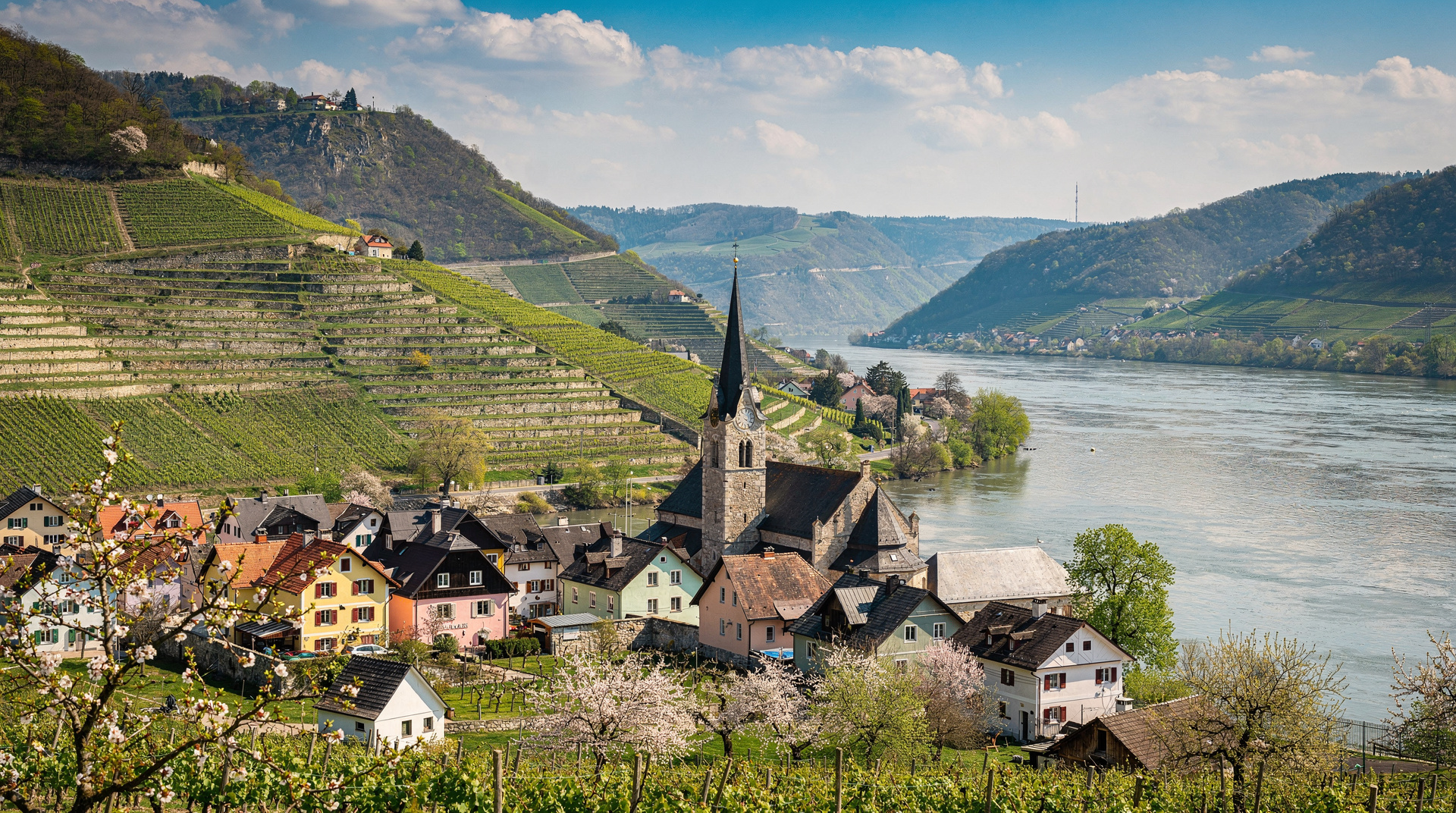
Dürnstein is a village of under a thousand people sandwiched between the Danube and the steep vine-covered slopes of the Wachau’s most compressed and dramatic stretch. Its two landmark elements — the powder-blue baroque tower of the Augustine abbey church that anchors every photograph of the valley, and the ruined Kuenringer Castle on the ridge above where Richard the Lionheart was imprisoned in 1192–93 — pack more concentrated history into 500 metres of village frontage than most Austrian towns ten times its size.
The village is compact enough that most visitors experience it as a stop on the Danube boat from Melk, stepping off for an hour or two, walking the main street, looking up at the abbey tower, and reboarding for Krems. That is enough time for the essential experience. For the castle ruins on the hill above — and for the wine — add another 45 minutes and a willingness to climb.
| Where | Wachau valley, between Melk and Krems |
| Cost | Small charge for the abbey church; castle ruins free |
| Time needed | 1–2 hours for the village; add 1 hour for the castle climb |
| Getting there | Train to Krems + bus 720, or Danube boat from Melk |
| Best time | April (apricot blossom) or September–October |
The blue abbey
The Stiftskirche Dürnstein — the church of the former Augustinian abbey — is the most recognisable landmark of the entire Wachau. Its powder-blue and white baroque tower is visible from kilometres in both directions along the river, a vertical accent against the vine-covered hillside that makes every bend in the Danube feel like a revelation. The tower was built between 1721 and 1733 in a florid late-baroque style attributed to Josef Munggenast; its colour, so specific and so memorable, has become shorthand for the valley’s visual identity — “Dürnstein blue” as a descriptive category.
Standing before the tower from the Danube boat dock is the full experience: the blue tower against grey stone, the vine terraces on the hillside behind, the Danube moving past in the foreground. This is the image that appears on every Wachau postcard, and the reality matches the expectation.
The church interior is equally elaborate — gilded side altars, ceiling frescoes, and the ornate choir stalls from the former monastery. The Stift (abbey) was dissolved under Emperor Joseph II in 1788 as part of his broad programme of monastery closures, and the church transferred to the parish. A small charge applies for entry; the interior justifies it.
The Kuenringer Castle
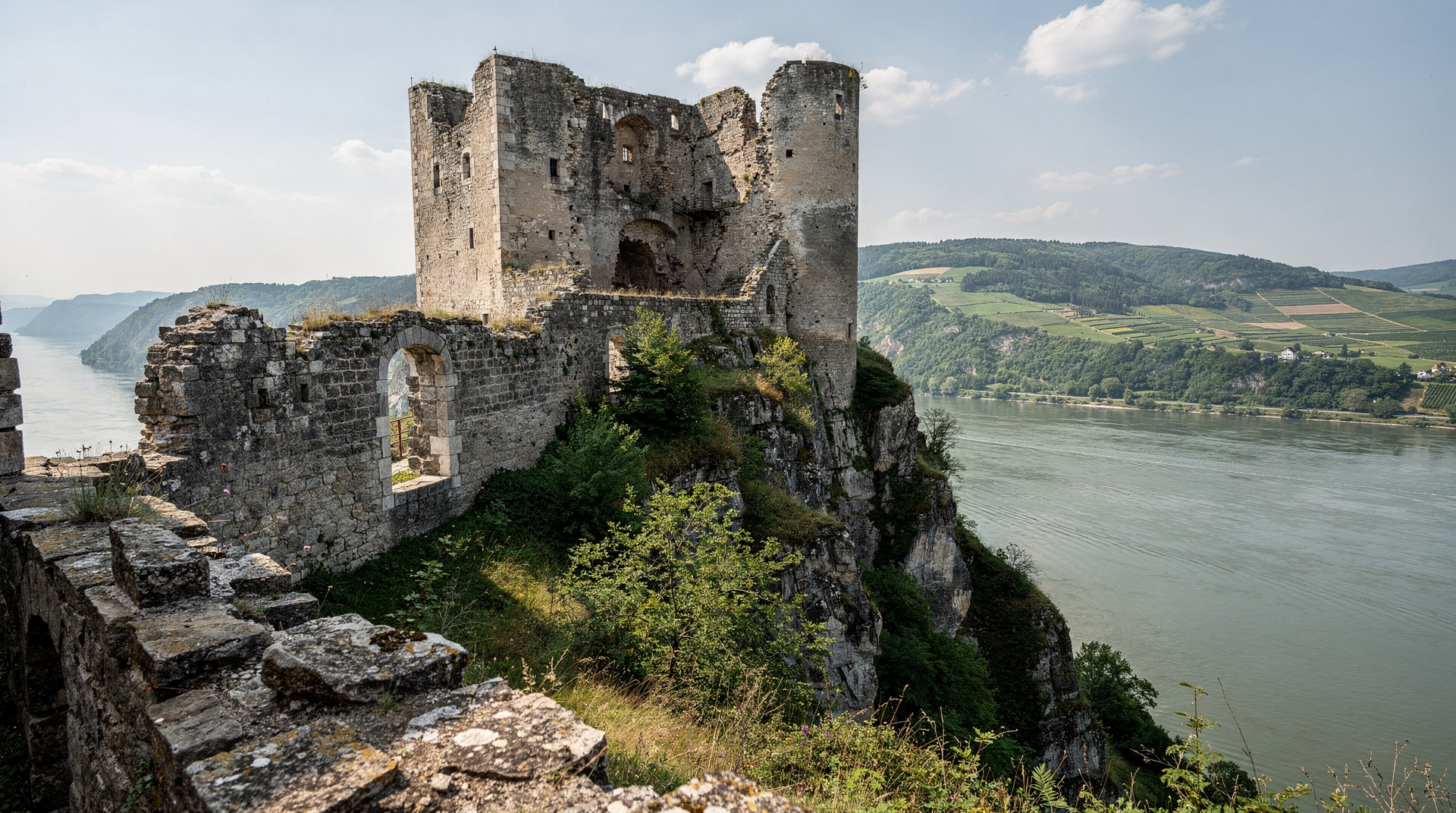
Above the village, reached by a marked footpath that takes 30–40 minutes uphill from the village square (steep in the final section, proper shoes recommended), the ruined Burgruine Dürnstein is the site of one of medieval Europe’s most famous imprisonments.
In 1192, the English crusader king Richard I — “the Lionheart” — was seized by Duke Leopold V of Austria near Vienna while travelling home from the Third Crusade disguised as a merchant. The capture was Leopold’s revenge: Richard had publicly insulted him at the siege of Acre, tearing down his standard from a captured fortification. Leopold held Richard at this castle above the Danube while negotiations for ransom proceeded. The eventual settlement — an enormous sum equivalent, by various historical estimates, to several times England’s annual tax revenue — was paid over time, and Richard was released in early 1194.
The legend that grew around the imprisonment is elaborate. The troubadour Blondel de Nesle, Richard’s companion, supposedly wandered from castle to castle across Europe singing a song known only to Richard and himself, until he heard the king’s voice join in from within the walls of Dürnstein. The story first appears centuries after the events and is almost certainly invented — but it has proved irresistible, and it runs through Austrian school curricula and tourist descriptions alike.
The castle ruins themselves offer the most panoramic view in the Wachau: the river bending far below, the blue abbey tower immediately beneath you, the terraced vineyards climbing the opposite slopes toward the Kremstal, and on clear days the silhouette of the Stift Melk visible far to the west. The climb is thoroughly rewarded.
Apricots and wine
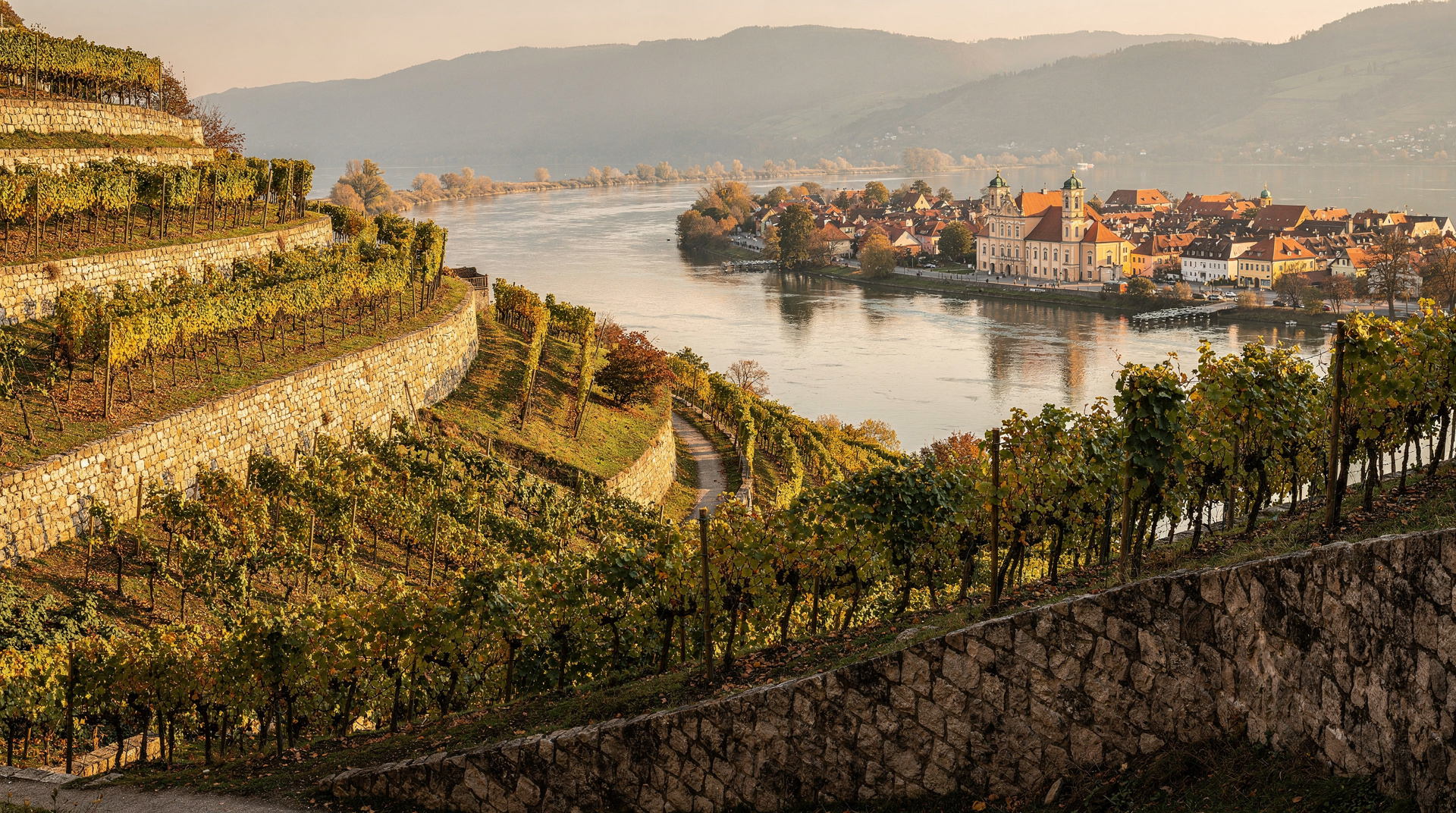
The terraced primary-rock slopes above Dürnstein produce Grüner Veltliner and Riesling of exceptional quality — the combination of the specific gneiss and mica schist soils, the extreme angle of the vine terraces (some exceeding 60 degrees), and the thermal influence of the Danube storing and releasing heat creates conditions that generate wines of a particular mineral precision found nowhere else in Austria. Several wineries in and around Dürnstein offer tastings and direct sales; Weingut Knoll in nearby Unterloiben and Weingut Alzinger in Unterloiben are among the Wachau’s most acclaimed producers, consistently appearing in serious Austrian wine discussions.
The apricot orchards (Marillen) on the lower Wachau slopes are the valley’s other great speciality. In April they flower in drifts of pink-white blossom along the terraced slopes and the lower banks above the river road — the most beautiful single sight of the Wachau calendar, visible from the passing Danube boats and drawing visitors specifically for the blossom season.
In July and August, roadside stalls sell fresh apricots, apricot jam, Marillenkuchen (apricot cake), and Marillenschnaps (apricot brandy). The Wachaumarille variety grown in the valley holds an EU protected designation of origin — the specific microclimate produces an apricot of intense flavour that is meaningfully different from supermarket apricots grown elsewhere.
The Wachau 3 castles and wine private guided day tour covers Dürnstein’s castle along with Aggstein and another Wachau fortress — the best option for visitors whose primary interest is medieval history and wine, combined in a guided circuit of the valley’s most significant sites.
The Wachau bus-and-boat tour from Vienna stops at Dürnstein for a village walk as part of the classic Melk-to-Krems circuit — the most popular single-day approach to the valley.
Getting there independently
Dürnstein has no direct train service. From Vienna: train from Franz-Josefs-Bahnhof to Krems (approximately 1 hour, hourly service), then bus 720 (the Linie Wachau service) westward to Dürnstein, approximately 20 minutes. The boat from Melk — the DDSG Blue Danube service — stops at Dürnstein on request on some services; check the current schedule at the DDSG website before depending on this, as stop availability varies by season and vessel. The boat approach, docking at the village quay with the blue tower framed above, is the most atmospheric arrival.
Most visitors combine Dürnstein with Melk and Krems as part of the standard Wachau day trip. An overnight in Dürnstein — at Hotel Schloss Dürnstein or Hotel Richard Löwenherz, both immediately beside the abbey — is the more considered option: the day-trippers leave by early evening, and the village in the hours before sunset, with the light on the abbey tower and the Danube quieting below, is among the most atmospheric places in Austria.
Combining with the rest of the Wachau
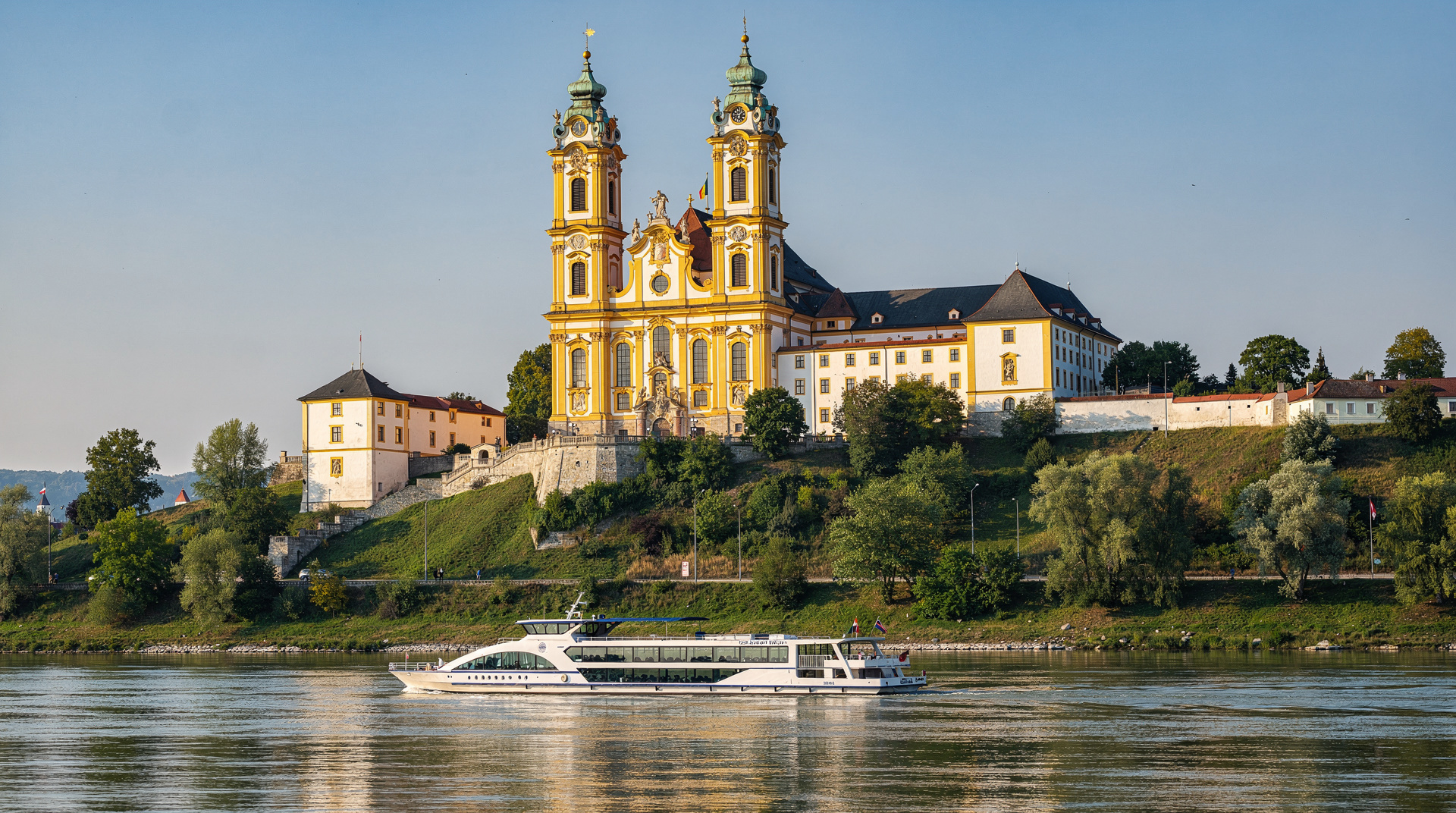
Dürnstein sits between Melk, with its grand baroque working abbey, and Krems, the valley’s largest town and a good base for wine. For the ruined castle comparison across the valley, see Aggstein, and for the fuller regional picture, the Wachau Valley overview. If a boat is part of the plan, the Melk to Krems boat trip guide and the Wachau Danube cruise guide cover schedules and what to expect on the water, while the Wachau day trip from Vienna guide ties the whole circuit together for a single-day plan.
How to shape your time in the village
Dürnstein rewards a slow rhythm more than a checklist. Start at the quay or the village square, walk the main street end to end, and let the abbey tower set your bearings: it is visible from almost everywhere, so you never really get lost. If you only have the short boat-stop window, choose between the church interior and the castle climb before you step off, rather than trying to squeeze in both and rushing each. The climb needs unhurried legs and a eye on the clock, while the interior can be enjoyed at a gentler pace.
With a little more time, the best order is the castle first, while your legs are fresh, then a long lunch or tasting at the bottom. The view over the river looks different depending on the hour and the weather, and a clear morning gives the cleanest outline of the valley. Cloud or haze softens the colours but makes the blue tower stand out even more against the slope. Bring water and a light layer, because the exposed ridge can feel noticeably different from the sheltered lanes below.
The main street itself is lined with small shops, wine cellars and cafés that sell apricot specialities. Browsing is part of the pleasure here, and it costs nothing. Courtyards and archways tucked off the street often hide a quieter table than the ones facing the river, so look beyond the first terrace you see.
Why Dürnstein works for different travellers
Wine lovers can treat the village as a gateway to the wider valley. Pair this page with the Wachau wine route guide and the Grüner Veltliner guide to understand what you are tasting, and consider the Burgenland wine route later if the Wachau leaves you curious about Austria’s other wine regions. A tasting counter is a good place to ask which bottles suit the wines you already like.
History enthusiasts get the most from the castle ruins, but the story of the village is bigger than one king. The monastery closures of Joseph II belong to a wider chapter of Habsburg history that the Habsburg history guide for travelers explains in plain terms. Reading it before you travel turns the empty abbey buildings into something more than scenery.
Walkers and hikers will enjoy that the village sits right on the edge of the vine terraces. The castle path is the obvious trail, but the lanes among the vines invite short wanders in either direction. For a different kind of outing closer to the capital, the Vienna Woods hiking guide is a useful companion.
Photographers will find that the tower is the headline, but the vine terraces, the river and the rooftops all reward patience. The Vienna photography spots guide is written for the capital, yet the same habits apply here: arrive early, wait for the light, and look for foreground interest.
Turning Dürnstein into a longer Wachau trip
A single stop is easy to enjoy, but Dürnstein also slots into several bigger plans. If you like the idea of a full day on the river, the Wachau and Danube cruise guide and the Melk to Krems boat trip explain how the stops fit together. For the abbey that anchors the western end of the valley, read the Melk Abbey day trip guide, and for a wider look at excursions from the capital, the best day trips from Vienna compares the main options side by side.
If you are building a longer itinerary, the Vienna 5-day itinerary and the Vienna 7-day itinerary leave room for a Wachau day, while a shorter stay can still fit it with some planning, as the Vienna 4-day itinerary shows. Travellers who want a personal account of the valley may enjoy the autumn in the Wachau blog post and the Wachau by bike diary, both of which show what the region feels like from the ground.
For those coming in the harvest or blossom seasons, the Vienna in autumn guide and the Vienna in spring guide help you think about what else to pack into the same trip. The best time to visit Vienna page gives the wider seasonal picture, which is useful because the Wachau’s rhythm follows the same calendar.
What to expect on arrival
Expect a very small place. There are no big attractions beyond the abbey church, the castle ruins and the views, and that is exactly the appeal. Visitors who arrive hoping for a long list of museums tend to leave disappointed, while those who come for atmosphere, a glass of local wine and a walk leave happy. On busy days the main street fills with tour groups, so the quieter moments are early, late, or once the boats have moved on.
Plan your food as you plan your time. Several places in the village serve regional dishes and apricot-based desserts, and a table with a river or vineyard view is worth a little patience. If you want the full experience, ask about local wines by the glass rather than ordering by habit, and let the staff steer you toward something from the surrounding slopes.
Finally, remember that the village is a place to be, not just a place to photograph. Sit down, look up at the tower, and let the valley do the work. That slower mood is the real reason the Wachau lingers in people’s memories long after the postcards have been forgotten.
Top experiences
Bookable activities with verified prices and instant confirmation on GetYourGuide.