Vienna with kids: a 5-day family itinerary
Vienna: Skip-the-line Tickets for Schönbrunn Zoo
Vienna is genuinely good for children — if you choose the right version. The city has a Baroque zoo inside a palace, a 19th-century giant ferris wheel, one of Europe’s best interactive museums (the Haus der Musik, where children can conduct a virtual orchestra), and Hallstatt for mountain lakes. This itinerary skips the quiet gallery rooms that exhaust children and doubles down on the things kids actually remember.
| Where | Schönbrunn, Prater/Leopoldstadt, Innere Stadt, Hallstatt day trip |
| Cost | around 400–600 € per person for 5 days, excl. flights |
| Time needed | 5 days (4 works if you drop Hallstatt) |
| Getting there | CAT or S-Bahn from the airport, U-Bahn between districts |
| Best time | school holiday weeks or shoulder season for shorter queues |
At a glance
Day 1: Schönbrunn Zoo and the palace garden. Day 2: Prater Riesenrad and the Naturhistorisches Museum. Day 3: Hallstatt. Day 4: Innere Stadt at child-pace. Day 5: Haus der Musik and Stadtpark. No U-Bahn-only logistics — everything is family-accessible.
This itinerary deliberately favours Schönbrunn and Prater/Leopoldstadt over gallery-heavy sightseeing. For the fuller reasoning on which Vienna attractions actually work for children and which to skip, see the Vienna with kids guide; for the zoo specifically, the Schönbrunn Zoo family visit guide goes deeper on timing and ticket options than a day-by-day itinerary can.
Which attractions suit which ages
Not every Vienna sight works for every age. Here’s the honest breakdown used to build this itinerary:
| Attraction | Best age | Notes |
|---|---|---|
| Schönbrunn Zoo | All ages | Pandas and the rainforest house are the reliable hits |
| Prater / Riesenrad | All ages | The wheel itself is calm; the funfair rides need height checks |
| Naturhistorisches Museum | 5+ | Dinosaurs and meteorites carry younger children through |
| Hallstatt day trip | 6+ | Long day; the boat and salt mine slide are the payoff |
| Stephansdom catacombs | 8+ | Bones and history land better with older children |
| Haus der Musik | 4+ | The virtual conductor works even for toddlers |
| Hofburg / Imperial Apartments | 10+ | More meaningful with a baseline of Habsburg history |
For a broader guide to what works and what doesn’t across the whole city, see Vienna with kids.
Day 1: Schönbrunn Zoo and the palace garden
Morning (9:00–13:00)
Start at Schönbrunn Zoo (Tiergarten Schönbrunn) — take U4 to Schönbrunn station. Book skip-the-line tickets for Schönbrunn Zoo ahead: the ticket queues in summer are long enough to make children impatient before they’ve seen a single animal.
The Zoo, founded in 1752, is the world’s oldest continuously operating zoo. Standouts for children: the giant pandas (Schönbrunn has had them since 2003), the tropical rainforest house (warm, humid, free-flying butterflies and birds), the polar bears, and the penguin enclosure. The whole zoo needs 3 hours to cover properly; if energy runs out, prioritise the main avenue from the main entrance.
Afternoon (13:00–17:00)
Lunch at one of the Zoo cafés (fine — not exceptional). Walk into the Schönbrunn Palace garden (free entry) after lunch: the formal parterre, the Neptune Fountain, and the children’s maze (Irrgarten Schönbrunn — a separate ticket, around 3.90 € children, 5.50 € adults). The maze takes 20–30 minutes and children universally enjoy it.
If children have energy: the Schönbrunn Palace skip-the-line tour covers the Imperial Apartments for an introduction to the Habsburg story (better for children over 9). The palace plus zoo combination is a full day.
Evening (18:00 onwards)
Dinner near the hotel. For Vienna family-friendly restaurants: Gasthof zur Wienerwald is reliable Austrian food without ceremony; or Pizza Mari in the 6th district for excellent Neapolitan pizza in a relaxed setting.
Day 2: Prater Riesenrad and the Naturhistorisches Museum
Morning (9:30–12:30)
Naturhistorisches Museum (Natural History Museum) — one of the best natural history museums in Europe and completely suited to children. Highlights: the dinosaur hall (Diplodocus skeleton), the Venus of Willendorf (30,000-year-old Ice Age figurine, 11cm tall, improbably powerful in person), the meteorite collection (you can touch some), and the whale skeleton. Allow 2 hours. Entry 16 € adults, children under 19 free on Sundays and holidays.
Afternoon (13:30–17:30)
Lunch near the museum (MuseumsQuartier food stalls, or Café Corbaci on Breite Gasse — good Turkish lunch).
Afternoon: Prater district for the Riesenrad (Giant Ferris Wheel). Book skip-the-line Giant Ferris Wheel tickets — the wheel takes 20 minutes for one rotation at 65 metres. The view of Vienna from the top is the best simple panorama in the city. Built in 1897, the Riesenrad is an icon (it appeared in Orson Welles’ The Third Man and in the Bond film The Living Daylights).
After the Riesenrad, the Prater meadows (Prater Hauptallee) are excellent for a bike ride or a walk — the chestnut-lined avenue extends 4.5 km to the Lusthaus café-pavilion. Bike rental available near the Praterstern.
Evening
Dinner in the Prater area — Schweizerhaus (Strasse des 1. Mai 116) has been serving Czech Budvar beer and roast pork in the Prater beer garden since 1920. Children are welcome; the outdoor garden is perfect in warm weather. Budget 20–30 € for a family of four.
Day 3: Hallstatt for big impressions
Early departure — the Hallstatt day trip with boat ride and Skywalk leaves around 7:00. The drive takes 3 hours.
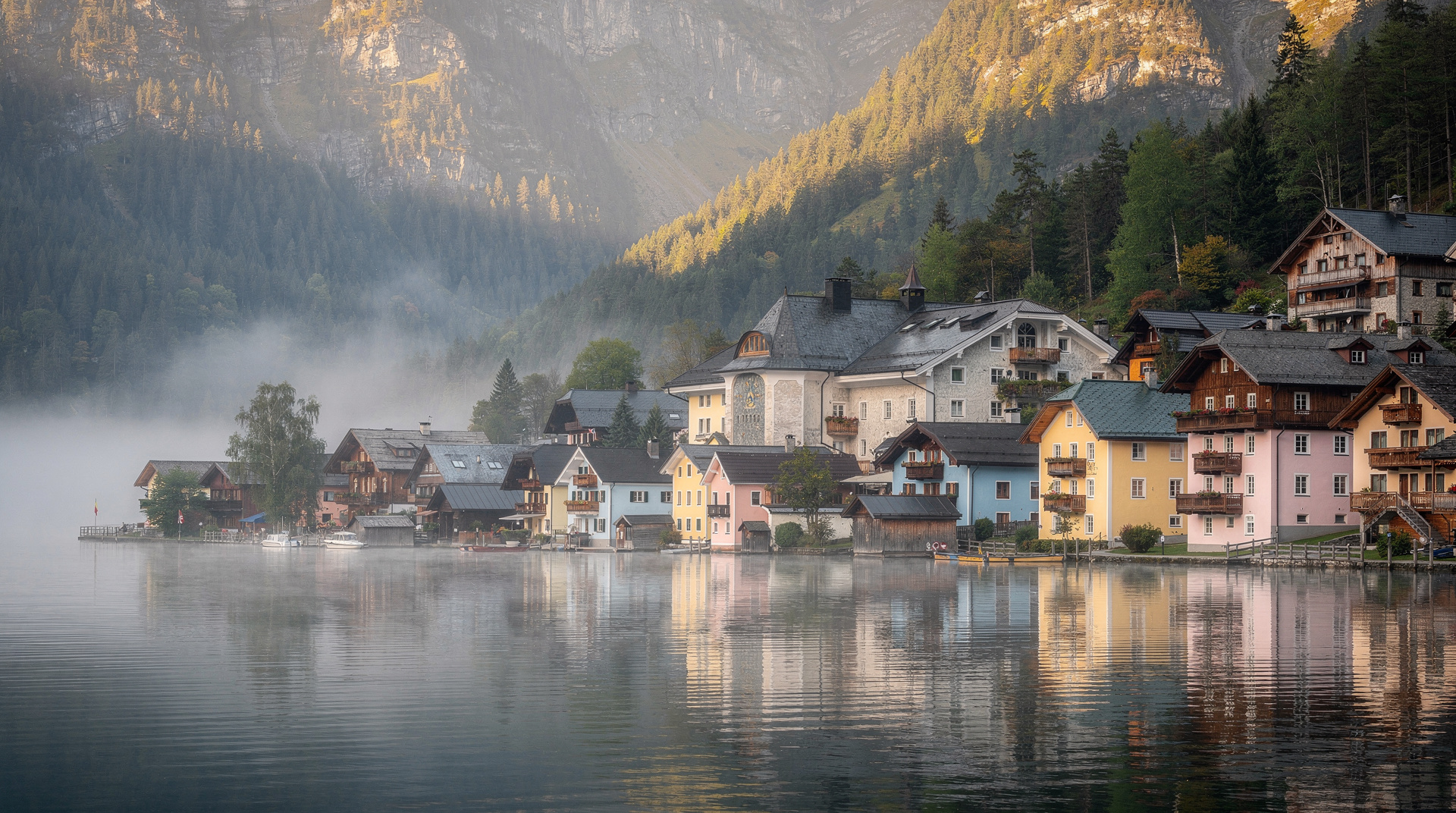
What children like in Hallstatt: the boat ride on the lake (most children’s highlight of the trip), the Skywalk cable car and viewpoint, and the salt mine tour (where children can slide down a wooden miner’s chute — genuinely fun). The village itself is photogenic but small; children who have done the mine and the boat are generally satisfied.
What to know for families: the tour is a long day (returns 20:00–21:00). Children under 5 may find it exhausting. The boat ride and mountain setting are the payoff. Pack snacks and a light jacket — even in summer the Salzkammergut can have afternoon cloud.
Day 4: Innere Stadt at child-pace
Morning (9:30–12:30)
Stephansdom — children respond to the scale and the South Tower climb (343 steps — make it a race). The catacombs tour (runs from 10:00, 7 € adults, 4 € children) takes 30 minutes underground past stacked bones and Habsburg viscera (literally — the Habsburg intestines are stored here, separately from their bodies at the Kaisergruft). Surprisingly appropriate for children over 8 who like history.
Walk the Graben — the street performers, the Pestsäule (Plague Column), and the general theatrical quality of the pedestrian zone are good for children. Stop at Demel (Kohlmarkt 14) for a Sachertorte or Apfelstrudel — the shop window filled with sugar sculptures is a draw for children. Demel is expensive (6–8 € per slice) but the quality is genuine.
Afternoon (13:00–17:30)
Lunch at Figlmüller Wollzeile — the Wiener Schnitzel is the size of a dinner plate and children universally love it. Book ahead. Budget 20 € per child’s portion.
After lunch, the Austrian National Library State Hall (Prunksaal) on Josefsplatz — this is one of the great Baroque library rooms in the world (18m high, 77m long, ceiling frescoes by Johann Bernhard Fischer von Erlach). Children are usually impressed by the sheer scale even if the books mean little. Entry 10 € adults, free under 18.
End the afternoon with the Augustinerkeller wine cellar as a drinks break (lemon sodas, apple juice — the space is 14th-century brick vaulting and interesting for older children).
Evening
Walking dinner on Naschmarkt — best for families who want to graze rather than sit. Sausage, cheese, fresh fruit, and good falafels.
Day 5: Haus der Musik and Stadtpark farewell
Morning (9:30–12:30)
Haus der Musik (Seilerstätte 30) — this interactive music museum is one of the best in Europe for children. Children can conduct the Vienna Philharmonic via motion sensors (genuinely magical), play instruments from around the world, experience Vienna’s musical history through immersive rooms, and compose their own ringtone. Entry 15 € adults, 9 € children. Allow 2–3 hours.
Afternoon (13:00–16:00)
Lunch near the Haus der Musik — Griechenbeisl (Fleischmarkt 11) if you want the oldest restaurant in Vienna (1447); more practically, Vapiano on Mariahilfer Strasse for pasta that children reliably eat.
Final afternoon: Stadtpark (City Park) — the green lung of the inner city. The Johann Strauss statue (gilded, photogenic), the duck ponds, and the playgrounds make it the ideal winding-down space. The Kursalon pavilion serves afternoon coffee if parents need it.
Evening: farewell dinner
Schweizerhaus again if children demanded it, or Steman (Otto-Bauer-Gasse 7) for reliably excellent Viennese cooking at honest prices. The Schnitzel, Gulasch, and Tafelspitz are all well-prepared; the wine list has good Austrian bottles at fair prices. No reservations usually needed.
Practical notes for families
U-Bahn: Vienna’s metro is accessible, with lifts at all major stations. The U2 and U4 are the most useful for this itinerary. A family day pass (Familienkarte, not officially named but available as a day group ticket) covers two adults and up to three children under 15 from one 24-hour stamp.
Strollers: Most Vienna museums have stroller access via lift. Schönbrunn Zoo is entirely pushchair-friendly; the Naturhistorisches Museum has level access throughout.
Best ages for each attraction: Zoo and Prater (all ages). Hallstatt (best 6+). Haus der Musik (best 4+). Stephansdom catacombs (best 8+). Hofburg (best 10+; the rooms are more meaningful with a baseline of history).
Child-friendly food: Vienna is actually good for this. Wiener Schnitzel is everywhere and universally accepted. The Würstelstand sausages are popular with children. Demel pastries are a reliable win. See the Vienna food guide for more, or the Naschmarkt eating guide for the graze-through-market dinner mentioned on Day 4.
Getting from the airport with children: the CAT (City Airport Train) is the fastest option at 16 minutes but costs more; the S-Bahn (S7) is cheaper and only slightly slower. Both are easier with luggage and a stroller than a taxi in traffic. See the airport to city guide for the full comparison.
If five days feels ambitious with younger children, the Vienna weekend itinerary compresses the highlights into a shorter trip; conversely, families wanting more classical culture alongside the child-friendly stops can look at the Vienna 7-day itinerary for a slower pace.
Frequently asked questions about this itinerary
Q: Is Vienna a good city for young children?
Yes — the Zoo, Riesenrad, Haus der Musik, and Naturhistorisches Museum are all genuinely excellent for children aged 4–12. The parks are good and the city is walkable in manageable sections. The challenge is the museum-heavy culture; this itinerary deliberately balances active and museum experiences.
Q: Should I take children to Hallstatt?
Children over 5 generally enjoy the boat ride and the Skywalk cable car. The salt mine tour (not always included in day trip packages) is the best addition for children — the mine slide is a highlight. The village itself is less interesting to children than the outdoor activities.
Q: What is the best interactive museum in Vienna for children?
The Haus der Musik is consistently rated first by families. The virtual conductor experience is unique. The Naturhistorisches Museum (free for under-19s on Sundays) is second, particularly for children interested in science and prehistory.
Q: How do we get around Vienna with a stroller and young children?
The U-Bahn is the easiest option — lifts exist at all major stations and the network reaches everywhere in this itinerary. See the Vienna public transport guide for tickets and the family day-pass option. Avoid the tram at rush hour with a stroller; the U-Bahn has more space.
Q: Is 5 days too long for a family trip to Vienna?
Not if Hallstatt is included — the day trip alone takes a full day, leaving four for the city. Families who skip Hallstatt can comfortably do this itinerary’s city content in 3–4 days; see the Vienna weekend itinerary for a shorter, city-only version.
Top experiences
Bookable activities with verified prices and instant confirmation on GetYourGuide.