Naturhistorisches Museum Vienna guide: dinosaurs, meteorites and the Venus of Willendorf
Vienna Kunsthistorisches Museum Day Admission Ticket
Is the Naturhistorisches Museum Vienna worth visiting?
Yes — the NHM Vienna is one of Europe's great natural history collections, with the Venus of Willendorf (28,000 years old, the world's oldest known female figurine), one of the finest meteorite halls in the world, Carinthian topaz crystals, and substantial dinosaur and palaeontology departments. Excellent for children and adults equally. Allow 2–3 hours; tickets are €16.
The NHM: one of Europe’s great natural history collections
The Naturhistorisches Museum Wien (Natural History Museum Vienna) is often described as the mirror image of the Kunsthistorisches Museum — and architecturally this is literally true, the two buildings having been designed by the same architects (Gottfried Semper and Carl von Hasenauer) in the same style and placed symmetrically on either side of Maria-Theresien-Platz. In content, however, they are as different as two museums can be.
| Where | Maria-Theresien-Platz, Innere Stadt |
| Cost | €16 adults, under 19 free |
| Time needed | 2–3 hours |
| Getting there | U2 Museumsquartier or U3 Volkstheater |
| Best for | All ages, especially families |
Where the KHM is the product of Habsburg cultural collecting — paintings, sculpture, decorative arts — the NHM is the product of Habsburg scientific collecting: natural history specimens, archaeological objects, and geological samples assembled through centuries of imperial exploration, excavation, and purchase. The result is one of the most complete natural history collections in the world, housed in a building that treats the display of science with the same monumental seriousness as the display of art.
What you need to know before you go
Address: Maria-Theresien-Platz, 1010 Wien Opening hours: Daily 9 am–6:30 pm; Wednesday until 9 pm. Closed Tuesday. Admission: €16 adults; under 19 free; combined ticket with the KHM available Getting there: U2 to Museumsquartier or U3 to Volkstheater (5 minutes walk each); tram D to Burgring Photography: Permitted in all permanent galleries without flash
What to see: room by room priorities
Room 11: The Venus of Willendorf
This is the NHM’s most famous object and one of the most important prehistoric finds in the world. The Venus of Willendorf — an 11.1-centimetre limestone figurine carved approximately 28,000–25,000 years ago — was found in 1908 near the Danube village of Willendorf in Lower Austria by archaeologist Josef Szombathy. It is the oldest known female figurine, predating agriculture by 20,000 years and the Egyptian pyramids by 25,000 years.
The figurine represents a female body with exaggerated secondary sexual characteristics, no facial features, and traces of ochre pigment. Its purpose — ritual, artistic, or practical — remains the subject of scholarly debate. What is not in dispute is its significance: it is the starting point of the longest human artistic tradition we know.
The room also contains other Venus figurines from Paleolithic sites across Europe, providing comparative context. Allow 20–30 minutes here.
Meteorite Hall (Room 5)
The NHM Vienna holds one of the three or four largest and most significant meteorite collections in the world. The centerpiece is the Tissint Martian meteorite — one of only a handful of confirmed samples from Mars in existence, a fragment that was ejected by an impact on Mars and eventually fell to Earth in Morocco in 2011. The collection also includes the Knyahinya meteorite (one of the largest stone meteorites in any museum, weighing 500 kg) and hundreds of specimens representing every major meteorite class.
The Meteorite Hall is often the highlight for visitors who did not anticipate it being significant. The Tissint meteorite’s Martian origin — confirmed by analysis of trapped gases matching the Martian atmosphere — makes it one of the more philosophically striking objects in any museum: a rock from another planet, in a room in Vienna, fallen through the atmosphere we share with Mars.
Palaeontology (Rooms 14–16)
The palaeontology halls cover the history of life from the Precambrian through the Mesozoic. The dinosaur material includes mounted casts of Allosaurus and Diplodocus (reconstructed skeletons based on specimens from North American excavations) and original Austrian specimens — particularly the ichthyosaur skeletons from the Hallstatt limestone, which are important original finds from the 19th century.
The ammonite collection is one of the finest in Europe, with specimens from Austrian and international localities covering a 300 million year span of cephalopod evolution. For visitors interested in palaeontology beyond dinosaurs, this collection is genuinely exceptional.
Mineralogy and Gemology (Rooms 1–3)
The mineral collection occupies the first three rooms and includes some of the finest mineral specimens in Europe: the Carinthian topaz crystals (among the largest and most perfect topaz crystals known), native gold specimens from various localities, massive quartz, and the spectacular amethyst geode collection. Room 3 contains an extensive display of cut gemstones and diamonds.
Children tend to be drawn immediately to the large crystals and the fluorescent mineral display — minerals that glow under ultraviolet light in vivid blues, greens, and oranges.
Anthropology and Prehistoric Room (Rooms 7–11)
The anthropological collection covers human evolution from early hominid fossils through the Paleolithic, Mesolithic, and Neolithic. The Venus of Willendorf is in this section (Room 11), preceded by a broader context of prehistoric material from Austria and Central Europe.
Zoology (Rooms 21–39)
The zoological collection fills much of the upper floor: birds, insects (a world-class entomology collection), mammals, fish. The whale skeleton hanging in one of the larger rooms is consistently popular with children. The dodo skeleton — one of the more complete dodo specimens in existence — is in the birds section.
The building as experience
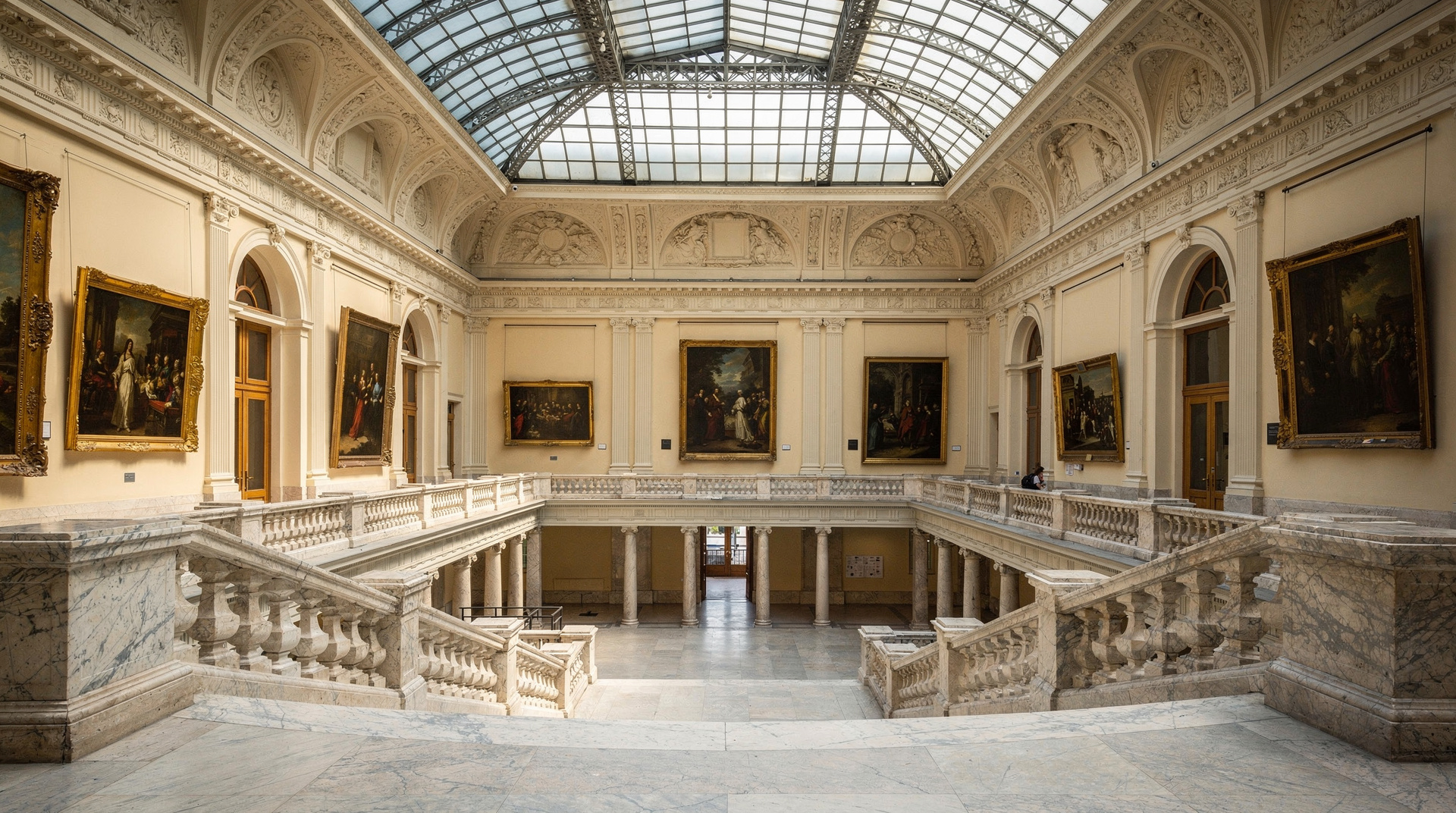
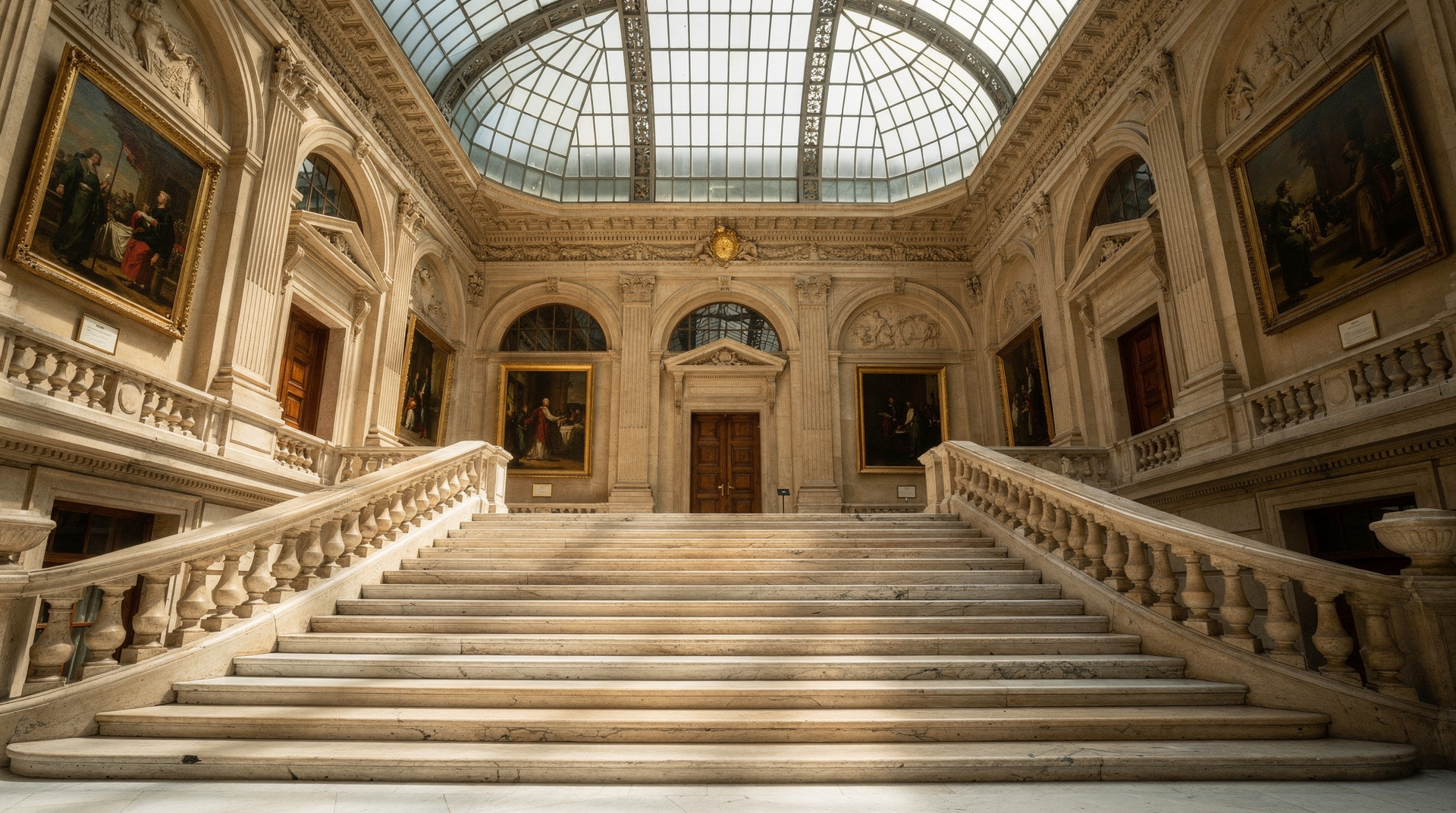
Unlike the KHM, where the building serves as a backdrop for art, the NHM’s interior is itself part of the collection in an unusual way: the ceiling frescoes and domed interior (painted between 1885 and 1891) depict scenes from natural history and classical mythology relating to science, creating a coherent iconographic programme that treats natural history as a subject worthy of the same visual treatment as the Habsburgs’ art.
The main staircase hall — with its marble balustrades, scientific busts, and painted ceiling — is one of the finest Historicist interiors in Vienna. The square outside, Maria-Theresien-Platz, and its wider architectural setting are covered in more depth in our Ringstrasse architecture walk, which places both museums within Vienna’s grand 19th-century building programme.
Combining with the KHM
The KHM and NHM are opposite each other across Maria-Theresien-Platz and are complementary in obvious ways: one covers human artistic production, the other natural and prehistoric history. Visiting both in one day requires careful time management — start at 9 am at the NHM (which opens earlier than the KHM), cover the key rooms (Venus, meteorites, dinosaurs) in 2.5 hours, then cross the square to the KHM for the painting galleries in the afternoon.
A more comfortable approach is to give each museum a dedicated half-day or full day. See our Vienna 3-day itinerary for a structure that avoids rushing both.
Vienna Kunsthistorisches Museum day admission ticket Vienna: guided walking tour of city center highlightsA walking tour that covers Maria-Theresien-Platz gives the architectural and historical context of the museum pair before you enter either building.
Practical tips
Children: The NHM is one of Vienna’s best family destinations. The discovery room (Kinderreich) specifically designed for younger visitors is in the basement. Allow extra time if visiting with children — the dinosaurs and crystals tend to generate extended study.
Thursday evening: Open until 9 pm with significantly reduced visitor numbers after 6 pm. The meteorite hall in the late afternoon is especially atmospheric.
Combined ticket: A combined NHM + KHM ticket is available and saves money. If you plan to visit both, this is the most economical option.
Planning a family day around the NHM
The Naturhistorisches Museum is consistently one of the strongest single attractions for families visiting Vienna, and it pairs naturally with a wider family-focused itinerary. Our Vienna with kids guide covers where the NHM fits alongside the city’s other family attractions (the Prater, Schönbrunn Zoo, Haus der Musik), and the Vienna with kids itinerary sequences a multi-day family visit so the NHM gets a proper half-day rather than being rushed between other sights.
If museums generally are a priority for your trip, our best museums in Vienna guide ranks the NHM against the city’s other major collections to help you budget time across a short stay.
What’s easy to miss on a first visit
Most first-time visitors head straight for the Venus of Willendorf, the meteorites and the dinosaurs, which is the right priority — but a few less-publicised rooms reward a slower visitor. The taxidermy dioramas in the zoology wing, arranged in the 19th-century manner with painted backdrops, are themselves a piece of museum history rather than simply specimens on display.
The anthropology rooms adjacent to the Venus of Willendorf trace human evolution in more detail than most visitors expect, with a genuinely global range of hominid casts. And the building’s own architecture — the painted dome, the marble staircase, the scientific allegorical frescoes — is worth 10 minutes of dedicated looking-up rather than being treated purely as a corridor between exhibits.
How to pace the visit once you are inside
Because the collection is so broad, the visit goes better with a loose plan than with a room-by-room march. Start with the one or two objects that matter most to you, whether that is the Venus of Willendorf, the meteorites or the dinosaurs, and let the rest of the visit fill in around them. Everything you see after that is a bonus rather than an obligation, and you will enjoy it more for not feeling rushed.
Museum fatigue is real in a building of this scale. Alternate the dense, text-heavy rooms with the visually dramatic ones, and sit down in the staircase hall when your attention flags. If you are travelling with children, let them choose the order of the rooms; the crystals, the whale skeleton and the dinosaurs will hold their interest far longer than a route imposed from the guidebook.
Pairing the museum with the rest of your day
The location makes the NHM easy to combine with other sights without much backtracking. The Museumsquartier is a short walk away and offers cafés and open space for a break between exhibitions, and its own galleries are described in our mumok guide and our Leopold Museum guide. For a rainy day built entirely around culture, the Albertina Museum guide and the Belvedere Palace guide make natural companions.
If you would rather spend the afternoon outdoors, the Ringstrasse is right on the doorstep, and the Hofburg Palace guide covers the imperial complex that lies just beyond the square. After the museum, a proper sit-down in a traditional café is the classic way to finish, and our best coffee houses in Vienna guide helps you pick one. Visitors who prefer to cover the highlights quickly can also compare the Vienna Pass review with the Vienna City Card review before deciding how to pay for a museum-heavy trip.
Choosing the right season and time of day
The museum is an indoor attraction, which makes it a dependable option in any weather. Our best time to visit Vienna guide explains the seasons in detail, and the Vienna in winter guide is especially relevant if cold days push you indoors. Early in the day and during the late-opening evening are generally the calmest moments, as noted above; midday tends to be busiest, particularly in the rooms that families head for first.
For a wider plan that places the NHM within a longer stay, the Vienna 5-day itinerary and the Vienna weekend itinerary both leave space for a museum morning, and the how many days in Vienna guide helps you decide how much time the city deserves. Travellers on a tight budget should read Vienna on a budget to see where a museum ticket fits among cheaper sights, and anyone needing step-free routes can consult the accessible Vienna guide before planning the day.
Frequently asked questions about the Naturhistorisches Museum
What is the Venus of Willendorf?
A limestone figurine 11.1 cm tall, carved approximately 28,000 years ago and found near Willendorf in Lower Austria. The oldest known female figurine and one of the most important prehistoric objects in the world. Room 11, NHM Vienna.
How long does the Naturhistorisches Museum take?
A thorough visit takes 2.5–3 hours. A focused visit to specific sections can be done in 1.5 hours.
Are there dinosaur skeletons at the Naturhistorisches Museum?
Yes — mounted dinosaur skeletons and extensive fossil collections in the paleontology halls (Rooms 14–16).
What is the meteorite collection at the NHM Vienna?
One of the world’s finest, including the Tissint Martian meteorite and the Knyahinya (500 kg) stone meteorite.
Is the Naturhistorisches Museum suitable for children?
Excellent for children aged 5 and above. Dinosaurs, meteorites, whale skeletons, and the fluorescent mineral display are consistently popular.
Is the Naturhistorisches Museum in the same building as the KHM?
No — they are two separate mirror buildings on either side of Maria-Theresien-Platz, designed identically from the outside but with different interiors and entirely different collections.
Top experiences
Bookable activities with verified prices and instant confirmation on GetYourGuide.