Imperial Apartments Vienna: what to see and how to visit
Vienna: Sisi Museum, Imperial Apartments & Hofburg Tour
Are the Imperial Apartments at the Hofburg worth visiting vs Schönbrunn?
Yes, and they serve a different purpose. The Hofburg apartments show how Franz Joseph and Elisabeth actually lived — spartan, bureaucratic, somewhat melancholy. Schönbrunn shows the ceremonial grandeur of the dynasty. Both are worth visiting on a 3–4 day trip; the Hofburg is better for anyone interested in the personal lives of the Habsburg family.
The apartments as living space
It is easy to visit grand palace rooms and see only furniture and wallpaper. The Imperial Apartments at the Hofburg work best when you remember that people actually inhabited them — that Franz Joseph woke in this iron bed at 4 am every morning of his 68-year reign, that Elisabeth had her gymnastic rings installed in that dressing room, that the documents on that desk were being read the morning the emperor died in 1916 at age 86.
The rooms are not especially large, and the decoration is largely functional rather than sumptuous. That is the point. Understanding how these two people — one who thrived in the institution, one who was destroyed by it — actually lived inside it is the experience the apartments offer.
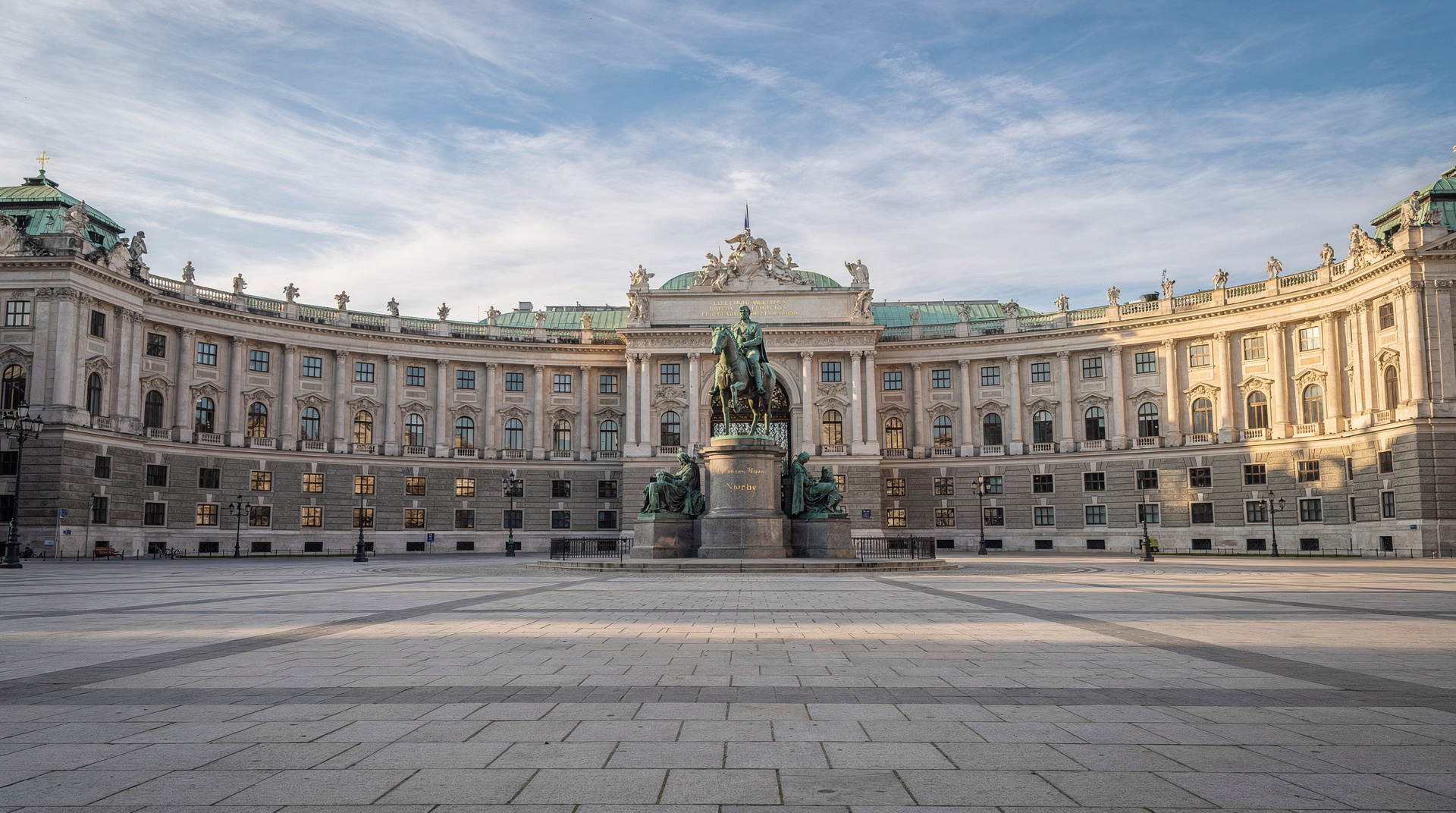
| Where | Hofburg Palace, entrance via Michaelerplatz, Innere Stadt |
| Cost | Around €17.50 (combined Sisi Museum + Apartments + Silver Collection) |
| Time needed | 45–60 minutes for the apartments; 2.5–3 hours for the full circuit |
| Getting there | U3 to Herrengasse or tram to Burgring, 5-minute walk |
| Best time | First hour after opening (9 am) or after 3:30 pm |
What you need to know before you go
Entry: From Michaelerplatz, through the Michaelerkuppel rotunda. The ticket desk and audio guide distribution are in the entrance hall. The complete circuit — Sisi Museum, then Imperial Apartments, then Imperial Silver Collection — is one-directional.
Ticket: Combined Hofburg ticket at €17.50 (Sisi Museum + Imperial Apartments + Imperial Silver Collection). Audio guide included.
Hours: Daily 9 am–5:30 pm. Closed major holidays.
Where to start: The route begins in the Sisi Museum (see our Sisi Museum guide for a room-by-room account) and continues into the apartments.
Through the Imperial Apartments
Franz Joseph’s rooms (Rooms 1–8)
The circuit moves through Franz Joseph’s private rooms before Elisabeth’s, which means you encounter the emperor’s world first: the waiting room where petitioners assembled each morning, the conference room where he received ministers, and the study where he actually worked.
The study is the most important room. It is small. The furniture is modest — a plain writing desk, bookcases with leather-bound files, a few family photographs. The camp bed is an iron frame with a thin mattress; he slept on it by choice, refusing more elaborate sleeping arrangements on the grounds that officers in the field did not have feather beds. The photographs of Elisabeth on his desk are arresting: he was devoted to a woman who spent most of their marriage avoiding him.
Franz Joseph worked seven days a week, received audiences from 5 am, and signed every significant state document personally until the day he died. The study makes this feel real in a way that facts alone cannot.
The Great Apartment (Rooms 9–14)
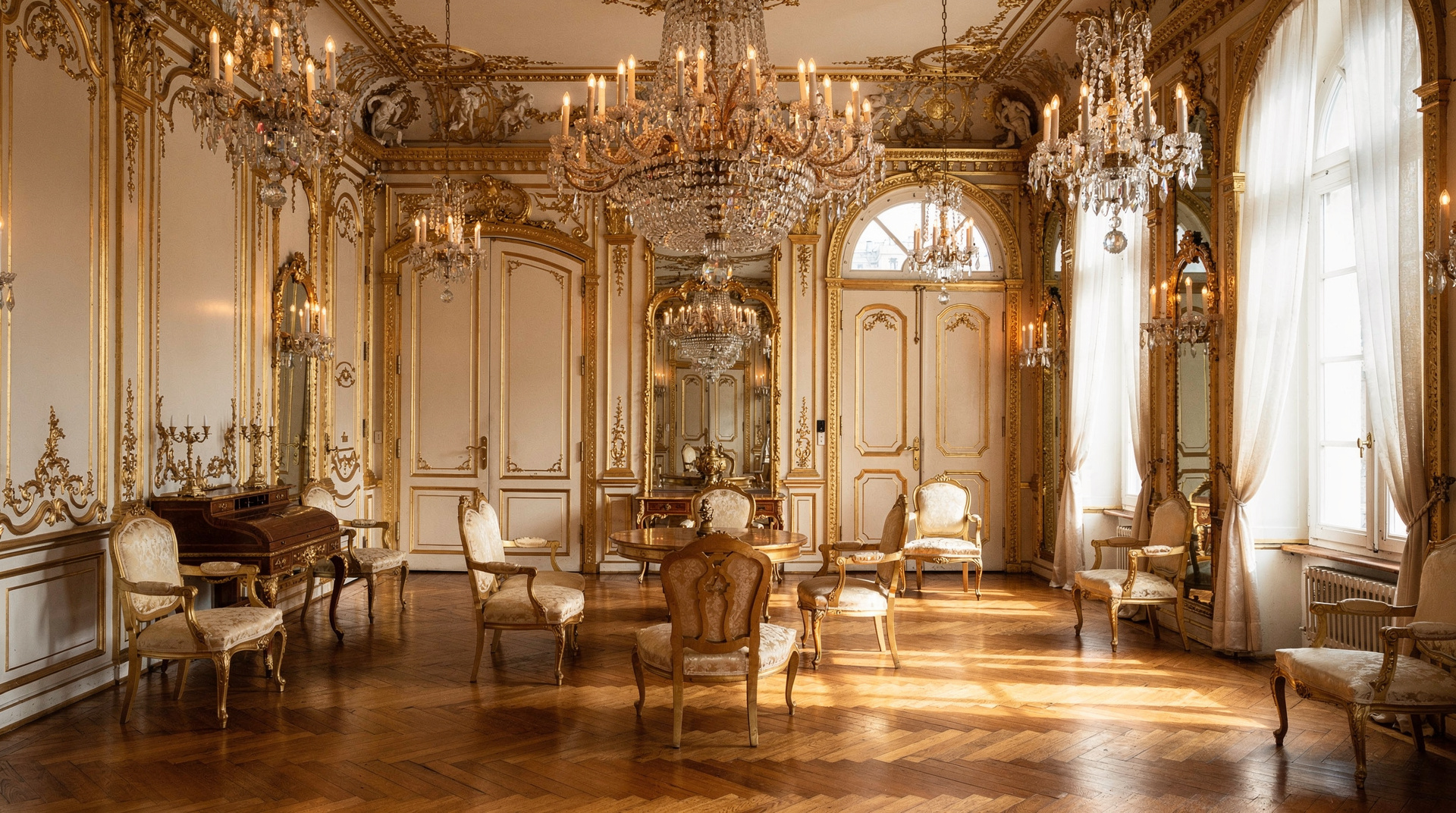
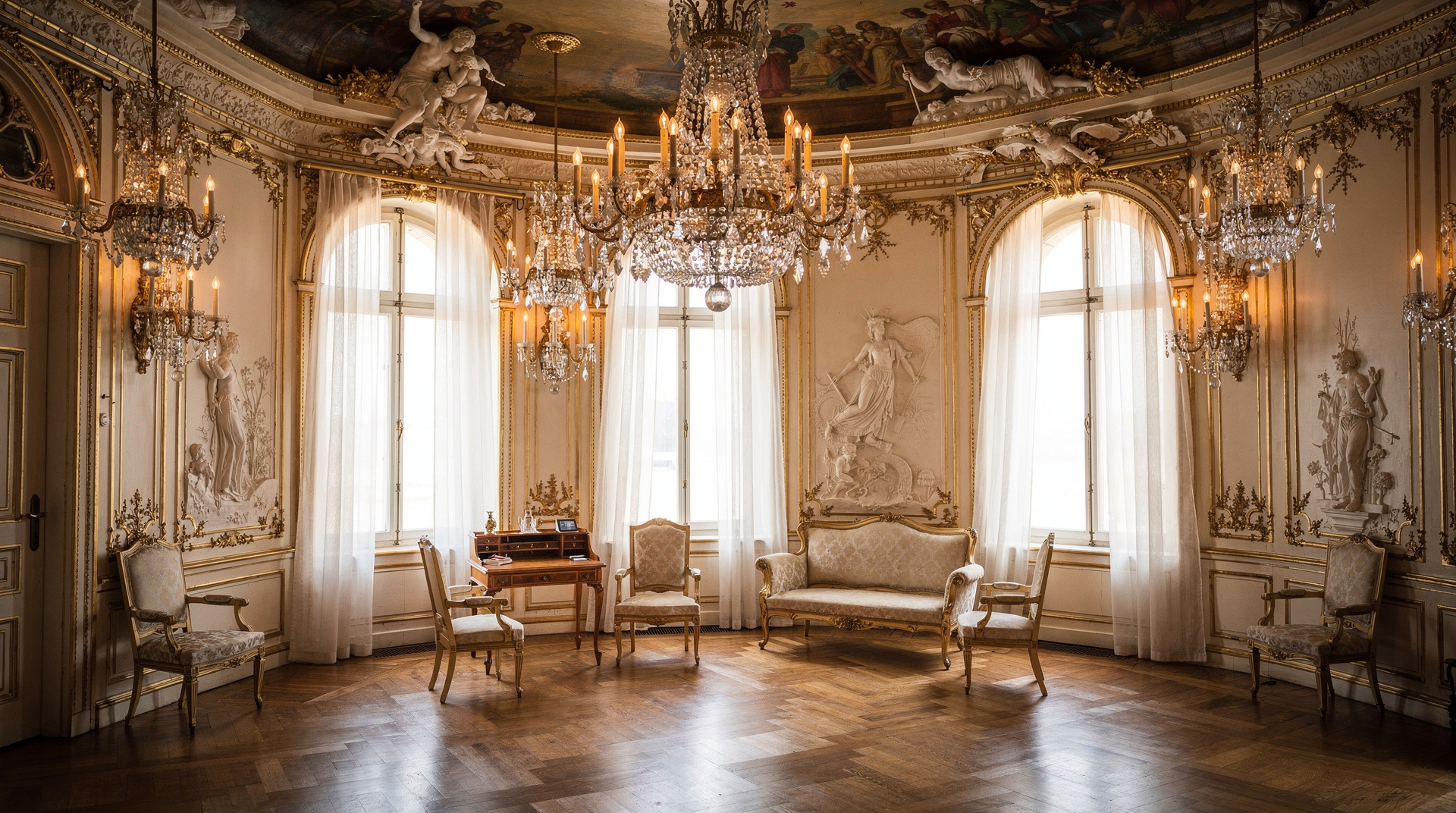
Moving eastward through the state rooms, the decoration becomes more elaborate — these were the ceremonial apartments used for official receptions, audiences with ambassadors, and court functions. The Large Salon contains portrait paintings of the Habsburg family, and the Small Salon has the famous portrait of Elisabeth by Franz Xaver Winterhalter (1865), showing her with diamond stars in her hair — the image that launched the Sisi myth and became one of the most reproduced royal portraits of the 19th century.
Elisabeth’s rooms (Rooms 15–22)
Elisabeth’s apartments are to the east of Franz Joseph’s and feel different in character. The gymnastics room — with rings, a horizontal bar, and records of her daily exercise regime — is one of the more historically unusual rooms in any European palace. She was considered eccentric for this; court ladies did not use parallel bars. She did not care.
Her dressing room contains the equipment used for the three-hour daily ritual of her hair — the specialized brushes, the hair oil, the personal hairdresser’s log of how many strands were lost at each session. The hair ritual was both vanity and anxiety: her ankle-length hair was one of her celebrated attributes, and its maintenance had become compulsive.
The rooms close with a sitting room that looks relatively normal — a place where she might actually have been comfortable — and then end. She was assassinated in Geneva in 1898. Franz Joseph lived in these apartments for another 18 years.
The Imperial Silver Collection
The Silver Collection (Silberkammer) continues the one-way circuit in a separate wing reached through a connecting corridor. It is often skipped by visitors who run out of energy after the apartments; this is understandable but regrettable.
The collection demonstrates how Habsburg state dinners actually functioned: complete banquet table arrangements set out to scale, showing how 140 metres of table would be laid for a major court dinner with vermeil flatware, Sèvres and Meissen porcelain, and Venetian glass. The logistical operation behind a Habsburg imperial banquet — hundreds of staff, months of preparation, a complete hierarchy of table placement — is vividly apparent.
The Napoleon Table Service — given by Napoleon to Empress Maria Louisa (his second wife and a Habsburg archduchess) — is the collection’s most historically loaded object. It ended up in Habsburg hands, a detail that says something about the century it inhabited.
Tickets and tours
Vienna: Sisi Museum, Imperial Apartments and Hofburg tour A guided tour is particularly valuable for the Imperial Apartments, where the family dynamics (Franz Joseph’s devotion, Elisabeth’s withdrawal, Rudolf’s death at Mayerling) provide the emotional context that makes the rooms intelligible. A good guide covers this in the 30 minutes the audio guide cannot.
Vienna: Hofburg and Empress Sisi Museum guided tourReading the rooms with context
The apartments reward a little preparation. If you know nothing about the dynasty, the sequence of waiting rooms, salons and studies can blur into one long corridor of period furniture. A short read of our Habsburg history for travelers before you arrive gives you the names, the marriages and the political pressures that the audio guide assumes you half-remember. It turns a portrait on the wall from a stranger into someone you have a view about.
Pay attention to what is missing as much as to what is there. There is very little of the gilded display you might expect from the most powerful family in central Europe. The modest desk, the plain bookcases and the narrow bed are deliberate choices made by a man who saw himself as the first civil servant of his empire. Once you notice that restraint, the contrast with the ceremonial rooms and with the Silver Collection becomes one of the most interesting threads of the whole visit.
For the two people at the centre of the story, the relationship is the real subject. Our Franz Joseph and Sisi guide traces how their marriage unfolded, and the Sisi Museum at the start of the circuit gives Elisabeth’s side of it. Walking the apartments with both in mind makes the separate sets of rooms feel like two people living parallel lives under one roof.
Combining the apartments with the rest of the Hofburg
The apartments sit inside a much larger complex, and it helps to decide in advance how much of it you want to take on in one day. Many visitors treat the apartments as the anchor and then add one other site nearby rather than trying to see everything. The Imperial Treasury is the natural companion for the dynasty’s ceremonial side. For a different kind of Habsburg tradition on the same grounds, the Spanish Riding School guide explains what the performances and training sessions involve, and whether they suit your plans.
If you would rather see how the Hofburg fits into the wider picture of the city, the Innere Stadt district page maps the surrounding streets, and our Ringstrasse architecture walk is a good way to spend the hour after your visit, since the boulevard was built as the Habsburgs’ showpiece of imperial confidence.
A sensible shape for the day is to take the apartments early while you are fresh, break for coffee in one of the nearby historic cafés, and keep the afternoon light. Our coffee-house etiquette guide will help you settle in without any awkwardness, and the long, unhurried stay that Viennese cafés encourage is a good way to absorb what you have just seen.
Planning the visit around your trip
Because the apartments take a good part of a morning, they slot most comfortably into a day with only one other fixed commitment. If you are still building your schedule, the three-day Vienna itinerary shows where the Hofburg fits alongside the other major sights, and the longer five-day Vienna itinerary gives you the space to pair it with Schönbrunn on a separate day. If you are working out how many days the city deserves in total, our how many days in Vienna guide helps you decide.
If you plan to visit several museums and palaces, check whether a pass makes sense for your plans before you buy individual tickets. Our Vienna Pass review walks through the logic, so you can judge whether the combined ticket here is better value for you on its own or as part of a larger bundle.
Making the most of the audio guide
The audio guide is included and worth using properly rather than as background noise. Treat it as a spine for the visit: listen to the main commentary in each room, then step back and look at the details it points toward. Visitors who play every optional track can find the circuit long, so it is fine to be selective, especially in the rooms you find less compelling. Linger instead in the study and in Elisabeth’s gymnastics room, where the objects speak for themselves.
If you are travelling with someone who has less patience for historical detail, agree on a few rooms that matter most to each of you before you go in. The one-way route means you cannot double back easily, so it helps to know where you want to slow down. A short pause in the quieter rooms, away from the tour groups, often gives the best sense of how small and private these spaces were meant to be.
Comparing Hofburg and Schönbrunn apartments
The question of which palace apartments to visit comes up for every visitor. Our honest recommendation: visit both on separate days if you have 3–4 days in Vienna. If you have only 2 days, choose based on what interests you:
- Hofburg apartments: Better if you want to understand the people who inhabited them. Franz Joseph’s camp bed and Elisabeth’s gymnastics rings are not in any way decorative — they are character statements.
- Schönbrunn apartments: Better if you want architectural grandeur. The Great Gallery, the Rococo interiors, and the gardens are more visually spectacular.
See our Schönbrunn Palace guide and the Franz Joseph and Sisi guide for deeper context on both.
Practical tips for visiting
Avoiding the queue: The Hofburg apartments are busiest between 10:30 am and 2:30 pm, especially in July and August when tour groups converge here after the Spanish Riding School’s morning exercise. Arriving right at 9 am opening, or after 3:30 pm, cuts the wait significantly — see our Hofburg Palace guide for the full complex layout and combined-ticket logic.
Pacing the visit: Because the circuit is one-directional, you cannot skip ahead to the Silver Collection if you are short on time — you must walk through the Sisi Museum and apartments first. Budget the full 2.5–3 hours if the Silver Collection interests you at all; rushing the apartments to “save time” for silver rarely feels worth it in practice.
With children: The apartments are more rewarding for children than most Habsburg sites because the story (an emperor who slept on an iron bed, an empress with gymnastics rings) is concrete rather than abstract. Pair the visit with the Prater amusement park afterwards to balance a morning of history with an afternoon of fun.
Beyond the Hofburg: If the personal, human side of the Habsburgs appeals to you here, the Imperial Treasury a few minutes’ walk away shows the same dynasty’s public, ceremonial face through the crown jewels — a useful contrast to visit on the same day.
Frequently asked questions about the Imperial Apartments
What is included in the Imperial Apartments ticket?
The combined Hofburg ticket (€17.50) covers three linked collections: the Sisi Museum, the Imperial Apartments (22 rooms), and the Imperial Silver Collection. All three are in the same building accessed from Michaelerplatz.
How long do the Imperial Apartments take?
The Imperial Apartments section takes about 45–60 minutes. Combined with the Sisi Museum and Silver Collection, allow 2.5–3 hours for the complete Hofburg experience.
What is the most interesting room in the Imperial Apartments?
Franz Joseph’s study — with its iron camp bed, the photographs of Elisabeth on his desk, and the documents he was working on the morning he died in 1916 — is the most revealing room in the Hofburg. The contrast between the spartan space and the immense power exercised from it is striking.
Are the Schönbrunn apartments better than the Hofburg apartments?
Different rather than better. Schönbrunn’s state rooms are more elaborately decorated (Baroque and Rococo with gilded surfaces), while the Hofburg apartments reflect Franz Joseph’s personal taste for austerity. Schönbrunn is more visually spectacular; the Hofburg is more historically intimate.
Can children visit the Imperial Apartments?
Yes. The rooms are not especially interactive, but children who have heard of Empress Sisi (from the films or musical) often find the rooms engaging. The gymnastics equipment in Elisabeth’s rooms is usually a hit.
Is there an audio guide for the Imperial Apartments?
Yes — an audio guide in 34 languages is included in the ticket price. It covers the Imperial Apartments section sequentially.
Top experiences
Bookable activities with verified prices and instant confirmation on GetYourGuide.