Vienna public transport guide: U-Bahn, tram and bus explained
Vienna City Card: Public Transport incl. 200+ discounts
How does Vienna public transport work?
Vienna's Wiener Linien network covers five U-Bahn lines, 30+ tram routes, and a bus network. Single tickets cost €2.40 (valid 1 hour); 24h passes €5.80; 72h passes €15.30. Validate paper tickets before boarding in the blue stamping machines — no validation needed for smartphone app tickets. The system is excellent and covers all major sights.
Vienna’s public transport: one of Europe’s best
Vienna’s Wiener Linien public transport system is consistently ranked among the best in Europe for coverage, frequency, and value. For a visitor spending three to five days in Vienna, the network covers every major sight, runs every 3–5 minutes on the U-Bahn during peak hours, and costs substantially less than comparable systems in London, Paris, or Zurich.
This guide explains the network, ticket options, validation rules (the most common point of confusion), and how to choose between transit passes.
| Where | 5 U-Bahn lines, 30+ tram routes, city-wide bus network |
| Cost | €2.40 single; €5.80–€15.30 for 24–72h passes |
| Validate | Blue stamping machines, paper tickets only — app tickets are pre-validated |
| Hours | ~5am–0:30am weekdays; 24h Fri/Sat nights |
| Best pass | 72h unlimited (€15.30) for a typical 3-day visit |
The U-Bahn network
Vienna has five active U-Bahn lines (a sixth, U5, is under construction and expected in the early 2030s):
U1 (red): Oberlaa — Leopoldau. Key stops for visitors: Wien Hbf (airport Railjet connection), Südtiroler Platz, Karlsplatz, Stephansplatz, Schwedenplatz, Praterstern. This line runs north-south through the heart of the city and is the most useful single line for most tourists.
U2 (purple): Karlsplatz — Seestadt (with some services to Aspern Nord). Key stops: Karlsplatz, Museumsquartier, Rathaus, Schottentor, Taborstrasse. Good for the Museumsquartier (Kunsthistorisches, Naturhistorisches), the Rathaus, and Vienna University area.
U3 (orange): Ottakring — Simmering. Key stops: Westbahnhof, Neubaugasse (7th district), Volkstheater, Herrengasse, Stephansplatz, Wien Mitte. Crosses U1 at Stephansplatz — the single busiest interchange in the network.
U4 (green): Hütteldorf — Heiligenstadt. Key stops: Hütteldorf, Schönbrunn, Pilgramgasse (Naschmarkt), Kettenbrückengasse (Naschmarkt), Karlsplatz, Wien Mitte, Schwedenplatz, Heiligenstadt. This is the essential tourist line: Schönbrunn at one end, the wine village district (Heiligenstadt) at the other, passing through Karlsplatz, the Naschmarkt area, and Wien Mitte.
U6 (brown): Siebenhirten — Floridsdorf. Key stops: Siebenhirten, Philadelphiabrücke, Längenfeldgasse (exchange with U4), Westbahnhof, Alser Strasse, Jägerstrasse, Handelskai, Floridsdorf. Less central for tourists but useful for reaching the 15th-22nd districts and connecting to the western suburbs.
U-Bahn practical notes
U-Bahn platforms are accessed through turnstile-free gates — ticket inspection is by plainclothes inspectors who randomly board trains. Validate paper tickets before descending to platform level in the blue stamping machines near the U-Bahn entrance (not on the platform itself).
U-Bahn frequency: every 3–5 minutes during peak hours (7–9 am, 4–7 pm), every 5–8 minutes off-peak, every 10–15 minutes after midnight.
Service hours: approximately 5 am to 0:30 am on weekdays. Friday and Saturday nights: the U-Bahn runs 24 hours.
The tram network
Vienna has 30+ tram (Strassenbahn) routes covering the city extensively. For tourists, the key tram lines:
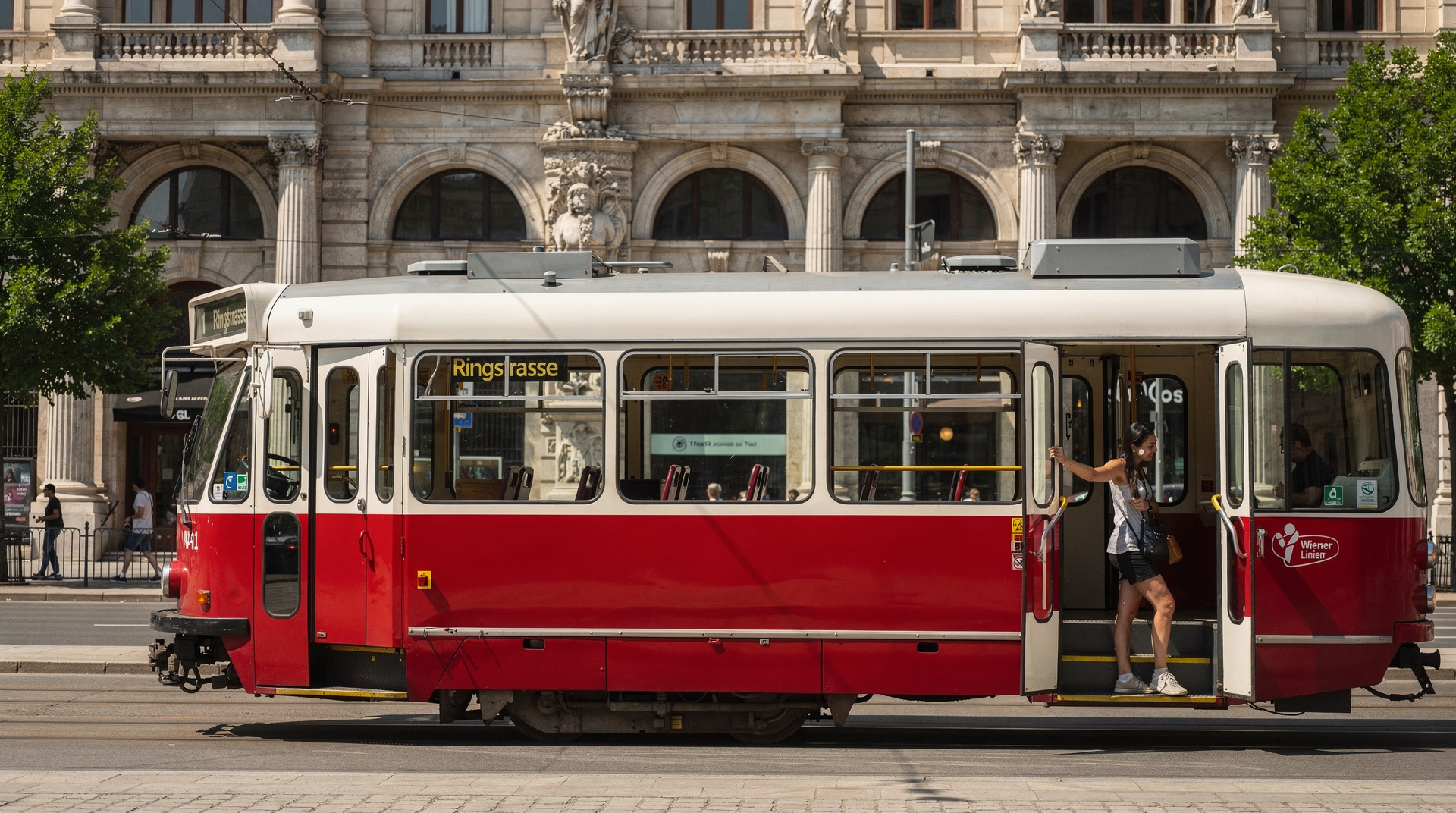
Tram 1 and 2 (Ring trams): Circle the Ringstrasse past the major Ringstrasse buildings — Staatsoper, Albertina, Kunsthistorisches, Parliament, Burgtheater, Rathaus. Excellent orientation circuits. Tram 1 is clockwise; tram 2 is anti-clockwise.
Tram D: From Südbahnhof through the 4th district to Grinzing via Beethovenplatz, Schwarzenbergplatz, and the 19th district. Useful for the Belvedere approach and the Grinzing wine village direction.
Tram 71: From Börse (Ringstrasse) to the Zentralfriedhof (Vienna’s vast cemetery, famous for the graves of Beethoven, Brahms, Schubert, and Strauss). A classic Vienna experience.
Tram 49 / Straßenbahn Linie 49: Connects Westbahnhof to the 14th district through the 7th district (Neubau).
Tram validation: validate paper tickets in the blue machines inside the tram carriage when boarding (not at stops). Low-floor trams (ULF models) have the machines near the doors; older trams near the driver.
Night transport
After U-Bahn service ends (around 0:30 am on weekday nights), Vienna’s Nachtbus (Night Bus) network of about 30 N-routes takes over. Night buses operate from 0:30–5:30 am on Friday and Saturday nights the U-Bahn runs 24 hours so night buses are less needed.
Night buses use standard Wiener Linien tickets — the same tickets or passes you use during the day are valid on night buses.
Ticket types and prices (2026)
| Ticket | Price | Coverage |
|---|---|---|
| Single (Einzelkarte) | €2.40 | 1 journey, unlimited transfers, 1h |
| 24-hour pass | €5.80 | 24h unlimited |
| 48-hour pass | €10.30 | 48h unlimited |
| 72-hour pass | €15.30 | 72h unlimited |
| 7-day pass (Wochenkarte) | €17.10 | 7 days unlimited |
| Vienna City Card 24h | €17 | 24h transit + 200+ discounts |
| Vienna City Card 48h | €25 | 48h transit + 200+ discounts |
| Vienna City Card 72h | €29 | 72h transit + 200+ discounts |
| Single (short trip, Kurzstrecke) | €1.50 | 2 stops (U-Bahn) or 5 stops (tram/bus) |
Which ticket is right for you?
2-day visit: 48h pass (€10.30) or Vienna City Card 48h (€25 if using many attractions).
3-day visit: 72h pass (€15.30) — the most common tourist purchase. Vienna City Card 72h (€29) if you plan to visit 5+ paid attractions with applicable discounts.
4–7 day visit: 7-day pass (€17.10) is better value than extending daily passes.
Just a few journeys: Singles (€2.40 each). The Kurzstrecke (€1.50) is only valid for very short hops.
Vienna City Card: public transport plus 200+ attraction discountsVienna City Card: is it worth it?
The Vienna City Card combines unlimited transit (U-Bahn, tram, bus, night bus) with discount vouchers at 200+ attractions. The discounts range from 10% to 30% off entrance fees at museums, concert venues, Heuriger wine taverns, and restaurants.
It is worth it if: You plan to visit 4+ paid attractions in a day (Schönbrunn, Belvedere, Kunsthistorisches, Spanish Riding School morning exercise), AND use transit frequently.
It is not worth it if: You plan mostly free sights (gardens, Stephansdom nave, Ringstrasse walk), in which case the simpler 72h transit pass saves €13.70.
The break-even math: 72h pass costs €15.30. Vienna City Card 72h costs €29. The difference is €13.70. If your attraction discounts across 3 days add up to more than €13.70, the City Card pays off. For typical first-timer itineraries visiting 3+ museums and one concert, it does.
See our detailed Vienna City Card review.
The critical validation rule
This is the most important practical information in this guide. Paper tickets must be validated before boarding. Failing to validate is treated the same as having no ticket — a €105 on-the-spot fine from plainclothes inspectors.
How to validate:
- U-Bahn: blue stamping machines at the entrance to each U-Bahn station (before descending to the platform). Insert ticket, hear a beep, ticket is stamped.
- Trams: blue machines inside the tram carriage, near the doors. Board first, then stamp immediately.
- Buses: blue machines near the driver or doors inside the bus. Board and stamp.
Smartphone app tickets: Tickets bought and activated in the Wiener Linien app are pre-validated. No stamping needed. This is the most convenient option for many visitors.
Day/multi-day passes: Need to be validated only once on first use. The machine stamps the date and time; the pass is then valid from that moment for 24/48/72 hours.
Where to buy tickets
- Wiener Linien app: Easiest. Buy and activate on your phone. Accepts major credit cards.
- Blue ticket machines: At every U-Bahn station entrance. Accept cash (coins and notes) and cards.
- Tram/bus ticket machines: Some tram stops have machines; most do not. Buy before boarding.
- Tobacco shops (Trafik): The traditional way — available at Trafikanten (tobacco/magazine shops) throughout the city.
- Vienna Airport: Wiener Linien machines at the S-Bahn platform for city transit tickets.
Hop-on Hop-off vs. U-Bahn
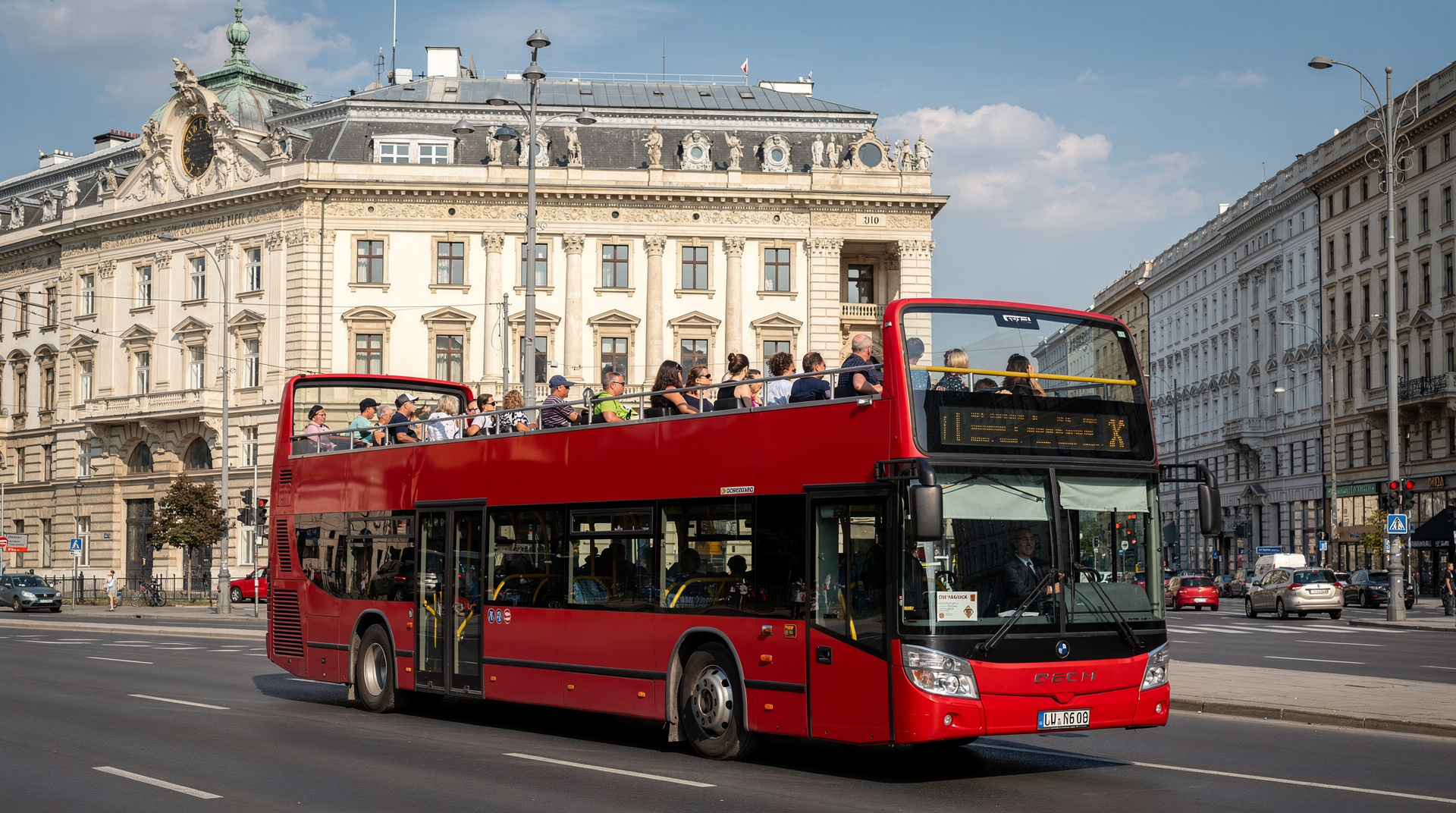
Vienna’s Hop-on Hop-off bus tours cover the Ringstrasse sights with commentary in 19 languages and are genuinely useful for a first afternoon’s orientation — seeing the layout of the Ringstrasse while getting an audio guide to the buildings. They are not a replacement for the U-Bahn for actual daily transport.
See our comparison guide Hop-On Hop-Off vs Vienna metro for the detailed analysis. If you like the idea of an orientation loop with commentary on your first afternoon, a hop-on hop-off sightseeing bus with audio in 19 languages is the straightforward way to do it, and you can then switch to the U-Bahn for everything else.
Travellers who want transit and sightseeing discounts in one card also have alternatives to the City Card. Another option is a Welcome Card bundling public transport with discounts, which follows the same logic and is worth comparing before you buy; our Vienna Pass vs FLEXI vs City Card comparison and the Vienna Pass review lay out how the options differ.
Key routes for tourists
| From | To | Best option |
|---|---|---|
| Airport (VIE) | Wien Hbf | Railjet (€4.40, 16 min) |
| Wien Hbf | Schönbrunn | U1 to Karlsplatz, change U4 (10 min) |
| Wien Hbf | Stephansplatz | U1 (2 stops, 4 min) |
| Wien Hbf | Belvedere | U1 to Südtiroler Platz (2 min walk to Belvedere lower gate) |
| Stephansplatz | Museumsquartier | U3 to Volkstheater (3 stops) |
| Stephansplatz | Naschmarkt | U4 from Schwedenplatz to Kettenbrückengasse (3 stops) |
| Karlsplatz | Prater/Riesenrad | U1 to Praterstern (3 stops) |
| Heiligenstadt | City centre | U4 (wine village train, 15 min) |
Using transit to reach the big sights
The network is at its best when you plan each day around one or two lines. A palace day pairs naturally with the U4: the Schönbrunn Palace guide explains what to see once you arrive, and the Belvedere Palace guide does the same for the other great Habsburg-era garden complex. For a museum-heavy day, the U2 and U3 lines bring you close to the Museumsquartier, while the Ring trams make a relaxed way to see the Ringstrasse without walking all of it.
If you are building a first itinerary, the 3-day Vienna itinerary is a good match for the 72h pass, since it groups sights by neighbourhood and keeps the number of transfers low. Evening plans such as a concert are easy to reach by U-Bahn, but check the last-service times above before you commit to a late finish.
Using transit for day trips and beyond the centre
Wiener Linien tickets cover the city, not the destinations outside it, so plan day trips separately. The best day trips from Vienna guide shows which excursions leave from Wien Hbf or Wien Mitte, and the Bratislava day trip and Wachau day trip guides explain how to reach them. For the wine villages, the Grinzing destination page and the Heuriger guide show what to expect once the tram or U4 drops you off.
Families will find that the network is easy with a pushchair, since most stations have lifts and low-floor trams are common; see accessible Vienna and Vienna with kids for the practical details. Travellers heading to the Prater can follow the Prater amusement park guide, and anyone who wants help placing transit within a longer stay can use the Vienna in 4 days itinerary.
Getting to and from the airport
Vienna’s public transport network extends cleanly to Vienna International Airport (VIE), though the fastest connection (the CAT airport express) is a separate ticket from the standard Wiener Linien network. The Vienna airport to city guide covers all the options in detail, and the head-to-head CAT vs Railjet vs bus comparison is worth reading before you land — the cheapest option (the S-Bahn/ÖBB Railjet at €4.40) uses standard Wiener Linien-adjacent ticketing and is usually the best value choice for most visitors.
Once you’re set on tickets and routes, the remaining question is usually how much transport you’ll actually need. The how many days in Vienna guide and Vienna on a budget guide both factor transit costs into a realistic daily budget, and can help you decide between a 72h pass and the pricier Vienna City Card covered above.
Frequently asked questions about Vienna public transport
Do I need to validate my ticket on Vienna public transport?
Yes, for paper tickets. Insert in the blue stamping machine before boarding. Smartphone app tickets are pre-validated. Failure to validate carries a €105 fine.
What is the cheapest way to get around Vienna as a tourist?
The 72-hour unlimited pass (€15.30) is best for a 3-day visit. The Vienna City Card (€17–29) adds 200+ attraction discounts but costs more. Singles (€2.40) only suit 1–2 journeys.
Which U-Bahn lines serve the main tourist sights?
U4: Schönbrunn and Naschmarkt. U1: Stephansplatz and Wien Hbf. U2: Museumsquartier and Rathaus. U3: Stephansplatz and Wien Mitte.
Is Vienna’s public transport safe at night?
Yes. The U-Bahn runs to 0:30 am on weekdays and 24 hours on Friday–Saturday nights. Night buses cover all major routes on weekday nights.
Can children travel free on Vienna public transport?
Children under 6 travel free at all times. Children aged 6–15 travel free on Sundays, public holidays, and during school holidays with adult accompaniment.
Top experiences
Bookable activities with verified prices and instant confirmation on GetYourGuide.