MUMOK Vienna guide: modern art at the Museumsquartier
Vienna: Upper Belvedere & Permanent Collection Entry Ticket
Is MUMOK worth visiting in Vienna?
MUMOK is Vienna's primary museum of international modern and contemporary art — Fluxus, Pop Art, Nouveau Réalisme, Vienna Actionism, and contemporary installation and painting. Worth visiting for anyone interested in post-war international art. For purely Austrian art (Klimt, Schiele), the Leopold Museum or Belvedere are stronger. Tickets are around €14; allow 1.5–2 hours.
MUMOK and Vienna’s relationship with international contemporary art
Vienna’s relationship with international contemporary art is more complex than it might appear. The city dominated European modernism through the Vienna Secession (from 1897) and produced some of the 20th century’s most significant artistic careers (Klimt, Schiele, Kokoschka). But from the 1920s through the post-war period, Vienna was largely outside the main channels of international contemporary art — which ran through Paris, New York, and Düsseldorf.
MUMOK exists partly to address this: it is the institution that connects Vienna’s exceptional local art history to the international post-war movements, and that holds the works by Warhol, Lichtenstein, Rauschenberg, and Klein that allow visitors to understand 20th century art as a single connected story rather than a set of national chapters.
| Where | Museumsplatz 1, Museumsquartier |
| Cost | Around €14 adults |
| Time needed | 1.5–2 hours |
| Getting there | U2 Museumsquartier or U3 Volkstheater |
| Best paired with | Leopold Museum |
The MUMOK building — a dark basalt lava cube that forms an architectural counterpoint to the Leopold Museum’s white limestone — is immediately distinctive in the Museumsquartier. The contrast between the two materials makes the cultural boundary between the two collections visible before you enter either.
The permanent collection: what to focus on
American Pop Art
The Ludwig Collection donation that forms the backbone of MUMOK’s permanent holdings includes major American Pop Art works: Andy Warhol screen prints and paintings, Roy Lichtenstein comics-derived canvases, Robert Rauschenberg combines, Jasper Johns flags and maps. These works — which transformed European art consciousness when they first appeared in the early 1960s — are well-represented here.
The Warhol works are the most immediately popular. The Rauschenberg combines — three-dimensional assemblages incorporating everyday objects with paint — are the most formally radical and the most interesting to spend time with.
European movements: Fluxus and Nouveau Réalisme
MUMOK holds significant examples of Fluxus — the international movement that sought to dissolve the boundary between art and life, often through performance and the use of everyday objects as art materials. Yoko Ono, Nam June Paik, Joseph Beuys, and Dieter Roth are among the Fluxus-adjacent artists represented.
The Nouveau Réalisme works (Jean Tinguely, Niki de Saint Phalle, Yves Klein) are among the strongest holdings in this section. Klein’s monochromes — the IKB (International Klein Blue) works — are particularly striking and tend to create strong viewer responses.
Vienna Actionism documentation
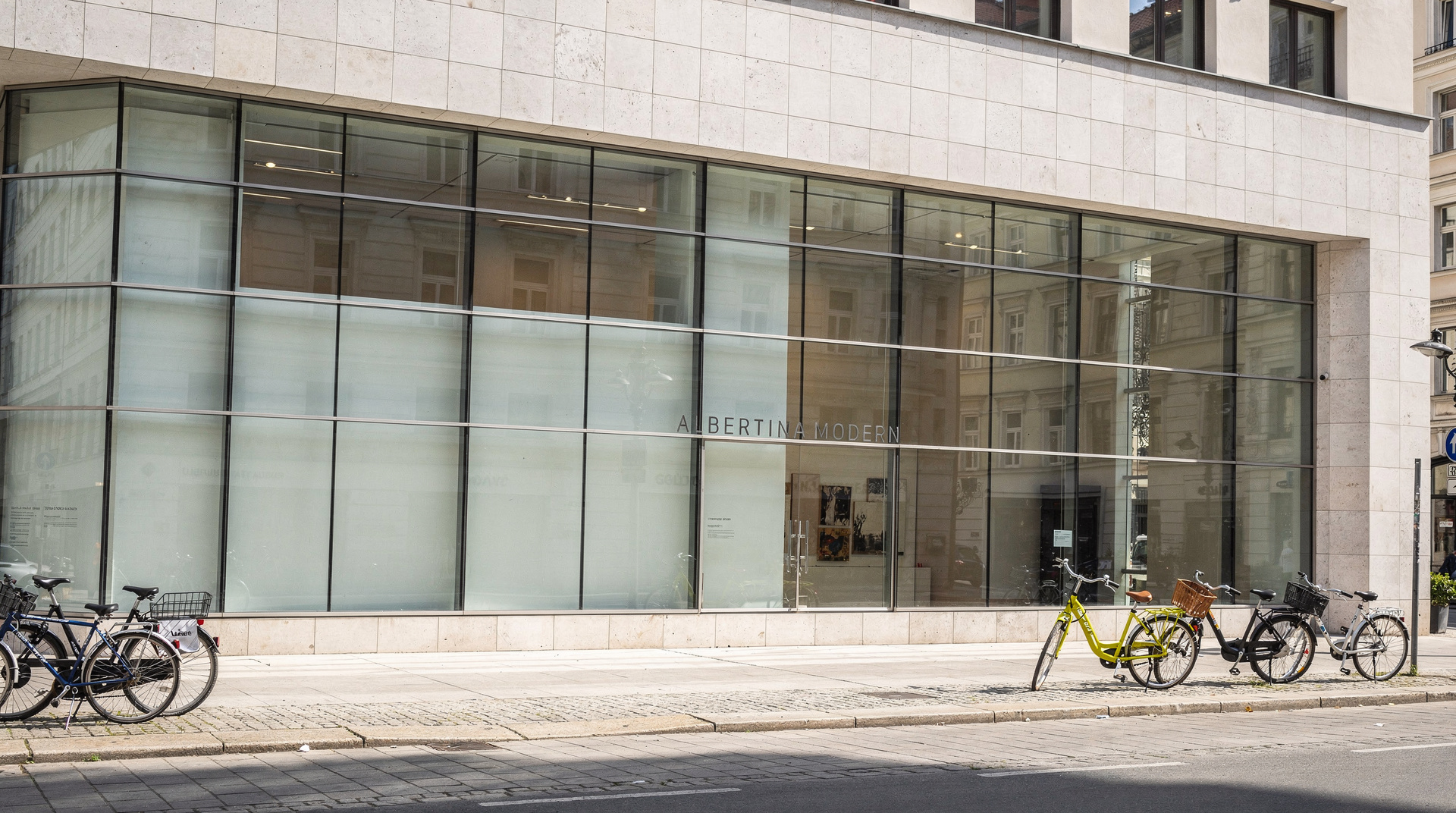
Like Albertina Modern, MUMOK holds significant documentation of Vienna Actionism. The collections complement each other: MUMOK’s Actionism material tends toward documentation (photographs, film, manifestos) while Albertina Modern’s holdings include more original materials.
For visitors interested in the Actionism movement in depth, visiting both institutions gives the most complete picture.
Contemporary art
The upper floors of MUMOK include rotating presentations from the contemporary collection: painting, sculpture, installation, and video art by Austrian and international artists working from the 1990s to the present. The contemporary section changes regularly and is the most variable in terms of specific works on display during any given visit.
The Museumsquartier context
MUMOK is one of several cultural institutions in the Museumsquartier campus, which also includes the Leopold Museum, the Kunsthalle Wien (temporary exhibitions only, no permanent collection), the architecture museum (Az W), and the Wien Museum’s children’s museum (Zoom). The central courtyard — one of the largest cultural courtyards in Europe — is a gathering place for Vienna residents on evenings and weekends.
The combination of Leopold Museum (Austrian modernism, Schiele/Klimt) + MUMOK (international post-war art) in one afternoon covers the key terrain of 20th-century art. The courtyard between them is a natural break point. For deeper background on the Vienna Secession movement that the Leopold Museum documents and that MUMOK’s collection picks up from historically, see the Schiele and Vienna Secession guide.
How to look at the collection without getting lost
Post-war art can feel closed to visitors who arrive without a map, and MUMOK is not a museum that explains itself through spectacle. A few habits make the visit far more rewarding. Begin by choosing one movement and following it properly rather than trying to see every gallery with equal attention. If Pop Art is what drew you, give the American works your best energy and treat the rest as context. If you came for the stranger edges of the century, start with Fluxus and Nouveau Réalisme and let the Pop material be the contrast.
Read the wall texts before the objects when a work puzzles you. Much of what MUMOK holds was made to question what art is allowed to be, so the idea behind a piece often matters as much as its surface. A Fluxus score, a combine assembled from found objects or a monochrome that looks like nothing at first all become more interesting once you know what argument the artist was making. Then look again: the second look is usually where the work starts to land.
Give yourself permission to move quickly through rooms that do not speak to you. A museum like this is best taken as a series of encounters rather than a march. Sit down when the gallery offers a bench, and let a single piece have a few quiet minutes. Visitors who treat MUMOK like a checklist tend to leave tired; visitors who pick a handful of works and stay with them tend to leave with something they remember.
If you are comparing the city’s modern art offer, the Albertina Modern guide explains how that museum approaches the same century from a different direction, which helps you decide whether to see one or both.
Who will enjoy MUMOK most
MUMOK suits curious travellers who like to think about what they see. It is a good fit for people who already enjoy modern art in other cities and want to see how Vienna tells the story. It also suits repeat visitors who have finished the headline sights and want something with more intellectual bite than another palace interior. Anyone who liked the Secession story at the Leopold Museum and wonders what happened next will find the answer here.
It is less natural for travellers who prefer atmosphere and beauty over argument. If your ideal museum is a room of glowing gold and famous faces, the Kunsthistorisches Museum guide and the Belvedere Palace guide will serve you better. And for families, the Vienna with kids guide points to places better suited to younger visitors than the Actionism documentation.
Couples and friends with different tastes often find MUMOK works well precisely because it sparks conversation. Few galleries in the city give you as much to disagree about over coffee afterwards, and that, rather than any single masterpiece, is much of its appeal. If you are planning a romantic trip, the Vienna honeymoon guide has ideas for balancing culture with slower moments.
The building as part of the visit
Do not rush past the architecture. The dark basalt-clad volume is a deliberate statement, and its interior is arranged so that the galleries feel like a sequence of large, calm spaces rather than a maze of small rooms. That scale suits big canvases, installations and video works, which need room to breathe. Notice how the light changes as you move between floors, and how the windows occasionally frame views back toward the courtyard and the surrounding city.
The exterior is also worth a pause on the way in or out. In the right light the stone reads almost black and sets off the pale Leopold Museum beside it, which is why the pairing is so popular with people who enjoy architecture and city photography. For more ideas on where to take good pictures around town, see the Vienna photography spots guide.
Planning around weather and crowds
The Museumsquartier is a place where the weather quietly shapes the day. On a bright day the courtyard fills with people and the temptation to stay outside is strong, so a morning at MUMOK followed by a long, unhurried lunch outdoors is a natural rhythm. On a grey or wet day the museums become the obvious plan, and the galleries can feel busier as other visitors reach the same conclusion. In that case, arriving early or visiting later in the evening on the longer-opening day gives you more space.
Seasonal timing matters too. Our best time to visit Vienna guide explains how the city’s rhythm shifts through the year, and the Vienna in winter guide is especially useful if you are building a museum-heavy trip for the colder months, when indoor culture does most of the work.
Getting around before and after
The Museumsquartier sits within easy reach of the main sights, which makes it simple to combine with other plans. Our Vienna public transport guide covers how to move between districts, and the Innere Stadt destination page is a good next stop for what lies on the other side of the ring. If you want to understand the grand boulevard you cross on the way, the Ringstrasse architecture walk turns the journey itself into part of the day.
After the museum, many visitors drift toward a coffeehouse to talk over what they saw. The Viennese coffee house guide will help you choose one that suits your mood, whether you want a grand historic room or something quieter.
Vienna Actionism: understanding the movement before you go
Vienna Actionism (Wiener Aktionismus) is the local movement that MUMOK’s documentation most directly connects to the international post-war story, and it rewards a little preparation before your visit. Active roughly from 1960 to 1971, the four core Actionists — Günter Brus, Otto Muehl, Hermann Nitsch, and Rudolf Schwarzkogler — staged performances involving the body, blood, and ritualised destruction that were deliberately confrontational responses to Austria’s postwar silence about its Nazi-era past.
The material MUMOK holds is largely photographic and filmic documentation of these performances rather than conventional artworks, since the performances themselves were the primary artistic act. Some visitors find this material genuinely difficult; the museum’s labelling is clear about content, and there is no obligation to linger in this section if it isn’t for you. Understanding the historical context — postwar Austria’s reckoning with its recent past — makes the material considerably more legible than encountering it cold.
A practical museum day: MUMOK and the wider Museumsquartier
A well-paced day starts at MUMOK in the morning (when it’s quietest), moves to the Leopold Museum for the Austrian modernist counterpart after lunch in the courtyard, and finishes with a walk through the Museumsquartier’s smaller spaces if time allows. For visitors building a broader Vienna museum itinerary, our best museums in Vienna guide ranks MUMOK alongside the city’s other major collections and helps decide how much museum time to budget across a multi-day stay — see also the Vienna 3-day itinerary for how a Museumsquartier morning fits alongside the rest of the city’s essential sights.
Vienna: Upper Belvedere and permanent collection entry ticketThe Belvedere’s Upper Belvedere is the complementary institution for Austrian art before MUMOK’s time period — Klimt, Schiele, and 19th-century Austrian painting.
Tickets for the Albertina exhibitionsThe Albertina Modern at Karlsplatz provides the bridge between the Vienna Secession period (Leopold Museum) and the post-war period (MUMOK) — its collection of 1920s–1960s Austrian art completes the picture.
Honest assessment
MUMOK is a serious museum for serious museum visitors. It is not primarily oriented toward tourists — its permanent collection does not have a single iconic work equivalent to Klimt’s The Kiss or the Venus of Willendorf. The reward comes from engaging with a coherent art-historical argument about the post-war period rather than from a sequence of masterpieces.
For visitors who have seen the essential Vienna sites (KHM, Belvedere, Schönbrunn) and want to extend their museum time into contemporary art, MUMOK is the right next step. For first-time visitors with limited time, the Leopold Museum and Belvedere are the Museumsquartier priorities.
Thursday evening (open until 9 pm) is the quietest time to visit. The permanent collection galleries in the late afternoon are rarely crowded.
Frequently asked questions about MUMOK
What is MUMOK?
MUMOK (Museum Moderner Kunst Stiftung Ludwig Wien) is Austria’s largest museum of modern and contemporary art, in the Museumsquartier. Its collection focuses on international art from 1900 to the present.
What is the permanent collection at MUMOK?
American and European Pop Art (Warhol, Lichtenstein, Rauschenberg), Fluxus, Nouveau Réalisme, Vienna Actionism, and contemporary international painting, sculpture, and installation.
Where is MUMOK in Vienna?
Museumsplatz 1, Museumsquartier — U2 to Museumsquartier (2 minutes) or U3 to Volkstheater (5 minutes).
Is MUMOK suitable for children?
Pop Art and Fluxus sections are often engaging for teenagers. Vienna Actionism documentation can be graphic. Children under 10 generally find Haus der Musik or the Naturhistorisches Museum more engaging.
How does MUMOK compare to the Leopold Museum?
MUMOK focuses on international post-war art; Leopold on Austrian Expressionism (Schiele, Klimt). Complementary rather than overlapping.
When does MUMOK close?
Closed Mondays. Open Tuesday–Sunday 10 am–6 pm; Thursday 10 am–9 pm.
Top experiences
Bookable activities with verified prices and instant confirmation on GetYourGuide.