Český Krumlov
Day trip from Vienna to Český Krumlov: the UNESCO castle town in South Bohemia, the Vltava river bend, how long it takes and whether the journey is worth
From Vienna: Cesky Krumlov Small-Group Guided Day Trip
Quick facts
- Distance from Vienna
- 230 km (3h30 by bus or organised tour)
- Bus
- FlixBus or RegioJet from Wien Erdberg, 3h30
- Currency
- Czech Koruna (CZK) — 1€ is approximately 25 CZK
- UNESCO status
- World Heritage Site (1992)
The medieval jewel of South Bohemia
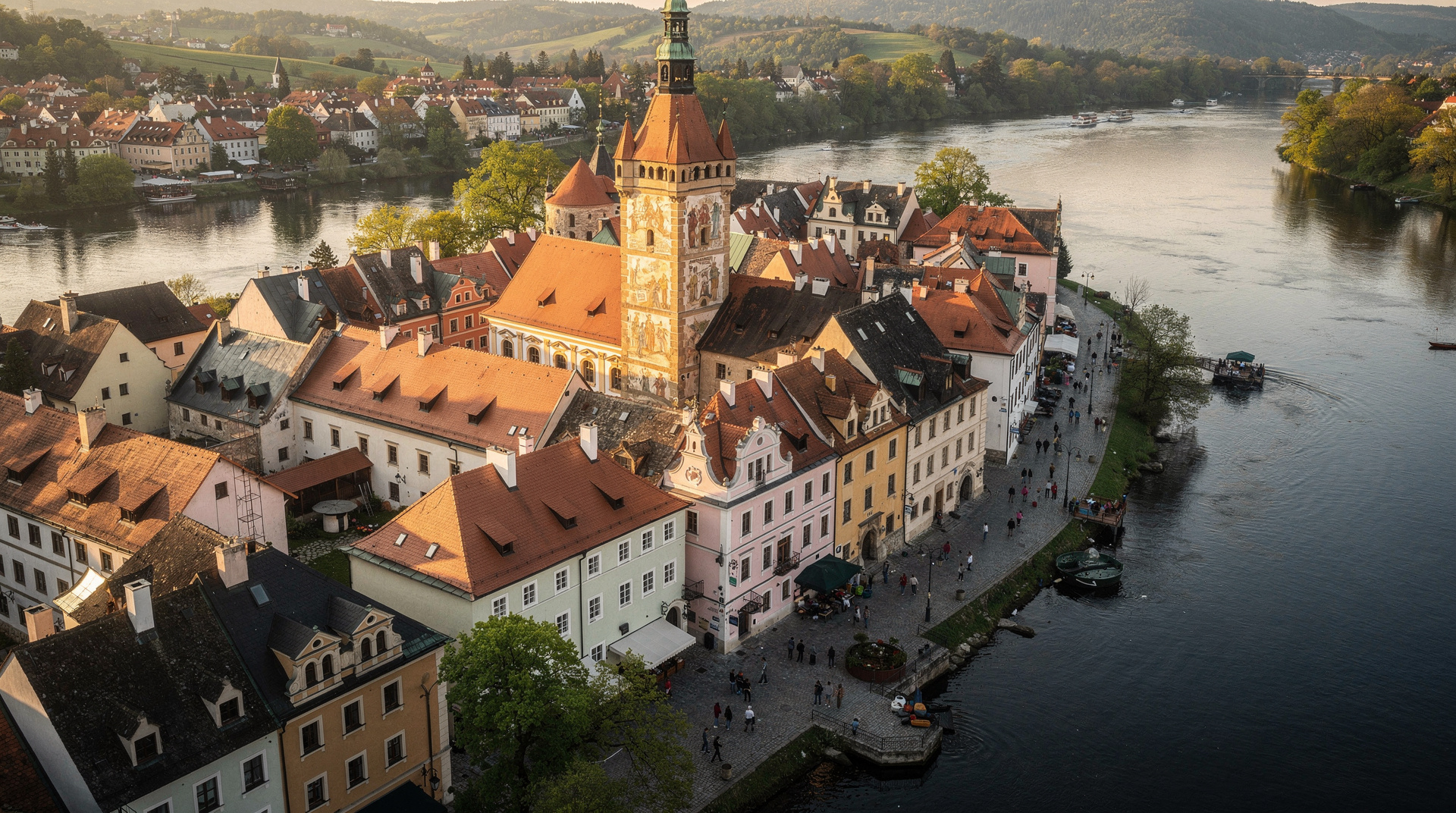
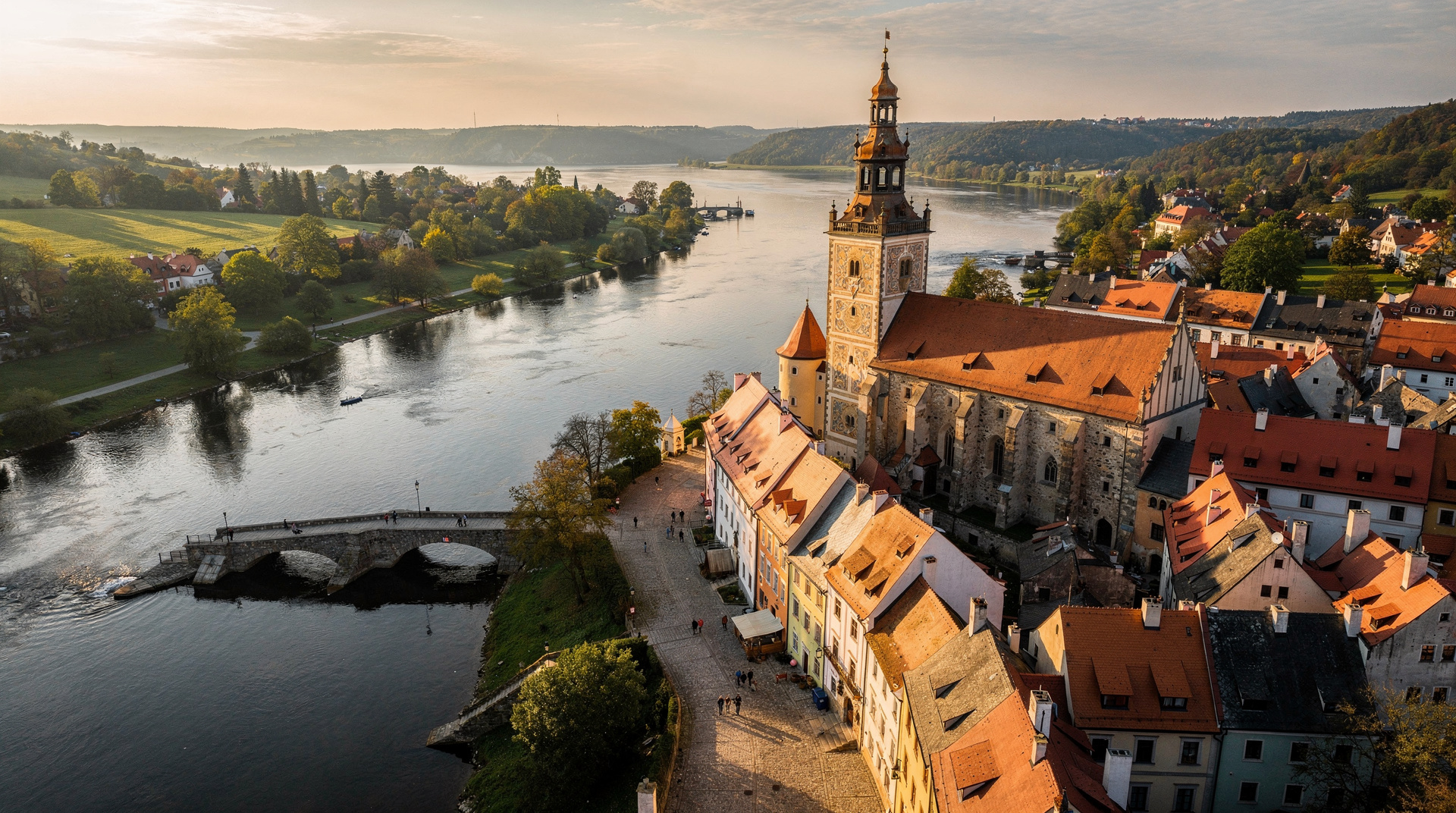
Český Krumlov is a small town in the Czech Republic where a 13th-century castle rises on a rocky promontory above a horseshoe meander of the Vltava River — the same river that flows through Prague, 180 km to the north. The meander wraps almost entirely around the old town, creating a natural moat that left the medieval street plan essentially unchanged for five centuries. UNESCO designated it a World Heritage Site in 1992, recognising what is evident from the first glimpse: this is the most spectacular small medieval town in the Czech Republic after Prague itself, and one of the best-preserved in Central Europe.
| Where | South Bohemia, 230 km from Vienna |
| Cost | Castle tours around 200–350 CZK; old town free to walk |
| Time needed | Full day (7 hours travel round trip) |
| Getting there | FlixBus/RegioJet from Wien Erdberg, 3h30, or guided tour |
| Best time | May–June and September |
For visitors based in Vienna, Český Krumlov is 3h30 by bus — a genuine day trip, though a long one by any measure. Whether the journey is worth it depends largely on what you are travelling for. If your Vienna visit is your first encounter with Central European baroque grandeur, Krumlov will feel redundant — you have just come from one of the most architecturally rich cities on earth. If you have spent several days in Vienna and want the opposite — a small, medieval, unhurried place where the castle above the river bend is the entire point — the journey makes complete sense.
It is also, as discussed below, the most efficient stopping point on the overland route from Vienna to Prague.
Getting there
By organised tour from Vienna: The most practical option for a single day. A small-group day trip departs early from Vienna, arrives at Český Krumlov mid-morning, includes a guided tour of the old town and castle grounds, and returns by early evening. The logistics — border crossing, parking in the old town’s limited zone, navigating Czech bus connections — are handled entirely.
The Český Krumlov small-group guided day trip from Vienna covers the main sights with transport and a guide — the recommended approach given the 7-hour total journey commitment involved in independent travel each way.
A private day trip from Vienna to Český Krumlov gives families or small groups flexibility and a personal guide, with the option to spend more time on aspects that interest you most.
By bus independently: FlixBus and RegioJet both operate from Wien Erdberg bus station (U3 line, Erdberg stop) toward Český Krumlov, though services often require a change at Linz or České Budějovice — check current schedules carefully, as they change seasonally. Journey time approximately 3h30 including connections when the service is direct.
Currency note: The Czech Republic uses the Czech Koruna (CZK), approximately 25 CZK to 1€. Cash is useful in smaller restaurants and for castle tickets; credit cards are accepted at the main ticket offices. Many tourist restaurants in the old town accept euros but at an unfavourable rate — use CZK where possible.
Český Krumlov works best as a stop on the way between Prague and Vienna rather than a return trip from either, because the return leg doubles a drive you have already made: a private one-way transfer from Český Krumlov to Vienna is what makes that itinerary linear.
What to see
Český Krumlov Castle — the second largest castle complex in the Czech Republic after Prague Castle, founded in the 13th century and expanded through five successive centuries of ownership by the Rosenberg, Habsburg, and Schwarzenberg families. The scale of the complex is immediately impressive: it consists of 40 buildings across five interconnected courtyards, rising up the promontory in tiers with the castle tower and the baroque theatre at the summit.
Of the castle’s 40 exhibition halls, a number are open to the public on guided tours. Tour Route I — the state apartments and baroque theatre — is the most popular, taking approximately 50 minutes with a guide. The highlight is the baroque theatre, which retains its original 18th-century stage machinery almost entirely intact — the counterweights, the wing-and-groove sets, the painted backdrops, the trapdoors and flying apparatus. Very few comparable theatres in Central Europe have survived to this degree of completeness. Book the theatre tour in advance in summer, as timed-entry numbers are limited.
The castle gardens above the main complex are free to enter via the upper castle ramparts. They contain the most celebrated view of Český Krumlov: looking back down from the formal garden over the castle complex, the rooftops of the old town in the meander below, and the wooded hills closing in on all sides. This is the definitive image of the town and is best in morning light before the coach-tour crowds arrive from Prague.
The old town within the Vltava meander is compact — about 15 minutes to walk end to end — with a central square (Náměstí Svornosti), medieval arcaded houses in pastel colours, the Gothic Church of St. Vitus, and a concentration of restaurants and wine bars. The streets are genuinely medieval in their width and texture, though heavily oriented toward tourism in peak summer. The best way to experience the town’s character is to arrive early in the morning — before 09:00 if possible — when the lanes are quiet and the light on the castle tower is at its most photogenic.
Rafting on the Vltava — kayak and inflatable raft hire from several operators near the town is popular in summer. The short river loop through the Vltava bend (2–3 hours on the water) gives a water-level view of the castle from the river approach — a completely different and highly recommended perspective. Book ahead in July–August.
Shaping your day in the town
Whatever route brought you here, the town rewards a loose plan rather than a strict checklist. A sensible order is to start with the castle gardens while the light is soft and the lanes are empty, then take the guided castle tour, and leave the old town streets for the middle of the day when you want to sit down, eat and wander without a goal. If you are on a river outing, it slots naturally into the afternoon, when the walking is done and being on the water feels like a rest rather than another activity.
Because the old town sits inside the river bend, you rarely need to retrace your steps for long. The square, the church and the castle ramparts all feel close together, and the geography itself keeps you oriented: if you are lost, walk downhill toward the water and you will find a bridge back to somewhere familiar. Comfortable shoes matter more than anything else you pack, since the lanes are cobbled and the castle approach climbs in tiers.
Photographers should plan around the two vantage points already described: the garden view over the rooftops, and the water-level view from the river. Together they give you the town from above and from below, and they make a better record of the visit than any amount of snapshots taken in the crowded central square.
Eating, drinking and taking a break
The old town packs a surprising number of restaurants and wine bars into a small footprint, and most cater heavily to visitors in the warm months. As a rule, the places a few lanes away from the main square feel calmer and less rushed than those directly on it. Many of them serve hearty Bohemian food that suits a cool day after a long morning of walking; a bowl of something warm and a drink by a window is a good way to reset before the afternoon.
Keep the currency note above in mind when you sit down: paying in CZK is generally the better deal than paying in euros, and having a little cash makes small purchases simpler. If you are on a guided tour, ask your guide where they would eat rather than choosing the first menu you see — guides tend to know which kitchens keep their standards when the town is full.
If you are travelling with a group that has different energy levels, the castle gardens are a gentle place to split up for a while: some can linger on a bench with the view while others climb to the tower or head back down to the river.
Combining Krumlov with the rest of your trip
Český Krumlov sits comfortably within a wider Central European itinerary. If you are still deciding how many days to give Vienna itself, the how many days in Vienna guide will help you judge whether you can spare a full day for the long journey. The best day trips from Vienna roundup puts Krumlov alongside the alternatives, so you can compare what each one asks of you in time and effort.
Travellers who prefer a shorter outing can look at Hallstatt or the Wachau valley, both of which offer a very different kind of scenery without the same commitment. Those who like the idea of crossing a border for the day may also weigh Bratislava and Budapest, and the Vienna versus Prague comparison is a useful read if you are trying to decide how much of the Czech Republic belongs in your plans at all. For a longer chain of cities, the Vienna, Budapest and Bratislava three capitals itinerary shows how neighbouring capitals can be linked.
If you would rather spend your Vienna days close to home and treat Krumlov as a someday trip, the three-day Vienna itinerary makes a good base plan that leaves you free to decide later. A longer stay, such as the seven-day Vienna itinerary, is where a dedicated day out to Bohemia fits most naturally.
Is it right for your kind of trip?
Krumlov suits travellers who enjoy atmosphere more than ticking off sights. There is no single blockbuster attraction here in the way the palaces of the Austrian capital are blockbusters; the pleasure is cumulative, built from the castle tiers, the river, the colour of the façades and the quiet of the early morning. If that sounds appealing, the long journey pays you back. If you prefer museums, concerts and cafés, you will probably be happier spending the same day in Vienna, perhaps with the Vienna tourist traps guide in hand to make the most of it.
Families with young children should weigh the length of the travel day honestly. The town itself is easy and visually exciting for children, especially the castle and the river, but a long day on the road is tiring, and a private transfer or a small group with a flexible guide takes much of the strain out of it. For a gentler alternative closer to the capital, the Vienna with kids guide lists options that do not involve crossing a border.
When to visit
May and June are the optimal months: the castle gardens are in bloom, visitor numbers are high but not yet at peak levels, and the weather is mild. The baroque theatre tours run on a regular schedule. The town has a particular quality in late spring when the chestnut trees on the castle ramparts are in flower.
July and August are peak tourist season, and the old town can become genuinely uncomfortable — particularly on weekends when coach tours from Prague arrive in volume and the narrow streets cannot absorb them. If summer is unavoidable, arriving on a weekday and being in the castle gardens before 09:00 is the practical solution.
September is excellent — arguably the best single month. Visitor numbers drop, the light on the Vltava is golden in the mornings, and the castle tour schedule remains at full capacity. October gives autumn colour but some castle tours may reduce their frequency, and the baroque theatre programme often ends for the season.
| Month | Crowds | Notes |
|---|---|---|
| May–June | Moderate | Gardens in bloom, full tour schedule, mild weather |
| July–August | Peak | Coach tours from Prague crowd the old town on weekends |
| September | Low | Best single month — golden light, full tour capacity |
| October | Low–moderate | Autumn colour, but some tours reduce frequency |
As a Vienna-to-Prague transit stop
Český Krumlov’s most logistically efficient use in a longer itinerary is as a stopping point between Vienna and Prague rather than a dedicated day trip. See Prague via Český Krumlov and the Vienna to Prague overland guide. The transfer-tour format — Vienna departure in the morning, 3–4 hours in Český Krumlov at midday, Prague arrival in the evening — converts what would otherwise be a transit day into a sightseeing day. It requires only one day’s travel time and delivers three cities in the course of a single circuit.
For the full multi-day route plan, the Vienna to Prague overland itinerary lays out how Český Krumlov fits between the two capitals, and the transfer guide comparing routes covers the alternative options in more depth. For a straightforward day-trip-only plan, the Český Krumlov day trip from Vienna guide has the full logistics.
Top experiences
Bookable activities with verified prices and instant confirmation on GetYourGuide.