Eisenstadt day trip: Esterházy Palace, Haydn and Burgenland wine
Eisenstadt: Esterhazy Palace Admission Ticket
Is Eisenstadt worth a day trip from Vienna?
Yes, particularly if you are interested in Baroque palaces, classical music history (Joseph Haydn spent 30 years here) or Burgenland wine. The palace alone fills a comfortable half-day; add a winery visit on the Neusiedlersee wine route for a full day.
Austria’s smallest state capital and its grand musical legacy
Eisenstadt is the capital of Burgenland, Austria’s youngest and easternmost state — a region that was part of Hungary until 1921. The city is small (about 15,000 residents), and most visitors who come here arrive for a single primary reason: Esterházy Palace, the seat of one of the wealthiest noble families in Habsburg Austria and the workplace of Joseph Haydn for nearly three decades.
That is the principal draw, and it delivers. But Eisenstadt also sits at the edge of a wine region of genuine quality, and the proximity of the Neusiedlersee — a shallow steppe lake of remarkable ecological importance — makes a full-day trip rewarding for visitors who enjoy combining cultural history with landscape and wine.
| Where | Eisenstadt, Burgenland — about 50km/1hr southeast of Vienna |
| Cost | Palace ticket around €15–18; bus €8–12 one-way |
| Time needed | Half day (2.5–3hrs) for the palace; full day with Neusiedlersee/wine |
| Getting there | Bus from Erdberg (~1hr) or car via A3 (~50min) |
| Best time | June–September for wine terraces and lake; September for harvest |
Getting from Vienna to Eisenstadt
The most straightforward route is by bus from Vienna’s Erdberg international bus terminal (accessible by U3 Erdberg). Direct regional buses (ÖBB/PostBus) run to Eisenstadt in approximately 1 hour, with departures roughly every hour during the day. Tickets: €8–12 one-way.
By car, the journey takes about 50 minutes via the A3 motorway. This is the most flexible option if you plan to combine Eisenstadt with the Neusiedlersee or winery visits.
By train: connections exist but require changes (at Neusiedl am See or Wulkaprodersdorf) and take 1h15–1h30. Not recommended unless you are specifically starting from the train network.
Eisenstadt does not feature on most organised day-tour itineraries from Vienna, making it a predominantly independent-traveller destination. The palace tickets can be booked in advance online.
Esterházy Palace
The palace and its history
The Esterházy family were one of the wealthiest noble dynasties in the Habsburg Empire — Hungarian magnates who had supported the Habsburgs through the Ottoman wars of the 17th century and were rewarded with vast estates across Hungary and Austria. The Schloss Esterházy in Eisenstadt was their main residence from the mid-17th century onward.
The current Baroque palace was built from 1663 to 1672, redesigned and extended in the 18th century. The yellow Baroque exterior with its corner towers is impressive; the interior, particularly the Haydn Hall (Haydnsaal), is the main attraction.
Eisenstadt: Esterházy Palace admission ticketThe Haydn Hall (Haydnsaal)
The Haydn Hall is the centrepiece of the palace visit and one of the most atmospheric concert rooms in Central Europe. Joseph Haydn premiered a substantial number of his 104 symphonies in this room — the proportions, the painted ceiling fresco (Allegory of the Arts and Sciences by Carlo Carlone, 1688), and the acoustics combine into an experience that music history makes deeply resonant.
The hall is still used for concerts; the Haydn Tage festival (annual, September) brings orchestras and chamber ensembles to perform here. Even without a concert, the hall is open to visitors and the audio guide (included in the palace ticket) explains the specific symphonies premiered in this room.
The Haydn Museum (In the steps of Joseph Haydn)
The palace also houses a biographical museum dedicated to Haydn’s 30 years in Eisenstadt. The exhibition covers his life, his relationship with the Esterházy princes (two successive Nikolaus Esterházys — Haydn’s primary patrons), his compositional output during this period, and his eventual departure for London in 1791, where his late symphonies (the “London Symphonies”, Nos. 93–104) were premiered.
Schloss Esterházy ticket: in the steps of Joseph HaydnHaydn’s position: The composer spent 30 years as Kapellmeister (court music director) for the Esterházy family. His contract required him to compose as directed, manage the court orchestra and opera company, maintain the instruments, and wear a powdered wig and court livery. He was, in the formal sense, a servant — but one whose genius was recognised and supported. The isolation of Eisenstadt, he later reflected, forced him to be original. The result was approximately 100 symphonies, 70 string quartets, and a vast quantity of other music.
The palace grounds and environs
The palace gardens are pleasant for a 20-minute walk after the interior visit. The Esterházy cellar (Schlosskeller) beneath the palace stores wine from the family’s Burgenland vineyards — tastings are available by arrangement.
Beyond the palace: Eisenstadt town
The Eisenstadt old town is compact and takes about 30 minutes to walk. Notable stops:
Haydn’s House (Haydngasse 19): The composer lived in this modest house from 1766 to 1778. The Haydn Museum here (separate from the palace museum) contains personal possessions, furniture and a clavichord. Entry: €7. Worth visiting if you have time after the palace.
Bergkirche (Mountain Church): The hilltop Baroque church above the town contains the elaborate mausoleum of Joseph Haydn — his remains were eventually brought here in 1954, though his skull (stolen after death by phrenologists) was reunited with his body only then, after 145 years of separate storage in the Vienna Musikverein. The story is one of the more macabre footnotes in music history.
Jewish quarter and Austrian Jewish Museum: Burgenland had one of Austria’s oldest Jewish communities, particularly in the “Seven Communities” of the region. Eisenstadt’s former Jewish quarter contains Austria’s oldest surviving synagogue (1832) and the Austrian Jewish Museum. Entry: €8.
Burgenland wine
The wine region surrounding Eisenstadt and the Neusiedlersee is Austria’s most celebrated for red wines. The Blaufränkisch grape produces full-bodied, spicy reds with aging potential; Zweigelt is more approachable and widely grown. The lake conditions — morning fog burning off by noon — create the botrytis (noble rot) that makes the Neusiedlersee the main production area for Austrian Trockenbeerenauslese, some of the world’s most concentrated sweet wines.
Several wineries in the Eisenstadt area offer tasting rooms open to visitors without appointment: Weingut Esterhazy (the family winery, adjacent to the palace), and producers in the villages of Rust, St. Margarethen and Mörbisch.
Rust, about 12 km south of Eisenstadt on the Neusiedlersee shore, is a designated “Freistadt” (free city) that paid its freedom from Hungarian suzerainty in the 17th century with 30,000 buckets of wine. The Ruster Ausbruch sweet wine style is one of Austria’s most distinctive. Rust is also famous for its white stork population — the village rooftops host some 40+ nesting stork pairs in summer.
The Neusiedlersee
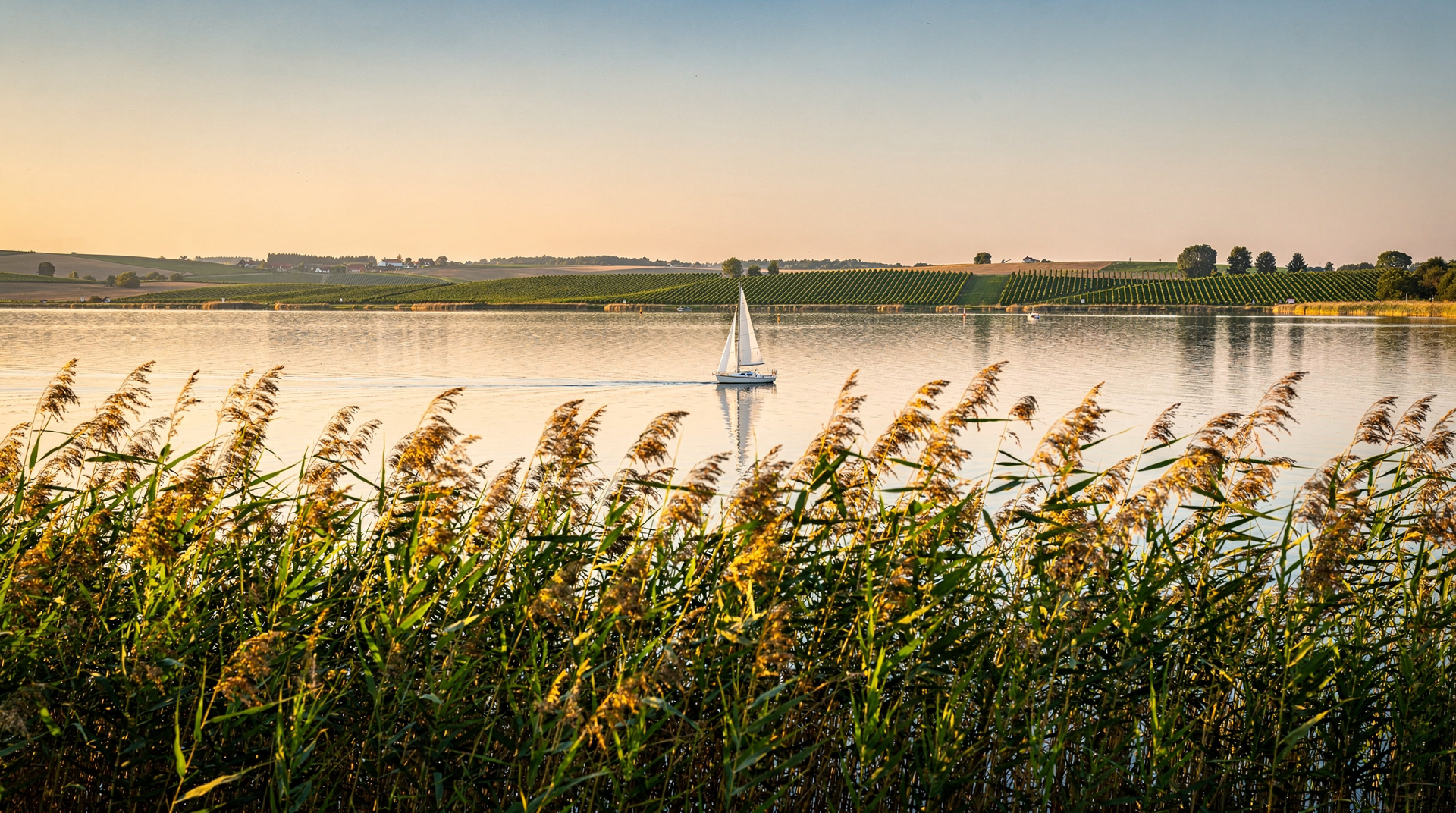
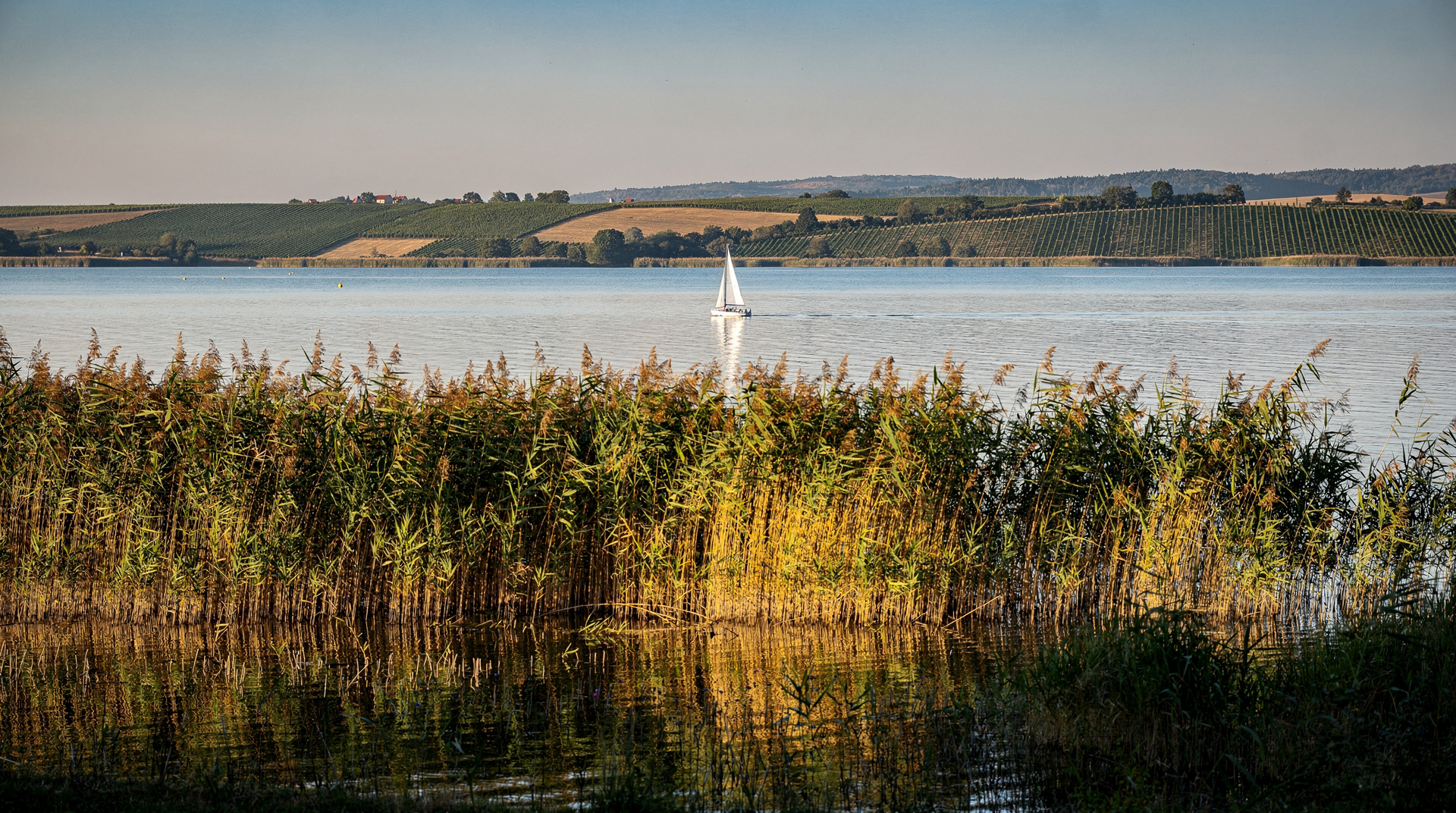
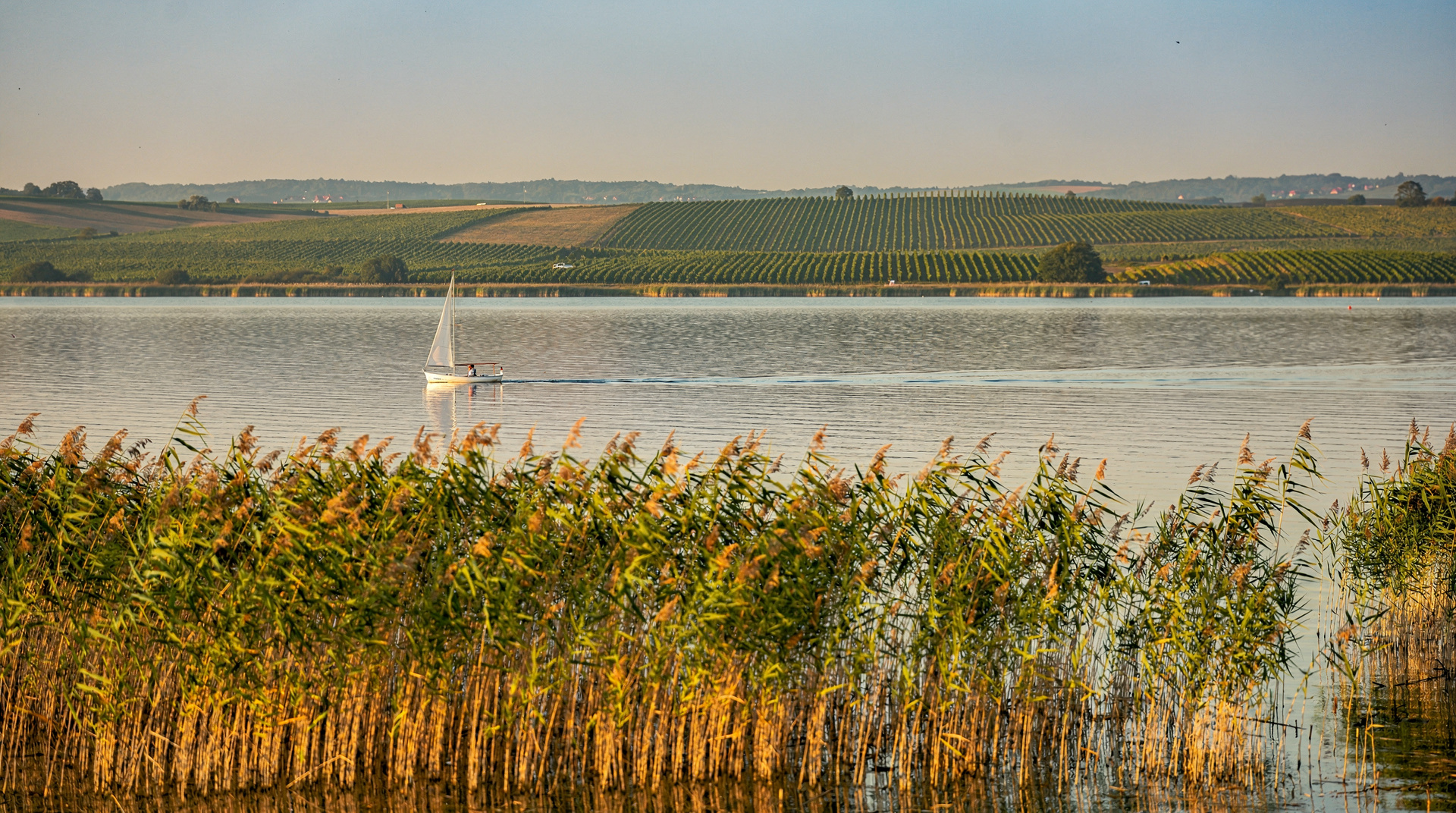
The Neusiedlersee, 12 km east of Eisenstadt, is a shallow steppe lake (average depth 1.5 m) shared between Austria and Hungary. It is a UNESCO World Heritage site and one of Central Europe’s most important bird habitats — white-tailed eagles, great white egrets, spoonbills, and vast numbers of migratory waterfowl use the reed beds. The cycling circuit around the entire lake (135 km) is covered in detail in the Neusiedlersee cycling guide.
For the day trip from Vienna, a visit to the lake shore at Neusiedl am See town (direct bus or train from Eisenstadt) adds a distinctive landscape experience. Boat rentals, electric bikes and the National Park visitor centre at Illmitz are accessible on the eastern (Hungarian) shore.
When to go
April–May: Good spring weather, storks arrive at Rust, vines leaf out. June–August: Warm, lake swimming possible, outdoor restaurant terraces. Haydn Festival in September. September–October: Harvest season, wine events in the villages, excellent conditions for the Neusiedlersee. Winter: The palace is open year-round (though on reduced hours October–March). The lake is sometimes frozen, giving a different landscape character.
Practical tips
Half-day focus: If time is limited, concentrate on Esterházy Palace — the Haydn Hall, the Haydn Museum, and the palace exterior — which gives the core experience in 2.5–3 hours.
Concert visit: If Haydn Hall is your reason for coming, check the Haydn Festival schedule (September) at esterhazy.at. Concerts in the original performance space are the most immersive experience.
Combine with Neusiedlersee: The most satisfying full day combines the palace in the morning, lunch in Rust (30-minute drive, possible by taxi or bus), and an afternoon at the lake or a winery tasting.
Wine to take home: Burgenland wines (Blaufränkisch, Ruster Ausbruch) are the most authentic food souvenir from the region and widely available at cellar-door prices in the villages.
See the best day trips from Vienna for the full comparison of Vienna day-trip destinations.
Planning Eisenstadt around the rest of your Vienna stay
Eisenstadt works best as a calm counterweight to the heavier sightseeing days in the capital. If you have already spent time in the imperial rooms of the Hofburg or walked through Schönbrunn Palace, the Esterházy residence makes a useful comparison: another great Baroque household, but one that reads through music rather than court ceremony. Visitors who have been following the Habsburg story will find the Habsburg history guide a helpful background read before they go, since the Esterházy family’s fortunes were closely tied to the dynasty.
Music lovers can turn the day into part of a wider theme. A morning in the Haydnsaal pairs naturally with an evening at a Vienna concert, and the Vienna classical music itinerary shows how to string such days together. If you want to be sure the concert you pick is a real one rather than a tourist show, the comparison in classical vs touristic concerts is worth reading first.
The wine side of the trip also connects to what you can do closer to home. Travellers who enjoy the Burgenland reds can follow up with a Heuriger evening in Vienna, where local wine is served in the traditional setting. For a deeper look at the lake and the villages around it, the Neusiedlersee destination page and the Eisenstadt destination page collect the practical background in one place.
Eisenstadt versus other day trips from Vienna
Eisenstadt sits in a different category from Vienna’s other popular day trips. It has none of the scenic drama of the Wachau day trip or the postcard lake views of Hallstatt — its appeal is quieter and more specific: a single world-class palace, a genuinely important music history, and an easy-going wine region attached. If your priority is landscape, choose the Wachau or the Neusiedlersee cycling loop instead; if your priority is the Habsburg-era arts patronage story with a lot less crowding than central Vienna, Eisenstadt delivers disproportionately well for the modest travel time.
It is also one of the cheapest day trips from Vienna once you are there — the palace ticket, a bus fare and a Heuriger-style lunch in Rust add up to a fraction of what a Hallstatt or Salzburg day costs. Budget-conscious travellers building a longer stay around Vienna on a budget should put Eisenstadt near the top of the list of good-value excursions, and it fits comfortably into a Vienna weekend itinerary that has a free Saturday or Sunday to spare.
Where to eat in Eisenstadt
Options in the old town are limited but solid rather than touristy. Gasthaus zur Sonne near the palace serves classic Burgenland fare — Blaufränkisch-braised beef, Gulasch, seasonal game in autumn. For something faster, the bakeries and cafés along Hauptstrasse do a reasonable lunch. The best food decision, though, is usually to save the meal for Rust: the lakeside town’s wine-tavern restaurants pair a full Burgenland meal with the region’s best-known wines and cost roughly the same as an equivalent meal in Vienna. If a car isn’t available, ask at the palace ticket desk about the current taxi rate to Rust (around €25–30 one-way for up to four people) — it is usually cheaper split between a small group than it looks at first glance.
Frequently asked questions about the Eisenstadt day trip
How do I get from Vienna to Eisenstadt?
The most practical route is by bus from Vienna’s Erdberg bus terminal (about 1 hour, ÖBB or regional buses). By train, you change at Neusiedl am See or Wulkaprodersdorf, adding 20–30 minutes. A car is most flexible for combining Eisenstadt with the Neusiedlersee.
What is Esterházy Palace famous for?
Esterházy Palace is one of the finest Baroque palaces in Austria, home to the Esterházy family for 300 years. It is famous as the workplace of composer Joseph Haydn, who served as court musician from 1761 to 1790. The Haydn Hall (Haydnsaal) where Haydn premiered his symphonies is still used for concerts.
Who was Joseph Haydn and why is he connected to Eisenstadt?
Joseph Haydn (1732–1809) is one of the most important composers of the Classical period — often called the “Father of the Symphony” and “Father of the String Quartet”. He served Prince Nikolaus Esterházy as court Kapellmeister for nearly 30 years, composing and premiering the majority of his symphonies in Eisenstadt and the nearby Esterházy summer palace.
What is Burgenland wine?
Burgenland, Austria’s easternmost state, is known primarily for red wines — particularly Blaufränkisch (a spicy, full-bodied red) and Zweigelt. The wine route along the Neusiedlersee produces some of Austria’s most celebrated sweet wines (Trockenbeerenauslese) from the lakeside fog conditions.
Can I combine Eisenstadt with Neusiedlersee?
Yes — Neusiedl am See is about 20 km east of Eisenstadt. The lake, the national park (important for birdwatching — white storks nest here), and the surrounding wine villages make a natural extension of an Eisenstadt day trip, especially with a car.
How long do you need in Eisenstadt?
Half a day (3–4 hours) is sufficient for Esterházy Palace and the Haydn Museum. A full day allows you to add the Neusiedlersee, a winery visit and a leisurely lunch.
Top experiences
Bookable activities with verified prices and instant confirmation on GetYourGuide.